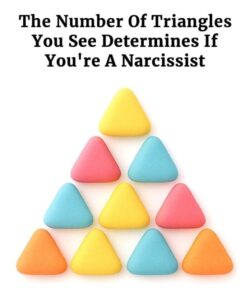
At first glance, it looks like nothing more than a bright pyramid of colorful triangles — a fun little puzzle floating across social media. Yet the longer you stare at the image, the more your mind starts to shift. Some people count 9 triangles. Others see 13, 16, or even more than 20. And somehow, each person feels convinced their number is right.
This simple optical illusion has captured millions of curious minds not because it’s a math challenge, but because it touches something deeper — the way we see, think, and interpret the world around us.
The Hidden Psychology Behind the Triangles
What’s happening here isn’t just about eyesight or counting skills. Psychologists would call it a Gestalt perception — our natural tendency to view patterns as unified wholes instead of separate parts.
Your brain decides almost instantly whether to focus on the smaller details or to piece them together into something larger. That snap decision says something fascinating about how you process life, relationships, and even emotions.
Some of us notice order and structure. Others see possibility and meaning in the smallest corners. Neither is right or wrong — they’re just different ways the mind organizes the world.
If You See 9 Triangles
You’re probably a realist at heart. You notice what’s in front of you and trust the facts you can verify. People like you value honesty, practicality, and clear results. You don’t chase after illusions or get swept away by “what-ifs.”
In everyday life, this mindset helps you stay grounded. You handle challenges by breaking them down step by step. But the same focus on the visible can sometimes make it hard to see the hidden layers — the quiet emotions, the subtle hints, or the motives behind people’s actions.
Still, your strength lies in your steadiness. You provide stability when others get lost in overthinking.
If You See 13–16 Triangles
You strike a rare balance between intuition and logic. You’re the kind of person who can analyze a situation without losing touch with emotion. You can zoom in on details, but you never forget the larger picture.
Friends often turn to you for advice because you understand both sides of a problem. You read between the lines, sense when something feels off, and still manage to find fair, reasonable solutions.
Your combination of empathy and insight makes you an excellent communicator — and a trustworthy partner in both work and life.
If You See More Than 20 Triangles
You might be what psychologists informally call a “pattern amplifier.” You notice possibilities where others see none. Your mind connects dots, builds stories, and weaves meaning from even the smallest detail. Creativity and imagination drive how you think.
This gift makes you a visionary. You’re likely drawn to art, storytelling, design, or innovation — anything that allows you to explore what could be, not just what is.
But there’s a flip side: that same imagination can make you overanalyze or assume that your perception is the only correct one. The viral headline — “The number of triangles you see determines if you’re a narcissist” — plays on this idea.
Seeing too much, or insisting that others must see things your way, doesn’t make you a narcissist in a clinical sense. It simply suggests confidence — sometimes too much confidence — in your interpretation of the world. In healthy balance, that self-assurance fuels creativity. When unchecked, it can cloud cooperation and empathy.
Why These Optical Games Fascinate Us
Tests like this one don’t diagnose anything. They’re lighthearted ways to explore how your brain filters information and emotion. But they remind us of an important truth: no two people see the same world.
Some of us see order. Others see opportunity. Some build structure; others build stories. And sometimes, what we notice reveals not just how we think — but who we are becoming.
These visual riddles play with more than color and shape; they tug at the way our minds organize chaos into meaning. They show that perception isn’t just about the eyes — it’s about experience, mood, and personality.
The beauty of the triangle illusion isn’t the answer you get, but the reflection it sparks. It nudges us to ask:
- Am I someone who seeks clarity or creativity?
- Do I focus on the obvious or look for hidden patterns?
- Do I accept that others might see the same picture differently — and both of us might still be right?
Seeing Ourselves in Simple Shapes
Our brains are wired to search for meaning, even in the simplest images. That instinct has kept us curious for thousands of years — to interpret clouds, constellations, and the small details that make life richer.
So, whether you counted 9, 13, or 27 triangles, you learned something valuable about yourself. Maybe you discovered your inner realist, your thoughtful balance, or your imaginative dreamer.
In the end, the picture on the screen isn’t what matters most. It’s the picture your mind paints from it — a reflection of how you see, connect, and make sense of the world.