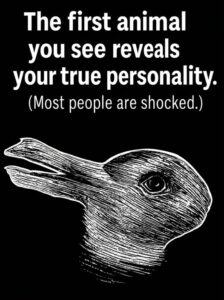
Have you ever looked at the same image as someone else and been surprised to discover that you each noticed something completely different? Experiences like this highlight how uniquely the human mind works. Our brains are constantly interpreting visual information based on past experiences, habits, and instincts, often in ways we are not consciously aware of. What seems obvious to one person may be invisible to another, reminding us that perception is highly personal and shaped by how our minds organize the world around us.
Visual illusions are especially interesting because they sit at the crossroads of perception and psychology. When we look at an illusion, the brain tries to make sense of it almost instantly, often before careful reasoning has time to step in. That first impression is guided by attention, intuition, and cognitive style. Because of this, optical illusions have long been used as simple tools to explore how people think and process information. They do not diagnose personality, but they can offer playful insights into mental preferences and tendencies.
One of the most well-known examples is an image that contains two animals hidden within the same drawing. At first glance, some people notice one animal immediately, while others are certain they see the other first. Neither perspective is more correct than the other—the image is designed to support both interpretations. What makes it fascinating is how quickly the brain commits to one view, often without effort. This initial reaction can reflect whether someone tends to focus on structure and detail or leans toward imagination and flexible thinking.
If you noticed one animal first, it may suggest that you naturally approach situations in a practical and organized way. People with this tendency often value clarity, logic, and efficiency, and they are comfortable analyzing problems step by step. On the other hand, noticing the other animal first may point to a more creative and intuitive mindset. These individuals often enjoy exploring ideas, thinking symbolically, and seeing possibilities beyond the obvious. Both ways of thinking are valuable, and most people use a blend of both depending on the situation. Ultimately, optical illusions are less about labeling personality and more about appreciating how wonderfully diverse human perception can be.