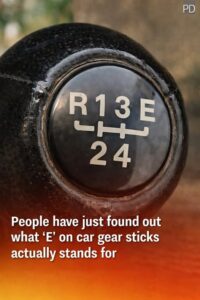
For decades, when it came to driving, the gear stick of a car was a familiar sight. Whether you were shifting gears in a manual transmission vehicle or selecting from the standard park (P), neutral (N), drive (D), or reverse (R) options in an automatic, the meaning behind each letter was clear and universal. However, for some drivers, particularly those who haven’t driven older cars or don’t have experience with certain car models, the letter “E” on a gear stick has remained a source of confusion.
When younger drivers and even some more seasoned drivers encounter this “E,” they often find themselves wondering, “What does that stand for?” Is it just a quirky relic of the past or does it serve a practical purpose? The “E” isn’t just there for decoration. It has a history, and its meaning has evolved over time, transforming along with the automotive industry itself. Understanding the significance of the “E” can shed light on both the history of car technology and its future.
This article will dive into the origins of the “E” marking on gear sticks, how it was used in older vehicles, why it became obsolete with the rise of modern automotive technology, and how its meaning has shifted in the context of today’s electric vehicles (EVs).
The ‘E’ Marking on Gear Sticks: A Brief Introduction
For many years, car gear sticks were relatively straightforward. In manual transmission vehicles, a driver was faced with a set of numbered gears, such as 1 through 5, or sometimes 6, for different levels of acceleration and speed. In automatic transmission vehicles, the gear stick typically displayed markings like P for Park, N for Neutral, D for Drive, and R for Reverse. These markings were easy to understand and allowed the driver to switch gears depending on their needs, from parking to cruising.
However, if you’ve ever driven an older car or glanced at an older model’s gear stick, you may have noticed a mysterious letter “E” sitting next to the more familiar “D” for Drive or “R” for Reverse. For a long time, this little letter confounded many drivers. It was a feature that seemed to belong to cars of the past, and for many new drivers, it was something of a mystery.
The ‘E’ for Economy: A Fuel-Saving Legacy
To understand what the “E” stood for, we have to travel back in time to the early days of modern automatic transmission cars. The “E” stood for “Economy,” a feature designed to help drivers achieve better fuel efficiency by keeping the engine revolutions (RPMs) lower than usual. When this setting was engaged, the car’s engine would operate at a lower power output, limiting how quickly the engine could rev up, which in turn saved fuel.
During the era when the “E” gear was most commonly used, fuel efficiency was a major concern. Gasoline prices were often higher than they are today, and many drivers were more conscious about how much fuel their vehicles consumed. This was especially true for long highway trips, where drivers sought to maximize every gallon of gas.
The “E” setting, activated through a simple flick of the gear stick, would optimize the car’s performance for steady, highway-style cruising. Instead of prioritizing acceleration, the setting helped the engine maintain a steady, low-power output, thereby reducing fuel consumption over longer distances. It was a feature that allowed drivers to take a more mindful approach to their fuel use, which was both practical and important in an era when mechanical controls were still the norm, and fuel efficiency wasn’t as sophisticated as it is today.
The Evolution of Car Technology: Why the ‘E’ Became Obsolete
As car technology evolved, the need for a dedicated Economy mode on gear sticks gradually disappeared. By the late 20th century, the automotive industry had begun to introduce computerized engine management systems, improved aerodynamics, and advanced transmission technologies that automatically balanced efficiency with power.
With the development of more sophisticated onboard systems, the ability to optimize fuel efficiency no longer required a manual intervention from the driver. Modern cars began to rely on electronic controls to adjust engine performance on the fly, taking into account factors such as driving speed, throttle input, and road conditions. This allowed vehicles to automatically adjust to the best fuel-efficient mode without requiring the driver to engage a specific “E” gear.
In essence, the once-essential “E” for Economy on older gear sticks was replaced by intelligent systems that managed fuel efficiency seamlessly in the background. Features like variable valve timing (VVT), advanced fuel injection systems, and adaptive transmissions emerged, allowing cars to balance power and fuel economy on their own without any input from the driver. These technologies were much more effective and comprehensive than simply relying on a specific gear for fuel savings.
By the early 2000s, the “E” gear, as a separate, manually activated feature, became largely obsolete. Newer cars, especially those with automatic transmissions, no longer included a dedicated “Economy” gear, as the onboard systems could perform this function more efficiently. Car manufacturers started focusing more on automatic optimization of fuel consumption, leading to the discontinuation of the “E” setting.
The ‘E’ in Today’s Electric Vehicles: A New Meaning Emerges
While the “E” for Economy may have been phased out in traditional gasoline-powered cars, it has made a return in a new form in the world of electric vehicles (EVs). However, this time, the “E” no longer stands for “Economy” in the traditional sense of reducing fuel consumption; rather, it has come to symbolize the broader shift toward electric mobility and sustainable transportation.
Electric vehicles, which don’t rely on conventional multi-speed gearboxes, have simplified transmission systems compared to internal combustion engine (ICE) vehicles. Instead of gears, many EVs use a single-speed transmission, which doesn’t require the driver to shift gears manually or select from multiple driving modes. However, some electric vehicles still carry the “E” symbol on their gear sticks or drive mode selectors, though the meaning has evolved.
In the case of modern electric vehicles, the “E” often refers to the “Electric” driving mode, which optimizes the vehicle for eco-friendly driving. This mode typically adjusts the throttle response and vehicle performance to maximize efficiency and battery range. By selecting “E” mode, drivers are ensuring that the car is operating in its most energy-efficient state, thereby extending the range of the vehicle on a single charge.
For instance, many electric vehicles feature multiple driving modes such as Sport, Normal, and Eco. In these modes, the “E” for Electric often activates the vehicle’s most conservative performance settings, reducing power output to ensure the battery lasts longer and the vehicle uses as little energy as possible.
The Future of the ‘E’ on Car Gear Sticks: A Symbol of Sustainability
As the automotive industry moves toward a future dominated by electric vehicles, the “E” has taken on a new life as a symbol of sustainability and energy efficiency. The letter “E” now represents more than just fuel economy; it embodies the transition from fossil fuels to cleaner, greener sources of energy.
The inclusion of “E” on electric vehicles’ gear sticks or driving modes serves as a subtle reminder that the automotive industry is shifting toward a more sustainable future. It reflects the growing importance of eco-conscious driving and sustainable mobility options. For those who are new to electric vehicles, seeing the “E” on the gear stick or drive mode selector is a clear indicator that the vehicle is optimized for energy efficiency—a critical factor in the adoption of electric transportation.
In a sense, the “E” has become a marker of progress and innovation in the automotive world. It signifies that the car you are driving is part of a larger movement toward reducing the carbon footprint and lessening the environmental impact of transportation. The use of the letter “E” in the context of electric vehicles also highlights the industry’s commitment to creating a cleaner, more energy-efficient future.
Understanding the Impact of the ‘E’ on Your Driving Experience
For those driving older vehicles, encountering the “E” marking on a gear stick might be a nostalgic reminder of a time when fuel economy was something that required conscious effort. But for those behind the wheel of an electric vehicle today, the “E” has an entirely different meaning—one that reflects the shift toward green technologies and a future where electric cars dominate the roadways.
For modern drivers, the experience of selecting the “E” mode on their electric vehicle is a very different one from the past. Instead of worrying about manually optimizing fuel economy, electric car drivers can simply engage “E” mode and trust that the vehicle’s advanced systems will handle the rest. This shift towards a more automated, seamless driving experience has made the “E” a symbol of convenience and innovation.
The ‘E’ Legacy: A Look Back and a Glimpse Forward
The “E” on some car gear sticks has evolved tremendously over the decades, adapting to new technologies and changing environmental priorities. Originally introduced as a manual mode for enhancing fuel economy in gas-powered vehicles, it now serves as a powerful symbol of the future of transportation in the form of electric vehicles. What was once a physical action—drivers actively choosing an economy mode—has transformed into a part of the broader trend toward energy-efficient, eco-friendly driving.
As electric vehicles become more widespread and continue to shape the future of the automotive industry, the letter “E” will undoubtedly continue to carry its important message—both as a reminder of the past and a beacon for the future of mobility. Drivers who see “E” on their gear sticks today are not just engaging with a transmission setting; they are embracing a new era in automotive history that is cleaner, smarter, and more sustainable.