Out there, beyond the edges of our knowing, something is moving toward us. Some call it a visitor. Others whisper it could be more. The question is not just what it is, but what it asks of us when we look up at the night sky and wonder. For centuries, humanity has searched the heavens for signs of connection, fearing danger and longing for meaning in equal measure. Each new discovery reminds us that the universe is vast, and our place within it still uncertain.
Join a community of 14,000,000+ Seekers!
Subscribe to unlock exclusive insights, wisdom, and transformational tools to elevate your consciousness. Get early access to new content, special offers, and more!
3I/Atlas by the Numbers: Discovery, Path, Size, Timing
On July 1, 2025, astronomers using the ATLAS telescope in Chile spotted something unusual. It was moving faster than most familiar comets, and calculations showed its orbit did not originate within our solar system. Soon, the Minor Planet Center confirmed its designation: 3I/ATLAS, the third interstellar object ever observed passing through our neighborhood.

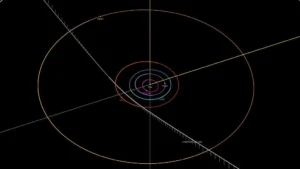
NASA’s Center for Near Earth Object Studies quickly analyzed the trajectory. At its closest, 3I/ATLAS will come within roughly 1.6 to 1.8 astronomical units of Earth, or about 170 million miles, a distance that astronomers classify as completely safe. As Paul Chodas, director of CNEOS, explained in an interview with the Associated Press, “We’ve been expecting to see interstellar objects for decades, frankly, and finally we’re seeing them.” He added, “A visitor from another solar system, even though it’s natural — it’s not artificial, don’t get excited because some people do … It’s just very exciting.”
Early measurements suggest that 3I/ATLAS is larger than the first two interstellar objects, Oumuamua and 2I/Borisov. Based on brightness, it may span several miles across, possibly making it comparable in scale to some of the solar system’s more imposing comets. Hubble observations placed a limit on its nucleus size, with David Jewitt of UCLA noting, “No one knows where the comet came from. It’s like glimpsing a rifle bullet for a thousandth of a second. You can’t project that back with any accuracy to figure out where it started on its path.” (NASA Science).
The comet will make its closest approach to the Sun in late October, passing between the orbits of Mars and Earth but closer to Mars. Before that, it will remain visible to telescopes through September, then vanish behind the Sun before reappearing in December. Jewitt described it as part of a hidden population now finally coming into view: “This latest interstellar tourist is one of a previously undetected population of objects bursting onto the scene that will gradually emerge.”
NASA’s Position vs. Viral Headlines
While some headlines suggested imminent danger, NASA has made its position unambiguous: 3I/ATLAS poses no threat to Earth. The object’s trajectory has been precisely mapped, and the agency stresses that it will remain millions of miles away.
Paul Chodas, who leads NASA’s Center for Near Earth Object Studies, explained to the Associated Press why these objects are so fascinating to scientists: “These things take millions of years to go from one stellar neighborhood to another, so this thing has likely been traveling through space for hundreds of millions of years, even billions of years.”
At the same time, astronomer David Jewitt of UCLA highlighted just how rare and fleeting these encounters are. Reflecting on the challenges of tracing their origins, he noted: “It’s like glimpsing a rifle bullet for a thousandth of a second. You can’t project that back with any accuracy to figure out where it started on its path.”

NASA officials and independent astronomers caution against conflating speculation with established science. Peer-reviewed studies on earlier interstellar visitors, such as Nature Astronomy’s analysis of Oumuamua, emphasize how these discoveries deepen our understanding of cosmic dynamics, but also that their most consistent explanations remain natural rather than artificial.
In other words, while the internet has a way of magnifying the most dramatic angle, the scientific consensus is calm and clear: 3I/ATLAS is a natural interstellar comet, remarkable in what it teaches us, not in what it threatens.
Lessons from Interstellar Visitors
Each new interstellar object reminds us that our solar system is not isolated but part of a wider galactic flow. The first known visitor, Oumuamua in 2017, surprised scientists with its elongated shape and unusual trajectory. Two years later, 2I/Borisov entered our skies and offered a clearer view of a comet from another star system, revealing a composition strikingly similar to comets formed around our own Sun. Now 3I/ATLAS continues this sequence, showing us that these encounters are not once-in-a-lifetime anomalies but natural events that our growing observational power allows us to witness.
Alongside the wonder of discovery comes the discipline of planetary defense. NASA’s Center for Near-Earth Object Studies and the Planetary Defense Coordination Office monitor thousands of objects each year, using orbital models to evaluate potential hazards with extraordinary accuracy. For an object to be considered risky, it must pass within about 0.05 astronomical units of Earth, which is roughly 4.6 million miles. 3I/ATLAS will remain more than 1.6 astronomical units away, over thirty times that distance. This clear separation, confirmed by repeated calculations, gives weight to NASA’s assurance that there is no danger. CNEOS’ Sentry system, which automatically scans asteroid catalogs for future impact risks, shows no scenarios where this object intersects with Earth’s orbit.
Taken together, these encounters with interstellar objects and the systems we have in place to track them reveal something profound. Human curiosity and human caution work side by side. We watch the skies both for the knowledge they offer and for the safety of the planet we call home. Interstellar visitors remind us that Earth is not the center of the universe but part of an unfolding story that stretches far beyond the reach of our Sun.
Beyond the Comet: What It Means for Human Consciousness
Discoveries like 3I/ATLAS remind us of our place in a universe that is not static, but alive with movement. An object traveling for millions, even billions of years, finally brushes past our solar system, and in that brief encounter we are given a mirror. The comet does not change its path for us, but it changes our perception of ourselves.
For some, it is a humbling lesson. The sheer scale of time and distance makes human conflicts, deadlines, and divisions seem temporary. As the late astronomer Carl Sagan once reflected about space exploration, “It has the power to humble us, to remind us of the shared destiny of life on Earth.” Interstellar visitors extend this humility into awe—reminding us that Earth is not the center of the story, but part of a much larger unfolding.

For others, 3I/ATLAS sparks curiosity. Its arrival asks us to look up, to observe, and to wonder. That impulse is not only scientific; it is deeply human. When we stretch beyond the boundaries of what we know—whether in research, creativity, or personal growth—we participate in the same spirit of exploration that drives astronomers to scan the skies.
In this way, the comet becomes a teacher. It challenges us to hold two truths at once: that we are small, yet our capacity for meaning-making is vast. That the universe will move on with or without us, yet in the brief time we are here, we can choose to expand, to ask deeper questions, and to live with a sense of connection.
The arrival of 3I/ATLAS may not bring alien contact or danger, but it offers something quieter: a nudge to shift perspective, to measure our lives not only in tasks and worries, but in relation to a cosmos that is endlessly wider than we imagine.
Choosing Wonder Over Fear
3I/ATLAS is not a threat to Earth. NASA’s measurements make that clear. What it is, however, is a rare chance to witness a fragment of another star system pass through ours—a reminder that the universe is dynamic, vast, and still full of surprises.
Speculation about hostile intent makes headlines, but the real story is more meaningful: an icy traveler from beyond our Sun offering scientists fresh data and the public a fresh perspective. As Paul Chodas of NASA explained, objects like these take “hundreds of millions of years, even billions of years” to reach us. Encounters on this scale invite us to place our daily lives into a broader cosmic frame.
The choice before us is simple. We can react with fear, amplifying the most dramatic speculation. Or we can respond with wonder—using discoveries like 3I/ATLAS to expand our sense of possibility and deepen our sense of connection. In looking outward, we are reminded to also look inward, to recognize that curiosity, humility, and awe are not just scientific virtues but pathways to living more fully on this small planet we share.
Featured Image from NASA/JPL-Caltech, Public domain, via Wikimedia Commons