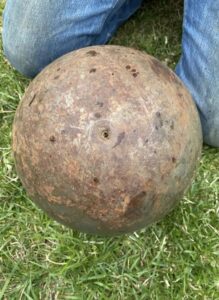
Have you ever walked along a quiet creek or river, stumbled across something strange, and thought to yourself, “What is this?” In one such unlikely encounter, a massive, mysterious object was discovered buried in the mud at the bottom of a creek—a huge steel ball, unceremoniously resting in the natural landscape, seemingly out of place. For many, this discovery was a puzzling moment, as they couldn’t quite place the object’s origins or purpose. Yet, for those who dug a little deeper into history, the true story of this massive ball slowly began to take shape, revealing a relic from a bygone era—an object that was once crucial to the growth of industrialization and the modernization of the world.
This steel ball, though hidden for years, tells a powerful story. It represents more than just the ingenuity of human hands; it embodies the relentless march of industrialization, the rise of manufacturing, and the tools that fueled the economic boom of the Industrial Revolution. But just how did such an object end up in the creek? What was its purpose, and how did it come to rest where it did? Let’s explore the untold story of this giant steel ball and the legacy it represents.
A Ball in the Industrial Age
At first glance, the steel ball discovered in the creek may seem like nothing more than a discarded piece of industrial debris. However, when placed in its historical context, this object was once a critical component in the operation of a grinding mill—one of the many machines that helped fuel the industrial muscle of the 19th and early 20th centuries.
During the industrial revolution, raw materials—ores, minerals, and other substances—needed to be processed in large quantities to support the burgeoning manufacturing industries. The steel ball, often seen as a humble piece of machinery, was an essential cog in the functioning of a ball mill, one of the critical tools that powered this transformation.
What Is a Ball Mill?
A ball mill is a large rotating cylinder filled with steel balls. These balls, like the one found in the creek, are used to grind materials into a fine powder. As the mill rotates, the balls collide with the material, crushing and grinding it down through mechanical force. The resulting powder could then be used in a wide range of industrial processes, from the production of metals and cement to chemicals and pharmaceuticals.
The sheer scale of these mills was enormous. They were the heart of many industrial plants, consuming vast amounts of raw material to produce the resources needed to build modern infrastructure, such as roads, bridges, and factories. The steel balls inside the mill were designed to endure repeated high-impact collisions, shattering rocks and minerals with precision and force. They may have seemed unimportant, but in truth, they were vital to the growth of cities and the advancement of technology.
A Silent Worker
It’s easy to overlook the steel balls that powered these mills. In fact, they were often the silent, unseen workers of the industrial revolution—hidden deep within the machinery, out of sight but essential to the process. These balls could weigh several hundred pounds, and the impact of each collision represented a crucial moment in the manufacturing process. For every steel bridge that spanned a river or every towering skyscraper that reached for the sky, there were countless ball mills grinding the raw materials that made these structures possible.
The sound of ball mills in operation was unmistakable: the clang of steel against steel, the pounding rhythm of the machinery, the constant grinding hum—like a cacophony of industrial progress. As the mills ran day and night, the world around them was being reshaped by these relentless forces.
The Industrial Revolution: A Catalyst for Change
The story of this steel ball is intertwined with the larger tale of the Industrial Revolution—a period of intense technological, economic, and social change that transformed the world. The rise of mass production, the development of new machinery, and the availability of vast quantities of raw materials helped shift human society from an agrarian-based economy to one based on manufacturing and industry. The ball mill played an essential role in this transformation, as it was used to process the materials that fueled this industrial growth.
The Role of Manufacturing
The Industrial Revolution (roughly between the 18th and 19th centuries) ushered in an era where manufacturing became the backbone of economic progress. Industry began to replace agriculture as the primary source of wealth. Materials such as coal, iron, and steel were in high demand, as industries sought to build the infrastructure that would support new forms of transportation (like railroads), the expansion of urban areas, and technological innovation.
In the midst of this transformation, ball mills were employed in mining operations, where they were used to grind ore and create the raw materials for steelmaking. Steel, in particular, was the foundation of the new industrial economy—it was used for everything from the construction of factories and railroads to the development of machinery, tools, and equipment. Without the grinding mills, this production of steel and other key materials would not have been possible.
The Steel Ball’s Role in the Manufacturing Machine
The steel ball, once part of a ball mill, can be seen as a representative symbol of the incredible machine that was the Industrial Revolution. But what was the actual process like? What kind of labor and engineering went into the production of materials that powered modern infrastructure?
The Grinding Process
Imagine, for a moment, the bustling scene inside a factory or mill during the height of the Industrial Revolution. The ball mill would hum with activity, massive drums rotating slowly while steel balls crashed into rocks and minerals, grinding them down into the fine powder needed for industrial processes.
The entire system depended on precision. Each ball had to be carefully engineered to be hard enough to withstand repeated impacts, yet soft enough to cause the right amount of friction to break down the minerals. Over time, these balls would become worn down by their labor, but as they wore down, new balls would be introduced to maintain the grinding process.
As each steel ball collided with the raw material, it wasn’t just a mechanical operation. It was a labor-intensive, carefully orchestrated process that embodied the work ethic and human ingenuity behind the industrial revolution. The ball mills became the backbone of an economy that was rapidly shifting from agrarian to industrial.
The Sound of Progress
The sound of a ball mill was a cacophony—a chaotic and continuous crashing of metal on metal. It was the sound of the Industrial Revolution, the soundtrack of a world remade by human hands. As the steel balls hit the rock and mineral ores, they produced a rhythm of heavy crashes, each one bringing raw material closer to being transformed into something useful. The dusty air in the mill halls would often be thick, creating an atmosphere that could almost feel oppressive at times.
But these sounds of progress represented the birth of an entirely new world—one of factories, cities, and modern technology. The mills were the heart of this industrial world, and the steel balls that powered them were at the center of it all.
A Legacy in Steel
As industries evolved over time, newer technologies replaced older systems. The ball mills, once crucial to manufacturing, were eventually phased out as sophisticated, cleaner technologies emerged. New methods of refining materials, such as hydraulic and pneumatic grinding systems, made the ball mill and its steel balls largely obsolete. Yet, despite the rise of more efficient machinery, the legacy of the ball mill and its crucial components remains.
The steel ball that was unearthed in the creek is a silent testament to an era of intense industrial growth. It stands as a reminder of the machines that helped shape the modern world—a symbol of human ingenuity, persistence, and the never-ending drive for progress.
The Forgotten Workers of Industry
While it’s easy to focus on the machines that powered the industrial age, it’s important to remember the unsung workers who operated these machines. The men and women who worked in the mills, often in harsh and dangerous conditions, were the true heroes of industrialization. They were the ones who ensured that the machines ran, day and night, grinding the raw materials that built cities, roads, and bridges.
The steel ball—buried in the creek and eroded by time—is a reminder of these workers. It’s a silent tribute to the countless individuals who labored tirelessly in the factories, mills, and mines of the industrial age. Their efforts helped create the foundation of the world we live in today, yet their stories often go untold.
The legacy of these workers, like the steel ball, is slowly being stripped away by time, but the echoes of their labor remain. And when we rediscover objects like this steel ball, we are given a chance to reflect on that legacy of toil and progress—and to honor the hard work that went into shaping the modern world.
Rediscovery: A Reflection of the Past
As the steel ball rests in the creek, eroded by the passage of time and obscured by the forces of nature, it serves as a physical manifestation of the past. Its presence in the creek is a reminder that while industries evolve and technologies advance, the marks of the past are never truly erased. Time, it seems, has a way of hiding and preserving the artifacts of earlier generations.
This rediscovery of the steel ball offers more than just an opportunity to study industrial machinery. It provides an opportunity to reflect on the history of human progress, the sacrifices made, and the remarkable feats of engineering that helped build our modern world.