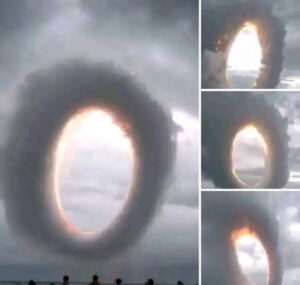
The sky has always held a quiet power over human curiosity. From glowing sunrises to drifting clouds that seem to tell stories of their own, we often look up and feel a sense of wonder that’s hard to explain. But every now and then, the sky presents something truly unusual—something so striking that it stops people mid-step, phones raised, eyes searching for answers.
One of those rare and fascinating sights is known as a fallstreak hole, often called a “hole-punch cloud.” If you’ve ever seen one, you know exactly how surreal it looks—a near-perfect circular or oval gap carved into a cloud layer, sometimes with delicate streaks trailing beneath it like soft brushstrokes across the sky.
At first glance, it can feel almost otherworldly.
But here’s the surprising truth: fallstreak holes are not mysterious in a supernatural sense at all. They are a fully understood natural phenomenon rooted in atmospheric science—and once you understand how they form, they become even more fascinating.
In this in-depth, reader-friendly guide, we’ll explore what fallstreak holes are, how they form, why they look so dramatic, and what they reveal about the delicate systems at work in our atmosphere.

What Is a Fallstreak Hole?
A fallstreak hole is a visible gap that forms within a cloud layer, typically in mid-level clouds such as altocumulus or cirrocumulus clouds. These clouds often appear as soft, patchy formations and exist at altitudes where temperatures can drop below freezing.
What makes these clouds unique is that they often contain supercooled water droplets—liquid water that remains unfrozen even though the surrounding air temperature is below 32°F (0°C).
This might sound surprising, but in the atmosphere, water doesn’t always freeze right at the freezing point. Without the right trigger, droplets can stay liquid in a fragile, suspended state.
And that’s where the magic begins.

The Science Behind How They Form
While fallstreak holes may look dramatic, their formation follows a clear and well-understood scientific process. Let’s break it down step by step in a simple, easy-to-follow way.
1. Supercooled Droplets Create a Delicate Balance
In certain cloud layers, tiny droplets of water exist in a supercooled state. They are stable—but only under the right conditions.
Think of it like a perfectly balanced system waiting for the smallest disturbance.

2. A Trigger Disrupts the System
Something eventually disturbs that balance. This could be:
- A sudden drop in air pressure
- A change in temperature
- Or even the passage of an aircraft
When this happens, some of the droplets freeze into ice crystals.
3. A Chain Reaction Begins
Here’s where things get interesting.
Ice crystals behave differently than liquid droplets. They attract water vapor more efficiently, causing nearby droplets to evaporate and feed the growing ice crystals.
This sets off a chain reaction:
- Surrounding droplets disappear
- Ice crystals grow larger
- The process spreads outward
4. The Hole Appears
As more droplets evaporate, a visible gap forms in the cloud layer. This gap expands into a circular or oval shape.
Meanwhile, the newly formed ice crystals begin to fall, creating the streak-like patterns beneath the hole—these are called fallstreaks, which is where the phenomenon gets its name.
The Surprising Role of Airplanes
One of the most fascinating aspects of fallstreak holes is that many of them are actually triggered by aircraft.
Yes—planes can unintentionally “punch” holes in clouds.
How Does That Happen?
When an airplane flies through a cloud layer filled with supercooled droplets, it causes rapid changes in air pressure around its wings or propellers.
This leads to:
- Sudden cooling of the air
- Freezing of water droplets
- The start of the chain reaction
Even after the plane has long disappeared, the hole continues to grow and evolve, leaving behind a striking visual formation.
This is a perfect example of how human activity can interact with natural systems in subtle but visible ways.

Why Fallstreak Holes Look So Dramatic
If fallstreak holes are relatively simple in terms of science, why do they look so extraordinary?
The answer lies in contrast, symmetry, and light.
Key Visual Features
- Clean, well-defined edges
- Circular or oval shapes that stand out sharply
- Wispy streaks falling beneath the opening
- Bright outlines where sunlight hits the cloud edges
The Role of Sunlight
Lighting plays a huge role in how these formations appear.
When sunlight passes through the hole:
- The edges of the clouds may glow
- Ice crystals reflect and scatter light
- The opening may appear brighter than the surrounding sky
Early morning and late afternoon are often the best times to see this effect, when the sun sits lower in the sky and enhances contrast.

Where and When You Can See Fallstreak Holes
Fallstreak holes can occur almost anywhere in the world, as long as the right atmospheric conditions are present.
Common Conditions Include:
- Mid-level cloud layers (altocumulus or cirrocumulus)
- Supercooled water droplets
- Cold temperatures at altitude
- Stable atmospheric conditions
Where They’re Most Common
You’re more likely to spot them in:
- Temperate climates
- Regions with frequent cloud cover
- Areas with active air traffic
That said, they are not limited to specific regions—they can appear anywhere under the right conditions.
Best Time to Observe
While they can form at any time of day, they’re most visible when:
- The sky is partly cloudy
- The sun is low (morning or evening)
- Lighting creates strong contrast
Common Myths and Misunderstandings
Because fallstreak holes look so unusual, they often lead to confusion or speculation.
Some people have interpreted them as:
- Unexplained atmospheric anomalies
- Artificial or unknown phenomena
- Even supernatural events
The Reality
In truth, fallstreak holes are fully explained by atmospheric science. Researchers have studied them extensively, and their formation is well understood.
There’s no mystery—just fascinating physics at work.
Why Fallstreak Holes Matter
Beyond their visual appeal, fallstreak holes actually play an important role in scientific research.
What Scientists Learn From Them
- How clouds form and evolve
- How water transitions between liquid and ice
- How precipitation processes begin
- How small disturbances can affect large systems
Broader Insights
These formations help researchers better understand:
- Atmospheric moisture patterns
- Temperature changes at altitude
- Interactions between natural processes and human activity
In short, they offer a window into how dynamic and sensitive our atmosphere really is.
A Photographer’s Dream
For photographers and sky watchers, fallstreak holes are a rare and exciting opportunity.
Why They’re So Popular
- Unique and unusual shapes
- High contrast against the sky
- Short-lived, making them special to capture
- Beautiful lighting effects
Tips for Capturing One
- Act quickly—they can change rapidly
- Use a wide-angle lens for scale
- Include trees, buildings, or people for perspective
- Shoot during golden hour for dramatic lighting
Even a smartphone can capture stunning images if you’re in the right place at the right time.
Encouraging Curiosity About the Sky
One of the most valuable things about fallstreak holes isn’t just how they look—it’s how they make people think.
When someone sees one, they often ask:
- What caused that?
- Is it rare?
- How does it work?
These questions spark curiosity, and curiosity leads to learning.
The Power of Looking Up
In a busy, fast-moving world, it’s easy to forget to pause and observe what’s above us.
But moments like this remind us:
- Nature is constantly changing
- Science can explain even the most unusual sights
- Beauty and knowledge often go hand in hand
Environmental Awareness and Perspective
Fallstreak holes also highlight something deeper—the sensitivity of our atmosphere.
What They Reveal
- Small changes can create large visual effects
- Natural systems are interconnected
- Human activity can influence atmospheric conditions
A Balanced Understanding
Rather than seeing this as something negative, it offers a chance to:
- Appreciate the complexity of nature
- Understand our place within it
- Stay curious about how the world works
Educational Value
Because they are both visible and scientifically rich, fallstreak holes are often used in education.
Why They’re Great Teaching Tools
- Easy to observe and recognize
- Clearly demonstrate scientific principles
- Engage students through real-world examples
They bridge the gap between textbook science and everyday experience.
Final Thoughts: A Beautiful Intersection of Science and Wonder
Fallstreak holes are a perfect example of how science and beauty can exist together.
What might seem mysterious at first is actually the result of precise, natural processes happening high above us. From supercooled water droplets to ice crystal formation—and even the role of passing aircraft—every part of this phenomenon tells a story about how our atmosphere works.
Understanding that story doesn’t take away the wonder.
It deepens it.
Conclusion
The next time you look up and notice a strange opening in the clouds, take a moment to really observe it.
You’re not just seeing something unusual—you’re witnessing a dynamic process unfolding in real time.
Fallstreak holes remind us that:
- Nature is full of intricate, hidden processes
- Small changes can create dramatic results
- Science helps us understand and appreciate what we see
- Curiosity is the first step toward discovery
In the end, the sky is more than just a backdrop to our daily lives—it’s a living, ever-changing system filled with moments of quiet beauty.
All it takes… is looking up.