At first glance, the object doesn’t seem friendly.
In fact, many people encountering it for the first time assume it must belong in a toolbox, a machine shop, or even a medical cabinet from a century ago. Its curved metal shape, rigid edge, and unusual structure can make it appear intimidating—almost like something designed for heavy mechanical work or an uncomfortable experiment.
Yet the truth is far more practical and surprisingly clever.
This unusual little device is actually a vintage corn husker, a specialized farm tool designed to make one of agriculture’s most repetitive jobs dramatically easier.
What might initially look like a strange metal brace or an odd mechanical fragment turns out to be a smart piece of agricultural engineering—one that reflects a time when tools were built for efficiency, durability, and everyday labor.
For generations of farmers and rural families, gadgets like this weren’t curiosities. They were essential helpers during harvest season, saving time, protecting hands, and speeding up a job that could otherwise take hours.
And once you understand how it works, you may find yourself admiring its simplicity and ingenuity.
The First Mystery: Why Does It Fit Your Hand?
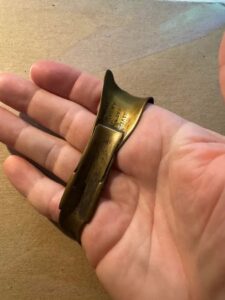
One of the first things people notice when they pick up this device is how naturally it fits in the palm.
Despite its unfamiliar appearance, the curved metal frame seems to settle comfortably into the hand. The shape isn’t accidental. Every bend and edge was designed with purpose.
The tool is meant to wrap partially around the user’s hand, creating a secure grip without requiring excessive pressure. A firm edge runs along one side of the device, positioned precisely where it can catch the husk of an ear of corn.
In essence, the tool turns your hand into a husking machine.
The design allows you to grasp a corn cob and pull the husk away with a single, smooth motion. Instead of peeling the leaves away piece by piece using your fingers, the metal edge does most of the work.
What’s even more interesting is that many versions of the tool include an adjustable component.
This sliding or pivoting section allows the device to accommodate different hand sizes. Farmers, field workers, and family members of varying ages could all use the same tool comfortably.
It was a practical solution for a practical world.
Of course, if you encounter one of these devices today, the adjustable portion may no longer move smoothly. Years of dust, rust, or exposure to the elements can cause the mechanism to stiffen.
But when new, it would have moved easily, allowing users to quickly adjust the fit before beginning a long session of husking corn.
What the Tool Actually Does
For anyone unfamiliar with traditional farming tasks, the purpose of a corn husker might not immediately seem obvious.
After all, removing the husk from an ear of corn doesn’t appear particularly difficult.
But that perception changes quickly when you’re faced with dozens—or even hundreds—of ears waiting to be processed.
Corn husks are surprisingly stubborn. The leafy outer layers cling tightly to the cob, and the silky fibers beneath them can tangle around your fingers.
When husking large quantities of corn by hand, several problems quickly arise:
-
Husks resist removal and require repeated pulling
-
Sticky corn silk clings to your hands and clothing
-
Fingers become sore from constant gripping and peeling
-
Processing large harvests takes a significant amount of time
This is where the corn husker shines.
Once strapped onto the hand, the tool allows the user to grip an ear of corn and pull downward. The curved metal edge slices through the husk layers and catches the silk strands at the same time.
In one smooth motion, the husk is stripped away.
The result is faster processing, cleaner corn, and far less strain on the hands.
Rather than spending hours peeling husks manually, a worker using a corn husker could finish the task far more efficiently.
This tool wasn’t designed to be cute or decorative.
It was designed for work.
The kind of work where dinner depends on finishing the job before the sun goes down.
A Tool from a Time of Hard Work
Today, most people encounter corn in grocery stores, farmers markets, or packaged products.
But in earlier generations, corn wasn’t simply purchased—it was grown, harvested, and processed by hand.
For rural families and farmers, corn was a staple crop.
It could be used for:
-
Fresh eating
-
Animal feed
-
Cornmeal and flour
-
Preserving or drying
-
Bartering within the community
During harvest season, large quantities of corn needed to be husked quickly.
Families often gathered together on porches, in barns, or around kitchen tables to process the harvest. Children, parents, and neighbors would sit side by side, husking ear after ear while talking and sharing stories.
Even with many hands working together, the task could take hours.
Tools like the corn husker helped speed things along.
They represented small innovations that made everyday labor just a little easier.
The Meaning Behind the Stamp
Many vintage corn huskers include small stamped markings along the metal surface.
These markings may appear cryptic at first, but they offer fascinating clues about the tool’s history.
Common markings include phrases like:
-
“Pat.” or “Pat’d” indicating a patent
-
A series of numbers referencing patent filings
-
The name of the inventor or manufacturer
-
A partial location such as a city or state
For example, a stamp reading “Nivers Pats” likely indicates that the design was protected by multiple patents.
The name “A.W. Brink” may refer to the inventor or the individual who registered the patent.
Meanwhile, partial wording such as “Upper S…” could represent a location—perhaps the beginning of a town or state name where the device was manufactured.
These stamps served several purposes.
They protected the inventor’s design from being copied, provided proof of authenticity, and helped identify the manufacturer.
More importantly, they remind us that someone once designed, patented, produced, and sold these tools to working farmers.
They were not experimental curiosities.
They were practical products made for real people with real tasks to complete.
Why Brass Was the Perfect Material
One of the most distinctive features of many vintage corn huskers is the material used to create them.
A large number of these tools were made from brass.
At first glance, brass might seem like an unusual choice. It has a warm golden color that people often associate with decorative objects or luxury items.
But in reality, brass was chosen primarily for its practicality.
Brass offers several advantages that made it ideal for agricultural tools.
First, brass resists corrosion.
Unlike plain iron or steel, brass does not rust when exposed to moisture. This was especially important for farm tools that frequently encountered wet conditions, dirt, and plant residue.
Corn husking can be a messy process. Moist husks, sticky silk, and outdoor humidity all create an environment where rust could quickly damage untreated metal.
Brass solved that problem.
Second, brass provides durability while remaining relatively smooth.
The smooth surface allows the tool to glide along corn husks without snagging excessively. At the same time, it remains strong enough to withstand repeated use.
Third, brass ages well.
Even after decades of storage in sheds or barns, many brass tools remain functional. They may develop a darker patina over time, but this natural aging process does not weaken the metal.
Finally, brass simply looks attractive.
While aesthetics were not the primary concern, the warm golden color of brass adds a subtle charm that modern plastic tools often lack.
A Window into Everyday Farm Life
Beyond its practical purpose, the corn husker offers a fascinating glimpse into how people lived and worked in earlier generations.
Today, food production often feels distant from daily life. Supermarkets and large-scale agriculture handle most of the processing before food reaches consumers.
But historically, many households participated directly in food preparation from start to finish.
Corn harvest season was a significant event in farming communities.
Fields would be harvested, and piles of corn would be brought home for processing.
The work might happen outdoors on a porch, where fresh air helped keep the process comfortable.
Neighbors sometimes gathered to help each other, turning the labor into a social activity.
Stories were shared.
Jokes were told.
Children learned skills by watching older family members.
In that setting, tools like the corn husker were more than simple gadgets.
They were companions in the work of everyday life.
Recognizing a Vintage Corn Husker
If you come across one of these unusual devices at an antique shop, flea market, or thrift store, several characteristics can help identify it.
Most corn huskers share a few key features.
First, they include a curved cuff or frame designed to fit comfortably around the palm or back of the hand.
Second, many versions include an adjustable mechanism that allows the tool to fit different hand sizes.
Third, they often include patent markings or manufacturer stamps along the metal surface.
Fourth, the tool features a firm edge designed to catch and pull the husk leaves away from the cob.
When all of these characteristics appear together, there is a strong chance the device is indeed a vintage corn husker.
Still Functional After All These Years
One of the most remarkable aspects of vintage tools is their longevity.
Unlike many modern products designed for short lifespans, older tools were often built to last decades.
If a corn husker remains structurally sound, it may still function exactly as intended.
Before using one, it’s usually best to clean it gently.
Removing accumulated dirt or debris can restore its smooth operation. However, collectors often recommend avoiding excessive polishing.
The natural patina that forms over time is part of the tool’s history and character.
For those who grow corn at home or maintain small farms, using a vintage husker can be both practical and enjoyable.
It connects the present to generations of agricultural tradition.
A Conversation Piece with a Story
Even if you never plan to husk corn in large quantities, owning one of these tools can still be rewarding.
Vintage farm gadgets often make excellent display pieces.
Placed on a shelf, hung on a wall, or added to a collection of agricultural antiques, a corn husker immediately attracts curiosity.
Visitors frequently pick it up and examine it closely.
They turn it over in their hands, trying to guess its purpose.
And when you reveal the answer—“It’s a corn husker”—the reaction is usually a mix of surprise and admiration.
The object transforms from a mysterious metal gadget into a clever invention from another era.
Solving the Thrift-Store Mystery
There is something deeply satisfying about identifying a mysterious tool.
Many people encounter objects like this while browsing antique stores, estate sales, or flea markets.
At first, the item seems puzzling.
Its purpose isn’t obvious.
But once the mystery is solved, the object suddenly makes perfect sense.
The curved shape fits the hand.
The edge aligns with the motion needed to remove husks.
The adjustable piece adapts to different users.
What once seemed strange now appears brilliantly logical.
It’s a reminder that older generations developed practical solutions to everyday challenges.
And sometimes those solutions were so effective that they still impress us today.
Small Tools, Big Ingenuity
The vintage corn husker may be small, but it represents a powerful idea.
Human ingenuity often appears in simple tools designed to solve specific problems.
A curved piece of brass.
A carefully placed edge.
An adjustable mechanism.
Together, these elements transform a tedious task into a faster and more comfortable process.
It’s a perfect example of how thoughtful design can make hard work easier.
A Lasting Piece of Agricultural History
Objects like this remind us that farming has always required creativity and resourcefulness.
Every tool was designed with a clear purpose: to help people work more efficiently, protect their hands, and make the most of their harvest.
Today, a vintage corn husker may appear unusual or mysterious.
But once its story is understood, it becomes something much more meaningful.
It becomes a small artifact of agricultural history.
A clever invention from a time when practical tools were essential.
And perhaps most importantly, it becomes a reminder that even the simplest designs can hold surprising brilliance.
Because sometimes the most genius inventions aren’t the biggest machines or the most complex technologies.
Sometimes they’re just small pieces of brass that fit perfectly in your hand—and turn a long afternoon of corn husking into a job finished before sunset.