There’s a particular kind of curiosity that only the internet can amplify.
It usually starts with something small — something you find in a drawer, tucked inside a box, or mixed in with everyday items. It doesn’t look especially important. It isn’t flashy or obviously valuable. In fact, it might seem almost insignificant.
But something about it feels… off.
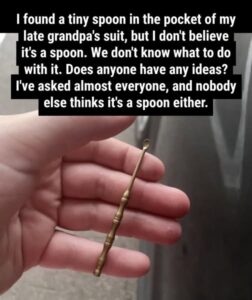
That’s exactly what happened when someone came across an unusually tiny metal spoon — far smaller than any teaspoon you’d expect to see in a kitchen. It wasn’t decorative. It wasn’t labeled. It didn’t come with instructions. It was just there — a miniature utensil with no clear purpose.
Naturally, the next step was to consult the internet.
The object was posted online, where thousands of curious minds quickly began speculating. Was it a novelty item? A tool from a different era? A specialized instrument? Something entirely unexpected?
What followed was a mix of humor, historical guesses, and surprisingly practical explanations.
And while the object may be small, the discussion surrounding it reveals something much bigger: how everyday mysteries bring people together, spark imagination, and sometimes uncover fascinating pieces of history.
Let’s explore what this mysterious tiny spoon might actually be — and why objects like this capture our attention in the first place.
The Power of a Simple Question
The original question was straightforward:
“What is this used for?”
The image showed a very small metal spoon — significantly smaller than a standard teaspoon. It appeared old-fashioned in design, with a narrow handle and a shallow bowl.
It didn’t resemble a measuring spoon. It wasn’t ornate enough to be purely decorative. It didn’t appear to match common kitchenware sets.
In other words, it didn’t immediately make sense.
And that’s exactly the kind of puzzle that people love to solve.
Why Tiny Objects Feel So Mysterious
There’s something inherently intriguing about miniature versions of everyday items.
A spoon, for example, has a clear and obvious function. We use it for stirring, scooping, serving, tasting.
But when you shrink it down to an unusually small size, its purpose becomes less obvious.
Is it still for food? Is it ceremonial? Is it specialized? Is it outdated?
Objects that fall outside modern norms often appear mysterious simply because we no longer encounter their intended use in daily life.
And that’s where the speculation begins.
The Internet’s First Reaction: Humor
Whenever an unusual object is posted online, humor is almost guaranteed.
Some commenters suggested whimsical explanations:
-
A “gnome teaspoon” for imaginary kitchens
-
A prop from a fantasy set
-
A novelty stirrer for invisible potions
While clearly playful, these responses reflect how people engage with uncertainty. Humor becomes a creative way to participate in the mystery.
But beyond the jokes, others began offering more serious theories.
Theory #1: An Antique Ear-Cleaning Tool
One of the more historically grounded suggestions was that the tiny spoon might be an ear-cleaning instrument — sometimes referred to as an ear scoop or ear pick.
Before modern cotton swabs became common, small metal or bone tools were used in various cultures for personal grooming.
Historically, ear-cleaning tools:
-
Were often spoon-shaped
-
Had narrow handles
-
Were made of metal, bone, or wood
-
Were reusable and portable
These instruments date back centuries in some regions.
While modern hygiene standards have evolved significantly, historical grooming tools often look surprisingly different from what we’re accustomed to today.
If the tiny spoon in question matched those characteristics, it could plausibly be a personal grooming implement.
However, context matters. Without clear provenance, it’s difficult to confirm.
Theory #2: A Nail-Cleaning Tool
Another suggestion was that the spoon was designed to clean underneath fingernails.
Before widespread availability of disposable manicure tools, small metal implements were common in personal care kits.
These tools often featured:
-
Narrow, curved tips
-
Smooth edges
-
Compact designs
Some antique nail cleaners resemble tiny spoons or scoops.
If the object came from a grooming set, it may have originally been part of a larger collection of personal care instruments.
This explanation is practical and plausible, especially given the object’s size and shape.
Theory #3: A Condiment or Spice Spoon
Small spoons have historically been used for:
-
Salt cellars
-
Mustard jars
-
Loose-leaf tea
-
Medicinal powders
In older households, miniature spoons were often paired with specific containers.
For example, salt cellars in the 18th and 19th centuries frequently included small dedicated spoons.
If the object was once part of a dining or kitchen set, it may have lost its original container over time.
Without the context of its matching piece, it can appear puzzling.
Theory #4: A Medical or Apothecary Tool
Some antique apothecary kits included tiny spoons used to measure powdered medicines.
Before standardized capsules and tablets, pharmacists and physicians often dispensed powdered remedies.
Specialized spoons were used to:
-
Measure small quantities
-
Transfer powders
-
Mix compounds
If the spoon’s proportions align with measurement tools rather than eating utensils, this explanation could be viable.
However, accurate identification would require examining its material, markings, and craftsmanship.
Why So Many Everyday Objects Become “Mysteries”
The truth is, many objects appear mysterious simply because:
-
They are separated from their original context
-
Their companion pieces are missing
-
Their function is no longer common
-
Design trends have evolved
What once felt obvious in a certain era can feel confusing decades later.
This tiny spoon might have been perfectly ordinary in its time.
But removed from its setting, it becomes a puzzle.
The Role of Collective Curiosity
One fascinating aspect of these discussions is how collaborative they become.
When someone posts a mysterious item online, responses often include:
-
Historical comparisons
-
Personal anecdotes
-
Family heirloom stories
-
Links to similar artifacts
-
Educational insights
It becomes less about the object itself and more about shared problem-solving.
People from different backgrounds contribute knowledge from:
-
Culinary traditions
-
Antique collecting
-
Personal grooming history
-
Museum studies
-
Medical history
The mystery becomes a community effort.
Why the Ear-Cleaning Theory Persists
Among all explanations, the ear-cleaning tool theory tends to resurface frequently in similar cases.
That’s because:
-
Spoon-shaped ear picks have existed historically
-
Their size often matches tiny spoons
-
They were made of durable materials like metal
In some cultures, ear-cleaning tools remain in use today — though designs may differ.
It’s important to note that modern health recommendations differ significantly from historical practices.
While such tools existed historically, contemporary medical guidance generally advises caution with inserting objects into the ear canal.
Understanding historical tools doesn’t mean endorsing outdated practices.
The Emotional Appeal of Antique Objects
Part of what makes these discussions compelling is nostalgia.
When people encounter unfamiliar vintage items, they imagine:
-
Past generations using them
-
Daily routines from different eras
-
Household habits that have since changed
Objects carry stories — even when those stories are unclear.
A tiny spoon might once have sat beside a teacup, inside a sewing kit, or in a grooming pouch.
Its mystery invites storytelling.
Why Identification Can Be Difficult
Accurately identifying an object often requires:
-
Provenance (where it came from)
-
Maker’s marks
-
Material analysis
-
Historical documentation
Without those details, identification becomes speculative.
Even experienced collectors can disagree when context is missing.
In many cases, multiple explanations remain plausible.
When Mystery Is Part of the Charm
Sometimes, the most satisfying part of these discoveries isn’t solving them completely.
It’s the journey of:
-
Asking questions
-
Sharing ideas
-
Learning new historical tidbits
-
Exploring forgotten tools
Even if the exact origin remains uncertain, the discussion itself adds value.
The object becomes a catalyst for education and curiosity.
Why Small Household Finds Go Viral
Tiny, puzzling objects often capture attention because:
-
They’re relatable
-
They spark imagination
-
They feel approachable
-
Anyone could find something similar
Unlike rare museum artifacts, everyday mystery items feel accessible.
You don’t need specialized knowledge to participate — just curiosity.
What We Can Reasonably Conclude
Based on common historical tools and object comparisons, the tiny spoon most likely falls into one of three categories:
-
A grooming tool (such as an ear or nail cleaner)
-
A condiment or spice spoon
-
A measuring or apothecary instrument
Each explanation aligns with known historical designs.
Without additional evidence, it’s difficult to confirm definitively.
But that uncertainty is part of what makes the object fascinating.
The Broader Lesson: Curiosity Matters
This tiny spoon reminds us of something simple:
Ordinary objects can lead to extraordinary discussions.
We often overlook small items in drawers, jars, and boxes. Yet those items may carry historical significance or represent outdated practices.
Taking the time to ask questions transforms routine moments into learning opportunities.
A Responsible Note on Historical Tools
If an object appears to resemble a grooming or medical tool from the past, it’s best to treat it as a collectible or historical artifact rather than attempting to use it.
Modern hygiene and medical standards have evolved significantly.
Antique items are best appreciated as educational pieces rather than functional tools.
The Value Beyond Monetary Worth
Interestingly, discussions about mysterious objects often focus less on monetary value and more on purpose.
People want to know:
-
What was this used for?
-
Who used it?
-
Why was it designed this way?
Function can be more compelling than price.
The story often matters more than the appraisal.
Final Thoughts
The tiny metal spoon that sparked online speculation may never have a single, universally accepted explanation.
It could be a relic from a grooming kit. A condiment spoon separated from its jar. A measuring instrument from an apothecary. Or something entirely different that modern eyes simply don’t recognize.
But perhaps the most interesting part isn’t the final answer.
It’s the collective curiosity.
One small object prompted humor, history lessons, creative theories, and thoughtful discussion.
In a world filled with complex news and constant noise, sometimes it’s refreshing to pause over something simple — and wonder.
So the next time you discover an unfamiliar trinket tucked away in a drawer, don’t dismiss it too quickly.
Ask questions. Compare notes. Learn a little history.
You may not solve the mystery completely — but you’ll gain something just as valuable along the way: perspective.
And sometimes, that’s more interesting than the answer itself.