Some images don’t simply capture a moment in time—they challenge the way your brain interprets reality itself. At first glance, everything appears perfectly ordinary, familiar, and easy to understand without effort or hesitation.
Then something subtle begins to feel wrong. It’s not immediately obvious, but your mind senses a mismatch between expectation and perception. You pause, look again, and start questioning what you thought you saw.
That moment of hesitation is what makes these images so powerful. They interrupt your automatic processing, forcing your brain to slow down and carefully analyze details it would normally ignore without a second thought.
Human perception is built for efficiency, not perfection. Your brain constantly fills in missing information, predicts outcomes, and simplifies complex visuals so you can react quickly in everyday situations without being overwhelmed.
Most of the time, this system works flawlessly. It allows you to navigate the world smoothly, recognize faces instantly, and interpret depth, distance, and movement with remarkable accuracy and speed.

However, under certain conditions, that same system becomes vulnerable to error. When perspective, lighting, timing, and alignment combine in unusual ways, your brain’s shortcuts can produce interpretations that are completely misleading.
This is where optical illusions and confusing photographs come into play. They expose the hidden assumptions your brain relies on, revealing how easily perception can be influenced by context rather than objective reality.
Consider an image where a person appears to be squeezed into an impossibly small space. At first, it looks physically impossible, as if the laws of proportion and anatomy have somehow been broken.
Your brain immediately tries to calculate the dimensions, comparing the person’s body to the surrounding environment. When the proportions don’t align with expectations, confusion sets in almost instantly.
After a closer look, the illusion becomes clearer. The effect is created by forced perspective, where distance and angle distort the relationship between objects, making them appear larger or smaller than they truly are.
Another example involves animals appearing as something entirely different. A harmless owl, when captured from a specific angle with certain lighting, can resemble a large, eerie moth with unsettling features.
This transformation happens because your brain prioritizes pattern recognition. It tries to match what it sees with familiar shapes, even if the match is imperfect or incorrect at first glance.
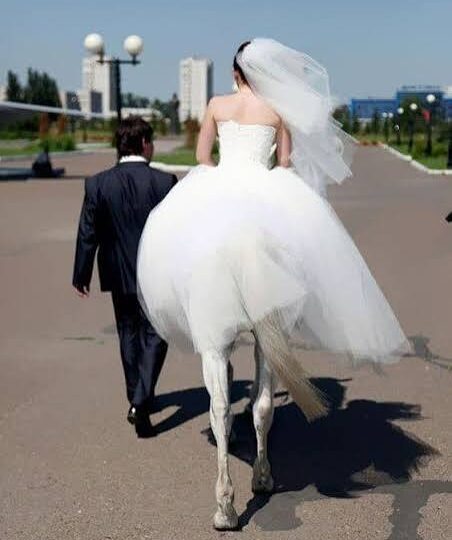
The same principle applies to objects blending together in unexpected ways. A photograph might show two unrelated subjects aligned so precisely that they appear to form a single, confusing entity.
In a wedding scene, for instance, the positioning of a person and an animal might create the illusion of a bizarre and impossible situation. The humor and confusion come from that temporary misinterpretation.
These illusions rely heavily on timing. A fraction of a second can determine whether an image looks completely normal or utterly confusing. The exact moment the photo is captured defines how your brain interprets it.
Reflections add another layer of complexity. A building with a mirrored surface can reflect the sky so perfectly that it appears flat, almost as if it lacks depth entirely.
Your brain expects buildings to have visible structure and texture. When those cues disappear due to reflection, it struggles to interpret the object correctly, creating the illusion of a two-dimensional surface.

Scale is another factor that frequently misleads perception. A small object placed close to the camera can appear enormous, while a large object in the distance can seem surprisingly tiny.
This is why a person near a lake might appear gigantic compared to the background. The lack of clear depth references causes your brain to misjudge the relative sizes of objects within the scene.
Similarly, a toy or small object can look like a real, full-sized machine when positioned correctly. Without context, your brain fills in the missing information based on assumptions rather than evidence.
Timing-based illusions often produce some of the most amusing results. A perfectly aligned object might appear to be interacting with something in a way that is physically impossible or even humorous.
For example, a bottle positioned in front of another object might briefly look like it is performing an action it was never designed to do. The illusion disappears once your brain processes the full scene.
Fog and atmospheric conditions can also distort perception. When a structure emerges through mist, its edges become blurred, making it appear almost transparent or unreal.

This effect occurs because your brain relies on sharp edges and contrast to define objects. When those cues are softened, the object can seem less solid, almost like a projection rather than a physical structure.
Another common source of confusion comes from surfaces and patterns. A tablecloth design, for instance, might look like a real object due to shading and perspective cues embedded in the pattern.
Your brain interprets shadows and highlights as indicators of depth. When those visual signals are replicated in a flat design, it can trick your perception into seeing something that isn’t actually there.
Human figures can also appear unnatural under certain conditions. A person captured from an unusual angle or in specific lighting might look overly smooth, distorted, or almost artificial.
This reaction stems from your brain’s sensitivity to human features. You are highly attuned to faces and bodies, so even small deviations from normal appearance can feel unsettling or unfamiliar.
Animals often contribute to visual confusion as well. A cat positioned at just the right angle might seem to be in a dangerous or impossible situation when, in reality, it is perfectly safe.
The illusion arises because your brain misjudges depth and distance, assuming the animal is much higher or more precariously positioned than it actually is.

Movement can also create misleading impressions. A dog caught mid-motion might appear to have an unusual shape or extra limbs, simply because your brain struggles to process the motion frozen in time.
In real life, movement is continuous and predictable. In a still image, however, that motion is captured in a single frame, often producing shapes that don’t align with your expectations.
Another fascinating phenomenon involves overlapping objects. When a bird flies in front of machinery at just the right moment, it can appear as though it is part of the structure itself.
Your brain merges the two elements into a single object because they occupy the same visual space, even though they are completely unrelated in reality.
Perspective can also make objects appear to defy gravity. A person sitting in a seemingly impossible position might actually be supported by something hidden from view due to the camera angle.
Without visible support, your brain assumes the person is floating or balancing in an unrealistic way, creating a sense of disbelief and curiosity.
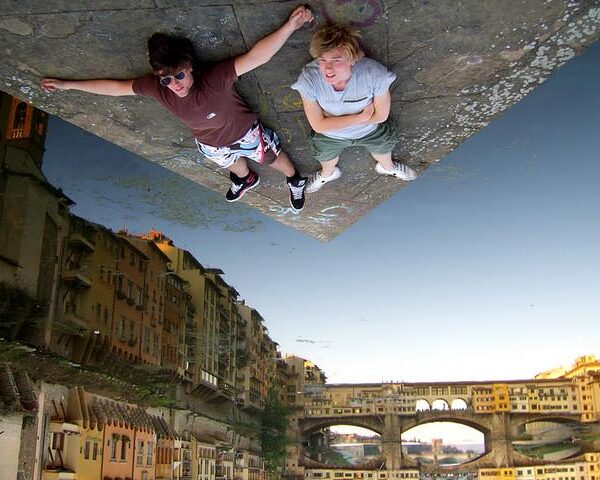
Alignment plays a crucial role in many illusions. When two distant objects line up perfectly from a specific viewpoint, they can appear to be touching or interacting with each other.
This effect is often used intentionally in photography to create playful images, but it can also occur naturally, leading to surprising and confusing results.
Lighting is another powerful factor. Shadows can dramatically alter the appearance of objects, sometimes making them look larger, smaller, or differently shaped than they actually are.
In some cases, shadows can even create entirely new forms that don’t exist physically, tricking your brain into seeing objects that are not present in reality.
Color contrast can influence perception as well. Certain color combinations can enhance or reduce depth cues, affecting how your brain interprets spatial relationships within an image.
Even familiar symbols can become confusing when viewed from unusual angles. A well-known logo might look completely abstract when seen from the side or under low lighting conditions.
Your brain relies on familiarity to quickly recognize symbols. When that familiarity is disrupted, recognition becomes slower and less certain, leading to temporary confusion.
Some illusions are so effective that they seem impossible to explain at first. You might stare at an image for several seconds before your brain finally reorganizes the information into something understandable.
This process highlights how perception is not immediate but constructed. Your brain actively builds a coherent interpretation based on incomplete and sometimes misleading data.
The delay in understanding is what makes these images so engaging. They create a small puzzle for your mind to solve, rewarding you with a sense of clarity once the illusion is resolved.
Importantly, these illusions do not involve any deception or manipulation beyond natural conditions. They are genuine moments captured through timing, perspective, and environmental factors.
This makes them especially fascinating, as they reveal how easily reality itself can appear distorted without any digital alteration or artificial enhancement.
They also demonstrate that seeing is not the same as understanding. Your eyes provide raw visual input, but your brain interprets that input based on prior knowledge and assumptions.
When those assumptions are challenged, your perception can shift dramatically, transforming a simple scene into something that feels surreal or impossible.
These images remind us that perception is flexible and context-dependent. What you see is influenced not only by the object itself but also by how and where you view it.
They encourage you to question your first impressions and look more carefully at the world around you. Sometimes, a second glance reveals details that completely change your understanding.
This awareness can extend beyond images into everyday life. It highlights the importance of considering multiple perspectives before forming conclusions based on limited information.
In the end, the appeal of these mind-bending images lies in their ability to surprise and challenge you. They turn ordinary moments into extraordinary experiences through simple visual tricks.
They reveal the hidden complexity of perception, showing that reality is not always as straightforward as it seems at first glance.
And perhaps most importantly, they remind you that the world is full of unexpected details—waiting to be discovered, questioned, and understood from a different point of view.