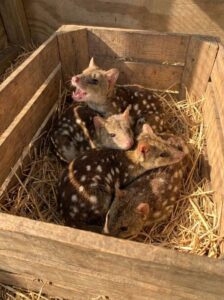
At first glance, the discovery looked almost unreal. Tucked inside a nest at Mt Gibson Wildlife Sanctuary in Australia were tiny, spiky newborn creatures so unusual that even seasoned researchers paused in disbelief. Their bodies were small, fragile, and covered in sharp-looking quills, giving them an almost mythical appearance. But as the ecologists leaned closer, the shock turned into awe. These were not unknown animals or a rare mutation. They were newborn western quolls—also known as chuditchs—a species that had once vanished entirely from this region. In that quiet moment, surrounded by red earth and native bushland, the team realized they were witnessing something extraordinary: proof that a species pushed to the edge was finding its way back.
Western quolls are cat-sized marsupial carnivores that once roamed much of mainland Australia. Before European settlement, they were widespread and played a vital role in keeping ecosystems balanced by controlling populations of insects, reptiles, and small animals. But habitat destruction, introduced predators, and environmental change caused their numbers to collapse. Over time, the species disappeared from large portions of the country, surviving only in small, isolated pockets in southwestern Australia. For conservationists, the loss of the western quoll was not just about one animal—it was a warning sign of how fragile entire ecosystems can become when one key species is removed.

Wikipedia Commons
In recent months, researchers at Mt Gibson Wildlife Sanctuary have been working carefully to reintroduce western quolls to an area where they had been extinct for generations. The effort involved years of planning, monitoring, and patience. Trail cameras tracked movements, bait stations helped study behavior, and ecologists watched closely for signs of stress or failure. Then came the moment that changed everything: the discovery of pouch young. According to Australian Wildlife Conservancy senior field ecologist Georgina Anderson, the appearance of the babies was a powerful sign that the animals had adjusted successfully to their new environment. One particularly bold quoll, nicknamed Aang, became a familiar face on camera traps, regularly raiding bait sites and showing all the confidence of a species reclaiming its ground.
The sight of those tiny, spiky newborns carried meaning far beyond their size. It represented resilience, careful conservation, and the possibility of restoring what was once lost. Each new life confirmed that the sanctuary was not just a temporary refuge, but a place where western quolls could truly thrive again. For scientists and wildlife advocates, it was a rare and hopeful victory—one that reminds us recovery is possible when commitment meets care. As these young quolls grow and spread, they carry with them the promise that one day the species_attach may again play its rightful role across Australia’s landscapes. Sometimes, the smallest discoveries deliver the biggest hope.