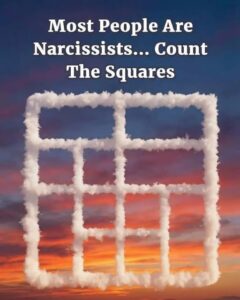
Every so often, a simple image appears online and captures everyone’s attention, not because it’s complicated, but because it sparks instant debate. That’s exactly what happened with the now-famous square-counting puzzle—an oddly cloud-shaped grid paired with the provocative statement: “Most people are narcissists… Count the squares.” The bold caption may seem designed to provoke, but what truly hooks viewers is the quiet challenge behind it. As people try to solve the puzzle, they quickly discover it’s less about counting shapes and more about questioning how they see the world. The grid invites you to slow down, reconsider your assumptions, and look beyond the most obvious details.
As this puzzle continues to spread, people confidently share answers ranging from just a handful of squares to dozens. The moment someone realizes there are hidden squares within the larger outline, something shifts. Their focus expands from isolated boxes to patterns, layers, and relationships—revealing that perception is far more complex than it seems at first glance. That transformation, from quick assumptions to deeper observation, is exactly why these challenges become so engaging. They remind us that perception isn’t fixed; it’s flexible, teachable, and often influenced by where we choose to direct our attention.
This viral trend also highlights an interesting truth about online behavior: even the simplest image can open the door to thoughtful conversation. While much of the internet moves fast and encourages instant reactions, puzzles like this do the opposite—they invite people to slow down and think. Users begin comparing strategies, exchanging logic, and reconsidering their initial guesses, all while participating in a harmless, mentally stimulating activity. In a digital world filled with noise and urgency, this kind of gentle, curiosity-driven engagement feels refreshing. It proves that not all viral content thrives on conflict; some thrives on wonder.
In the end, the true lesson of the square puzzle isn’t the final number—it’s what the process reveals about how differently we all see the same thing. Two people can stare at the same grid and walk away with completely different interpretations, and both can be valid. That simple insight extends far beyond puzzles, reminding us to approach conversations, decisions, and even everyday interactions with more openness and patience. So while the viral challenge may seem lighthearted, its message is lasting: the world is full of hidden layers, and sometimes all it takes to notice them is a willingness to look just a little closer.