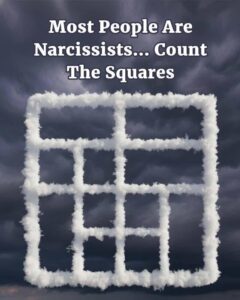
A small visual puzzle has been making the rounds online, showing nothing more than a cloud-shaped outline filled with a square grid. It often appears beside an eye-catching claim that “most people are narcissists,” followed by the challenge, “Count the squares.”
The dramatic line is meant only to grab attention. What the puzzle truly demonstrates is something far more universal: the way our minds interpret shapes, patterns, and the world around us.
At first glance, most people notice only the smallest squares inside the grid. This reaction is natural. The human brain tends to lock onto the simplest, most obvious details before taking in the broader structure. The puzzle does not reveal anything about personality. Instead, it gently shows how perception works and how easy it is to draw quick conclusions based on the first thing we see.
As more people try the puzzle, the range of answers is striking. Some count only the nine small squares. Others start to notice medium-sized shapes or even a single larger square created by the grid.
A few count every possible variation: small, medium, large, and anything formed by overlapping lines. The variety of responses highlights something important—people approach visual information differently, and no two minds work in exactly the same way.
Exercises like this invite us to pause and widen our view. In many cases, the final number of squares turns out to be higher than expected. That moment of surprise is part of the lesson. It reminds us that assumptions made too quickly can leave out important details. Slowing down and taking a second look often reveals more than we realized.
In today’s fast-moving world, where information appears instantly and distractions compete for our attention, this simple puzzle becomes a gentle reminder. When we focus too tightly on one small piece, we risk missing the larger pattern entirely.
The cloud-shaped border adds to the challenge. Its soft, rounded outline disguises the sharp angles of the squares inside, making the overall structure harder to detect at first glance. It encourages the viewer to look beyond the obvious and explore the design more intentionally.
Even after the correct square count is explained, many people express surprise. They often realize just how much they overlooked the first time.
That reaction is common and reveals how limited our perception can be when we rely only on our instincts or hurried judgments.
More than anything, the puzzle encourages curiosity. It invites us to pay closer attention not just to what we see, but to how we see it. Looking deeper, asking questions, and reconsidering our first impression are valuable habits—both in puzzles and in everyday life.
A simple grid inside a cloud may seem like a small thing, but the message behind it carries far greater meaning: when we broaden our perspective, we gain a clearer view of the world.