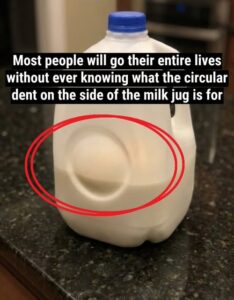
We’ve all been there: reaching for a jug of milk from the fridge, pouring it into our cereal bowl, or perhaps into a steaming cup of coffee. Amidst the routine of our morning ritual, it’s easy to overlook the small details of everyday items. But if you take a closer look at your milk jug, you’ll notice a small, round dent on its side. It’s perfectly circular, slightly sunken, and almost seems like it serves no real purpose. For years, it may have simply seemed like a quirk of the plastic molding process or a mere decoration. But what if I told you that this seemingly inconspicuous feature serves a crucial, multi-faceted function? Let’s dive into the fascinating reason behind the circular dent and uncover how it makes your milk jug smarter than you ever imagined.
The Hidden Purpose Behind the Dent in Milk Jugs
The round dent on a milk jug is far from an accidental design choice or a manufacturing oversight. In fact, it’s there for a number of reasons, all aimed at improving the jug’s safety, durability, and environmental impact. If you’ve ever wondered why it’s there, you’re not alone. Many people overlook it, but once you understand its function, you might never look at a milk jug the same way again.
1. Buffer for Expansion Due to Temperature and Pressure Changes
Milk is a perishable liquid that needs to be stored under cool conditions to maintain its freshness. Like all liquids, milk is sensitive to temperature changes, which means it expands or contracts depending on the environment. For instance, when a milk jug is transported from a warm truck to a cold refrigerator, it undergoes subtle changes in pressure and temperature. This is where the circular dent comes into play.
The dent provides an essential buffer, allowing the jug to expand or contract without risking damage. In situations where milk is exposed to freezing temperatures (like being stored in a poorly regulated freezer section), the pressure inside the jug can increase due to the milk’s expansion as it freezes. Without the dent, the jug might swell, crack, or even burst under this pressure. The dent essentially acts as a stress-relief feature, creating an area where the jug can flex when needed, preventing it from cracking or rupturing. In this way, the dent helps to preserve the integrity of the jug and keeps the milk safe.
2. Shock Absorption to Prevent Cracks
Have you ever accidentally dropped a milk jug, only to watch in horror as it cracks open and spills all over your kitchen floor? It’s a frustrating and often messy situation, but the dent in the jug is designed to help prevent this from happening. When a milk jug is dropped or subjected to sudden impacts—whether it’s during shipping, at the grocery store, or even in your own kitchen—the dent acts as a shock absorber.
The recessed area helps to absorb and redistribute the force of the impact, reducing the likelihood of the jug cracking or splitting. By minimizing the chance of a cracked jug, the dent not only saves you from a mess but also helps dairy producers avoid significant losses from damaged products. In a highly competitive industry, even a few cracked jugs can result in substantial financial losses, making the dent a small but important feature for protecting the product.
3. Structural Support with Minimal Plastic Use
You might not expect it, but that circular dent also plays a role in improving the structural integrity of the jug. Instead of making the plastic walls thicker (which would increase production costs), the dent is strategically added to reinforce the jug’s structure without requiring additional plastic material. The dent essentially serves as a design feature that adds strength to the jug, allowing it to maintain its shape while keeping the material lightweight.
In engineering terms, this is a bit like the arch in a bridge—an efficient design that uses minimal material while providing maximum strength. By incorporating this feature into the jug, manufacturers are able to create a stronger, more resilient product using less plastic, which can reduce costs and environmental impact. It’s a clever solution that combines functionality with sustainability.
How the Circular Dent Can Indicate Spoiled Milk
Here’s an interesting—and somewhat surprising—aspect of the circular dent: it can serve as an early warning system for spoiled milk. When milk begins to spoil, bacteria inside the jug multiply and release gases, which causes the pressure inside the container to rise. As this pressure builds, the dent may start to pop out, becoming visibly puffed or distorted.
Now, this doesn’t mean every time you see a bulging dent, your milk is spoiled—other factors like improper handling or temperature fluctuations can cause a dent to pop out as well. However, if you notice that the dent is unusually puffed up and the milk has passed its expiration date, it’s a good indication that something might be off. In this case, it’s best to err on the side of caution and discard the milk. This hidden feature essentially gives consumers a visual cue that their milk may not be as fresh as they thought, potentially preventing an unpleasant surprise.
Why a Circle? The Science Behind the Shape
Now that we understand the function of the circular dent, you may be wondering why this particular shape was chosen. Why not a triangle, square, or some other shape? The answer lies in the structural strength of a circle. Circles are inherently more efficient at distributing pressure evenly across their surface. Unlike corners or edges, which tend to concentrate stress, the smooth, continuous curve of a circle ensures that pressure is spread out evenly. This makes the circular dent the ideal choice for a feature that needs to flex and adapt to changing pressure.
From a manufacturing standpoint, circles are also simpler to mold and create. The uniformity of the shape makes it easier to replicate hundreds of millions of times across a wide range of products. This simplicity, combined with the circle’s strength, makes it a practical and effective design choice.
The Environmental Benefits of the Milk Jug Dent
In addition to the practical benefits of the circular dent, it also has an impact on sustainability. By allowing the jug to be thinner and use less plastic while still maintaining its structural integrity, the dent plays a role in reducing plastic waste. This has several key environmental benefits:
1. Reduced Plastic Waste
Because the dent reduces the amount of plastic needed in the design of the jug, it contributes to a reduction in overall plastic waste. With plastic pollution becoming a growing concern, every small step toward reducing plastic usage matters. The dent helps achieve this goal without compromising the strength or durability of the container.
2. Easier Recycling
Milk jugs are typically made from high-density polyethylene (HDPE), which is one of the most widely recycled plastics. By using less plastic, the dent makes the jug easier to recycle, further contributing to sustainability efforts. As consumers continue to focus on reducing their environmental footprint, the design of the milk jug is a small but significant step in the right direction.
3. Lighter Transportation
The thinner, lighter design of the jug also makes it more efficient to transport. Lighter jugs mean lower transportation costs, which translates to less fuel consumption and fewer emissions. This is another example of how a seemingly small design feature can have a broader environmental impact.
Other Hidden Design Features of Milk Jugs
While we’re on the subject of milk jug design, there are a few other clever features you might not have noticed. These small design elements are carefully thought out to improve the jug’s functionality and overall performance:
-
The Handle Hole: The hole in the handle isn’t just there for grip—it helps to reduce the amount of plastic used in the jug’s design while maintaining its structural integrity.
-
Base Bumps: The little bumps at the base of the jug help it maintain stability, preventing it from tipping over easily, even on uneven surfaces or in crowded refrigerators.
-
Cap Color: In some regions, the color of the cap can indicate the milk’s fat content—blue typically signals 2% milk, while red indicates whole milk.
These features demonstrate just how much engineering goes into the design of something as simple as a milk jug, ensuring that it meets both consumer needs and environmental goals.
Conclusion: The Ingenious Engineering of the Milk Jug Dent
The circular dent in milk jugs is far more than just a random feature—it’s a well-thought-out design element that serves multiple purposes. From preventing cracks and absorbing shock to reducing the amount of plastic used in production, the dent is a small but essential part of the milk jug’s engineering. It’s a clever solution that helps protect the product, the environment, and your kitchen from messy milk spills.
Next time you grab a jug of milk, take a moment to appreciate this unsung hero of everyday design. It’s a tiny detail, but one that makes a big difference in the way we experience and interact with a seemingly simple product.