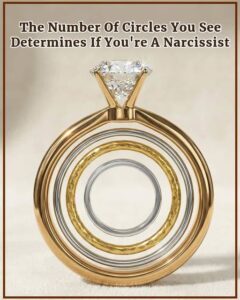
Everyone in the room leaned closer to the screen, captivated by an image of a ring composed of endless circles nested within one another. The caption promised that the number of circles you noticed would reveal something unsettling about your personality. Some people laughed, counting quickly and announcing their totals with confidence. Others lingered, their smiles fading as the circles seemed to multiply the longer they stared. What began as a playful challenge gradually turned quiet, as if the image itself was observing them.
The circles drew eyes to the center, yet no one could stop discovering new layers. With each glance, the design appeared to shift subtly, creating the illusion of motion and depth. The more someone focused, the more complex it seemed. What had initially felt like a simple visual puzzle now carried a strange weight, compelling viewers to reconsider their attention and perception.
Mara saw only one circle at first—the diamond, perfect and gleaming. She counted confidently and then paused, noticing the gold band, the inner rings, and reflections she had initially missed. Each new discovery brought a subtle unease, as if the image were revealing something she hadn’t consciously acknowledged.
The pattern forced a kind of introspection. People realized the circles weren’t about narcissism, or even numbers, but about how deeply they were willing to examine what was in front of them. Some quickly looked away, uncomfortable with the persistent invitation to focus and reflect.
Others continued to study the rings, captivated by the interplay of shapes and light. With each layer they uncovered, the image seemed less like a simple optical illusion and more like a mirror of thought, quietly probing patience, curiosity, and self-awareness.
The room remained unusually still. Laughter had faded, replaced by contemplation. The image’s power lay not in revelation but in the act of noticing itself.
Finally, Mara looked away, her gaze heavy with awareness. The lesson lingered: the circles didn’t define you. Instead, they revealed how willing you were to look at yourself before choosing what you wanted to see.
The experiment ended, but the impression remained, leaving each person to consider not just the circles—but the attention and care they brought to perception itself.