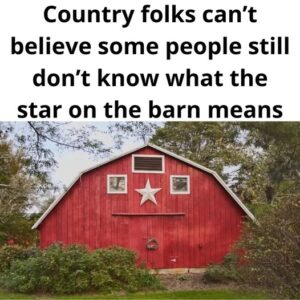
Have you ever driven down a rural road, passed by an old farmhouse, and noticed those large, five-pointed stars hanging above the door or mounted on the gable of a barn? They often appear a little faded by years of sunlight and wind, but there they are—proudly on display for everyone to see. If you’ve ever wondered, “What’s the deal with those barn stars?” you’re not alone. They’re common in rural areas, especially across the eastern United States, and while they might seem like simple rustic decor, these symbols actually carry a rich history. Are they just decorative? Or do they hold deeper meaning? Let’s take a closer look at these iconic barn fixtures and their significance.
The History and Origins of Barn Stars
Barn stars have been a staple of the American countryside for generations, and while you might hear them referred to as “barn stars,” their true name and meaning vary depending on where you are. They are also known by several other terms, including Amish stars, hex signs, and even barn quilts. While not all of these terms refer to exactly the same thing, they are all part of the same larger tradition, where the meaning of the symbol can shift depending on the region, the family, or even the exact design.
The tradition of using symbols to decorate barns and homes dates back to the 18th and 19th centuries, particularly among the Pennsylvania Dutch (which, confusingly, were actually of German descent). In the past, these stars were not merely for decoration, as we might think of them today. They had deep symbolic and protective meanings, often connected to folk magic. In this context, the barn star wasn’t just a decorative feature; it was thought to be a form of protection. Many believed that hanging a star on the barn would act as a charm to ward off evil, bad luck, and even to protect livestock and crops. These symbols acted almost like an invisible shield, keeping the farm and its resources safe.
As time went on, the use of barn stars expanded beyond the practical and magical to include personal meaning, cultural identity, and a touch of community pride.
What Do the Colors Mean?
One of the most interesting aspects of barn stars is the color symbolism associated with them. Each color was said to convey a different type of protection or energy, influencing everything from personal well-being to the health of the land. These colors are not merely decorative; they hold deep significance.
-
Red: Associated with energy, vitality, and good fortune. Red barn stars were thought to bring strength and positive energy to the household or farm. They were often linked to the idea of protection—keeping the home or farm energized and safe from misfortune.
-
Blue: Symbolizing peace, tranquility, and balance. A blue star was thought to encourage calm, harmony, and a sense of balance on the land, fostering peaceful relationships and a calm home life.
-
Green: Linked to fertility and growth. A green star was especially associated with the fields and gardens, thought to help crops flourish and promote fertility in both the land and animals.
-
Black: Often seen as a protective color, black barn stars were thought to act like a guard against evil forces, almost like a visual “guard dog” for the property.
-
White: Symbolizing purity and spiritual connection. White stars were meant to invoke a sense of spiritual grounding and cleanliness, representing a connection to higher forces and often related to the idea of a purified space.
These meanings could vary somewhat depending on the community and time period, but the general idea was that the colors weren’t just random. They served a purpose—to imbue the property with certain attributes and protection.
Hex Signs vs. Barn Stars
While barn stars are five-pointed stars, hex signs (which can sometimes be confused with barn stars) are a bit different. A hex sign is often a more intricate, painted design that incorporates a variety of geometric shapes and symbols, with the star serving as the central focus. Hex signs, like barn stars, are deeply rooted in Pennsylvania Dutch folk art, but they are more elaborate and frequently used in different ways. Some hex signs are still believed to have magical properties, while others are simply decorative. They’re often circular or mandala-like and can be found in a variety of colors, each carrying its own meaning, much like the stars.
Barn Stars as Family Identity
In addition to the protective and symbolic functions, barn stars also came to represent identity and family pride. Some families used barn stars almost as a signature, displaying their own personal design or a specific star to indicate that they had crafted it themselves. In this way, a barn star was both a badge of craftsmanship and a family hallmark—an expression of pride in the work that went into not only the barn but also the creation of the star itself.
As the tradition continued, these stars became a form of visual shorthand for establishing roots—a reminder that this particular piece of land, this barn, and this family had been there for generations. The star, in essence, acted as a quiet declaration: “We are here, and we are part of this land.”
From Functional to Folk-Chic
Today, barn stars are not confined to rural barns and farmhouses. They’ve undergone a significant transformation. They’re just as likely to be seen on a suburban porch or in an urban garden shed as they are on a farmhouse in the country. Over time, barn stars have evolved into folk-chic décor. While they may have once symbolized protection, prosperity, and faith, they are now often used as simple rustic or vintage décor, hanging in gardens, on interior walls, or as charming additions to patios.
Despite this shift away from their original meanings, the star still carries a subtle charm. Even if people aren’t thinking about warding off evil spirits when they hang a star, there’s something inherently nostalgic about the symbol. It evokes a sense of heritage, harkening back to simpler times when people relied more heavily on community and tradition.
A Symbol of Tradition and Storytelling
Barn stars may have changed in their practical use over the years, but their cultural significance remains intact. Even in modern settings, these stars still symbolize family and legacy—whether that legacy is tied to the land, the craftsmanship of the star itself, or the personal stories behind each one. They’re reminders of the past and our connection to it.
Each time you drive by a barn or farmhouse and spot one of these stars, take a moment to think about what it represents. Sure, it might seem like a simple decoration at first glance, but in truth, the barn star has a rich and layered history, weaving together tradition, belief, and family pride. It’s a symbol of time well spent—hard work, hope, and protection.
The next time you spot a barn star tucked away above a door, or maybe one hanging on someone’s porch, pause and reflect on its journey through history. It may be there to tell a story, to share a legacy, or simply to remind us that we were here.