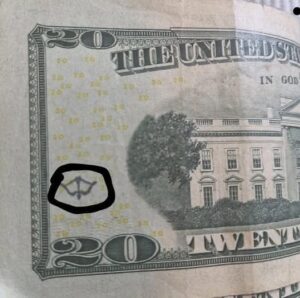
If you’ve ever looked closely at a U.S. dollar bill and noticed an unfamiliar symbol, stamp, or tiny shape that doesn’t seem official, you’re not alone. Some bills carry small markings that look like arrows, stars, or abstract designs, quietly printed or stamped onto the paper. At first glance, they can feel mysterious, almost secretive, as if the bill is hiding a story. These markings aren’t part of the original design, yet they aren’t random vandalism either. They are clues, pointing to a journey far beyond American borders.
These symbols are commonly known as chop marks. They are small stamps applied by money changers, merchants, or currency handlers in foreign markets to confirm that a bill has been checked and deemed genuine. In regions where counterfeit currency is a serious concern, visual verification has long been essential. A stamp, sometimes resembling a bow and arrow or other simple shape, serves as a silent approval. It tells the next person handling the bill that it has already been examined and trusted, saving time and reducing risk in fast-moving markets.
The tradition behind chop marks dates back centuries, especially in China, where merchants stamped silver coins to verify their weight and purity. The word “chop” itself comes from this historical practice. As global trade expanded and paper money became more common, the habit carried over. The U.S. dollar, widely accepted and circulated around the world, naturally became one of the most frequently marked currencies. Each stamp reflects a moment when the bill passed through another economy, another hand, another system of trust built on experience rather than machines.
Although U.S. law prohibits damaging currency to the point that it loses value, chop marks do not cross that line. They don’t change the bill’s denomination or invalidate it as legal tender. However, heavily marked bills may sometimes be rejected by vending machines or scrutinized by banks simply because they look unusual. Still, these marks don’t reduce the bill’s worth. Instead, they add an invisible layer of history, turning an ordinary dollar into a quiet traveler that has crossed borders, cultures, and systems of commerce, carrying proof of where it has been and how it earned trust along the way.