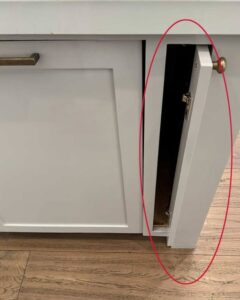
At some point, almost everyone has stood in a kitchen and stared at a strange, narrow strip of cabinetry wedged between two major appliances and thought, “What is that even for?” It’s usually only a few inches wide. It doesn’t look substantial. It doesn’t scream storage. And at first glance, it can feel like a design afterthought — a filler panel installed simply because something didn’t line up.
To the untrained eye, it appears to be wasted space.
But that narrow strip is not a mistake. It is not decorative padding. And it certainly isn’t an oversight.
It is one of the most cleverly engineered solutions in modern kitchen design: the cabinet filler pull-out.
What looks like a slim, static panel is actually a precision-built storage system designed to reclaim the “awkward inches” that most kitchens accidentally lose. In today’s homes — especially where square footage comes at a premium — those inches are incredibly valuable.
The modern kitchen is where beauty meets constraint. Designers aim for symmetry, clean lines, and seamless integration of appliances. Yet real-world measurements rarely cooperate perfectly. Dishwashers, ovens, refrigerators, and cabinetry all come in standardized widths. Walls, however, do not. As a result, small gaps naturally occur — typically between three and six inches wide.
In the past, those gaps were covered with simple filler boards. They were dead zones. Dust traps. Black holes for crumbs and lost utensils.
Today, they are strategic assets.
Let’s explore why.
The Battle Between Aesthetic and Space
Kitchen design has always balanced two competing forces: visual harmony and functional efficiency.
On one hand, homeowners want uninterrupted cabinet lines, symmetry around appliances, and a layout that feels intentional. On the other, kitchens must be practical — every drawer, every cabinet, every shelf working hard to justify its footprint.
Those skinny gaps that appear between an oven and cabinetry, or between a refrigerator and a wall, are a direct result of standard appliance widths. Manufacturers produce dishwashers at fixed measurements. Ovens and ranges follow industry norms. Cabinets are built in modular increments. Walls, unfortunately, rarely align perfectly with those increments.
The result? A 3-inch void. Or a 4-inch mystery strip. Or an oddly specific 5-inch space that feels too small to matter.
But when you calculate that space across the full depth and height of a base cabinet, something interesting happens.
A 3-inch gap running 24 inches deep and 34 inches high offers more storage volume than many realize. Multiply that by multiple locations in a kitchen, and suddenly you’re looking at meaningful capacity.
The problem wasn’t the space. The problem was imagination.
The Illusion of “Nothing”
Closed, a filler pull-out is almost invisible.
It blends seamlessly with surrounding cabinetry. Same finish. Same hardware. Same proportions. From across the room, you’d never know it exists.
That subtlety is intentional.
Minimalist design trends dominate modern interiors. Clean lines. Hidden storage. Concealed functionality. The less clutter visible, the better.
A narrow pull-out supports this philosophy perfectly. It hides in plain sight.
Then, with a gentle pull, the illusion disappears.
Instead of a blank panel, the entire strip glides outward, revealing vertical shelving that extends the full depth of the cabinet run.
It is not a hollow void.
It is a slim vertical tower of storage.
Engineering in Tight Spaces
Designing something that narrow is not simple.
A three-inch cabinet has to carry weight. Bottles of oil. Cans. Glass jars. Vinegar containers. Cleaning products. Even baking trays. That weight must glide smoothly without tipping or sticking.
Cheap hardware cannot accomplish this.
High-quality filler pull-outs use full-extension ball-bearing slides rated for significant load capacity. These slides distribute weight evenly and prevent the cabinet from torquing sideways during movement.
Balance is everything.
If the weight distribution is off, the unit could tilt. If the slides are weak, they could warp over time. If the build quality is poor, the pull-out might bind or stick.
Modern versions are remarkably sturdy. Many incorporate soft-close mechanisms to prevent slamming. Others include adjustable rails that keep tall bottles from toppling.
It’s precision engineering disguised as a sliver of wood.
Why Vertical Storage Changes Everything
Traditional base cabinets are deep. Very deep.
And while depth sounds like a good thing, it creates a problem: visibility.
Small items disappear.
You buy paprika. It gets pushed to the back. Months later, you buy paprika again because you forgot the first one exists. Eventually, you discover three half-used jars hiding behind a rice cooker.
The narrow pull-out solves this in one motion.
Because it is vertical and shallow, everything is visible at once. No stacking. No reaching. No kneeling to peer into darkness.
You pull it out, and the entire inventory presents itself like a curated display.
That alone can transform how a kitchen feels.
The Ergonomic Advantage
Think about cooking flow.
You’re at the stove. You need olive oil. Then salt. Then pepper. Then red pepper flakes.
If your oils are stored across the kitchen and your spices are buried in a deep cabinet, you’re moving constantly. Opening doors. Shifting items. Reaching awkwardly.
Now imagine a slim pull-out positioned directly beside your range. Oils, spices, seasoning blends — all vertically arranged at arm’s reach.
No steps wasted.
Ergonomics in the kitchen isn’t just about comfort. It’s about reducing friction in daily routines. Fewer steps mean smoother workflow. Smoother workflow means less stress.
Tiny changes add up.
It Only “Seems Small”
A common misconception is that three inches can’t possibly hold much.
But volume tells a different story.
A 3-inch by 24-inch by 34-inch cavity equals over 2,400 cubic inches of storage.
That’s dozens of spice jars. Multiple bottles of oil. Rows of canned goods. Cutting boards stored vertically. Even baking sheets.
And here’s the hidden benefit: by moving small items into this slim unit, you free up entire shelves in your main cabinets.
The big cabinets can finally serve their intended purpose — storing bulky cookware, appliances, and mixing bowls without being crowded by tiny containers.
The kitchen feels larger because clutter is redistributed intelligently.
Modern Hardware Has Changed the Game
Older kitchen gadgets earned a reputation for fragility.
Tracks jammed. Slides warped. Hinges loosened.
Today’s hardware is vastly different.
Heavy-duty runners, soft-close slides, corrosion-resistant rails, and reinforced bases mean these units are built to last. Many manufacturers test slides for tens of thousands of open-and-close cycles.
Maintenance is minimal. Occasionally wiping down rails and ensuring alignment is typically enough.
And importantly, retrofitting is often possible.
Homeowners who already have a filler strip installed can sometimes remove that fixed panel and replace it with a pull-out system — provided measurements allow.
That means what was once a dead strip of wood can become one of the most functional elements in the kitchen.
Sustainability Through Efficiency
There’s also an environmental dimension to consider.
When ingredients disappear into deep cabinets and expire unnoticed, food waste increases. Duplicate purchases become common. Overbuying happens because inventory is unclear.
Visibility reduces waste.
Knowing what you have prevents buying what you don’t need.
In smaller urban homes, where every inch matters, filler pull-outs align perfectly with the “waste nothing” mindset.
Minimalist design is not just aesthetic — it’s strategic.
Where These Units Shine Most
Certain placements maximize their impact:
-
Next to the stove for oils and spices
-
Beside the refrigerator for condiments
-
Adjacent to the sink for cleaning supplies
-
Near baking stations for sheet pans and cutting boards
Position matters.
When placed thoughtfully, the pull-out becomes part of the kitchen’s work triangle — the flow between stove, sink, and refrigerator.
It supports movement instead of obstructing it.
Small Additions, Big Psychological Impact
Clutter affects mood.
Open a chaotic cabinet, and frustration spikes instantly. Items tumble. You can’t find what you need. Cooking becomes annoying instead of enjoyable.
Open a slim pull-out where everything is aligned neatly in vertical order, and something shifts psychologically.
Control replaces chaos.
Organization creates calm.
That’s not exaggeration — it’s human behavior. Visual clarity reduces cognitive load. When you can see your inventory, your brain works less to process it.
And in a room used multiple times daily, that matters.
Design That Respects Every Inch
The filler pull-out represents a broader philosophy in modern home design:
No space is too small to matter.
Rather than accepting awkward gaps as inevitable waste, designers now treat them as opportunities.
This mindset reflects larger architectural trends, especially in urban environments where smaller homes demand smarter layouts.
Micro-solutions create macro impact.
Addressing the Skepticism
Despite its benefits, skepticism persists.
Some believe the units are unnecessary. Others assume they are expensive upgrades reserved for luxury remodels.
But consider this:
If you’re already investing in cabinetry, converting a filler strip into usable storage adds disproportionate value relative to cost. It maximizes what you’re already paying for — space.
And unlike flashy features that impress visually but rarely get used, a pull-out cabinet serves daily function.
It’s not decorative flair.
It’s practical intelligence.
The Evolution of the “Gap”
Historically, filler panels were simply structural spacers. They ensured doors opened properly without colliding with walls or appliance handles.
Over time, innovation reframed them as opportunity.
What was once dead space is now premium territory.
This evolution mirrors countless other design improvements — where small refinements quietly transform everyday life.
When Every Inch Is Accounted For
Ultimately, the narrow cabinet filler pull-out proves something important:
A space is only wasted if you fail to imagine its potential.
In a kitchen — the most heavily used room in most homes — efficiency compounds. Saving seconds here and there, reducing frustration, increasing visibility, minimizing clutter — these incremental gains create meaningful quality-of-life improvements.
The skinny gap isn’t a mistake.
It’s a hidden asset.
When it slides open to reveal neatly arranged rows of spices or perfectly aligned baking trays, it becomes clear that thoughtful design lives in the details.
And in the world of interior architecture, the smallest solutions often deliver the greatest return.
So the next time you see that narrow strip beside a dishwasher or stove and wonder what it’s for, know this:
It’s not wasted space.
It’s waiting to be used.