Away from campaign rallies and televised debates, the political map of the United States is being reshaped through a quieter but increasingly consequential process.
District lines—often revised with little fanfare and minimal attention from the broader public—are once again at the center of the balance of power, subtly altering the terrain on which future elections will be fought and, in some cases, reshaping representation far more dramatically than a single campaign speech ever could.
Every decade, following the U.S. Census, the 435 seats in the U.S. House of Representatives are reapportioned among the states based on population changes. But redistricting — the act of redrawing district lines — plays out on a timetable and in a political context that can extend far beyond that once‑a‑decade rhythm.
While the census provides the data that typically triggers redistricting, in the current political moment lawmakers in several states have moved to redraw their districts mid‑decade — a highly unusual and controversial step that has intensified partisan conflict nationwide.
The Stakes of Redistricting in Today’s Political Landscape
At its core, redistricting is supposed to reflect population changes — to ensure that each person’s vote carries roughly equal weight.
But the way lines are drawn can influence which party is more likely to win seats, sometimes for many election cycles. This has made redistricting a strategic tool more than a mere administrative task.
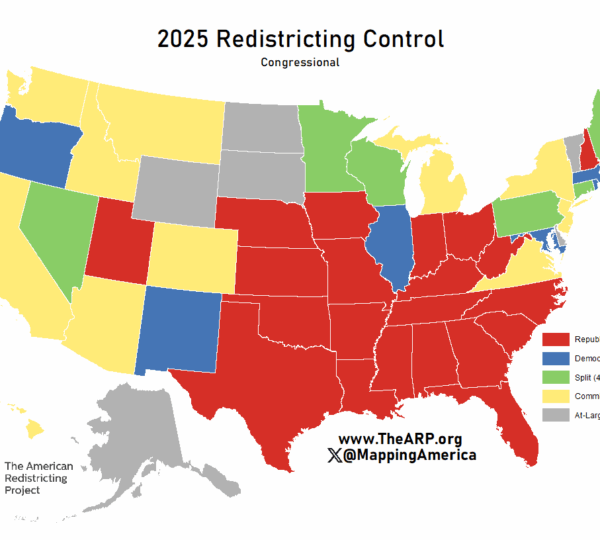
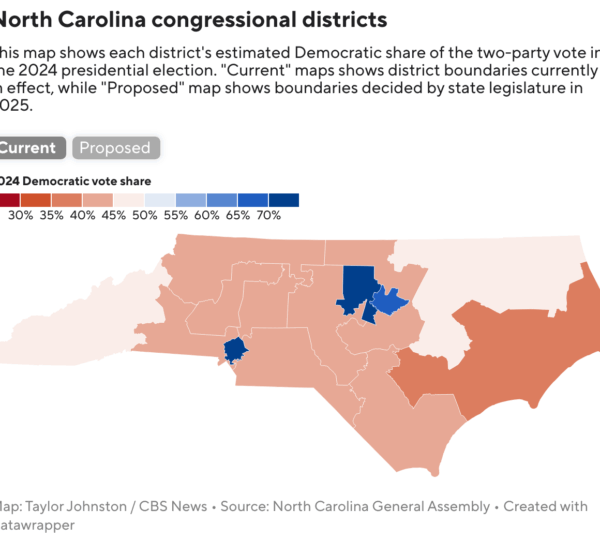
In states such as North Carolina, Texas, Missouri, and California, the process has taken on starkly political contours.
What appears at first glance to be technical map drawing has become deeply strategic, with each party seeking maps that lock in advantages and insulate elected officials from the normal ebb and flow of public opinion.
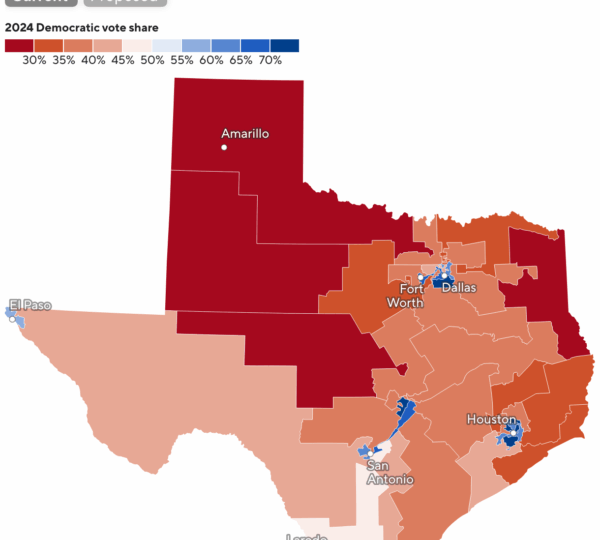
For example, Republican‑controlled legislatures in states like North Carolina, Texas, and Missouri have adopted new congressional maps in 2025 designed to increase their party’s share of U.S. House seats.
In Texas, Republican lawmakers approved a plan that was intended to add up to five new Republican‑leaning seats for the 2026 elections, even though the state’s overall population is politically more competitive than its current delegation suggests.
Measures like this matter because the House majority can hinge on just a few seats. If a party can reliably secure extra seats through district lines, that can translate into legislative power regardless of whether [its candidates won a majority of the overall votes across the country].
Even a small gain — one or two seats — could determine whether a president’s legislative agenda advances or stalls, tying local redistricting decisions directly to national governance and policy outcomes.
Mid‑Decade Redistricting: An Unusual and Controversial Trend
Traditionally, redistricting follows the census once every ten years. This is based on the principle that districts should reflect population changes captured by the decennial census. Mid‑decade redistricting — when a state redraws its districts before the next census — used to be rare.
According to analysis, only a couple of states voluntarily redrew maps between census cycles in the 52 years between the 1970s and 2024.
That pattern changed in 2025. Republican leaders in states like Texas, Missouri, and North Carolina moved forward with mid‑decade redistricting plans aimed at generating extra House seats ahead of the 2026 midterm elections.
The push was explicitly tied to national political objectives: former President Donald Trump and other GOP leaders encouraged state officials to redraw maps to protect and expand Republican House control.
The Texas Legislature’s special session to redraw congressional districts, for example, came under direct pressure from Republican leadership in Washington.
Texas lawmakers approved a map that would shift several Democratic seats to Republican‑friendly configurations and potentially net the GOP up to five additional seats.
That map was then challenged in court as an unconstitutional racial gerrymander. After judicial back‑and‑forth and a timing battle tied to candidate filing deadlines, the U.S. Supreme Court allowed the redrawn lines to be used for the 2026 elections.
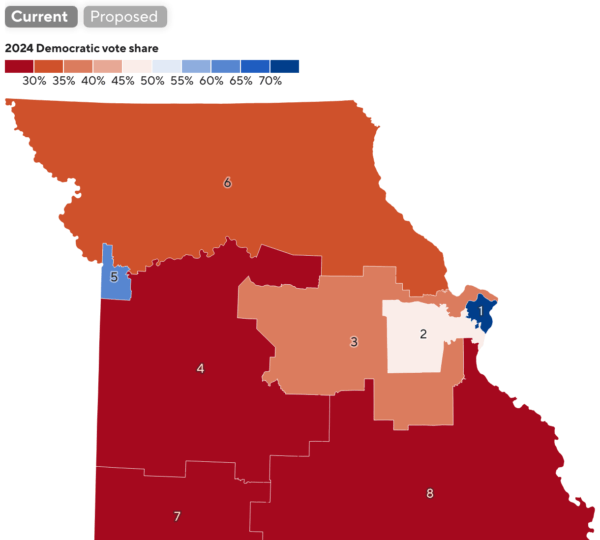
In Missouri, Republican officials also called a special session in 2025 to redraw congressional boundaries, with the new map passed and signed into law.
That map has been met with lawsuits and an efforts to collect referendum signatures that could suspend it until voters decide in a special election.
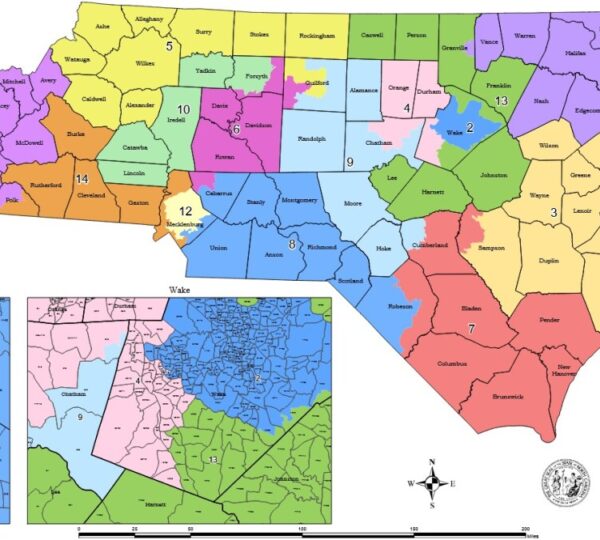
And in North Carolina, a federal judicial panel permitted the state to use a map that was designed to give Republicans a new seat by reshaping a competitive district.
Democratic Responses and the Battle in California
In response to this Republican‑led wave, some Democratic leaders have begun considering their own mapmaking strategies rather than relying on long‑standing reform principles like independent commissions. One of the most notable examples is California.
For years, California was held up by reform advocates as a model: the state’s independent redistricting commission was designed to remove legislators from direct control over line drawing, reducing partisan influence and increasing fairness in representation.
However, in 2025 voters passed Proposition 50, which temporarily altered that commission and allowed the Legislature to adopt new congressional maps intended to produce five additional Democratic seats for upcoming elections.
Those maps were upheld by a federal appeals court in early 2026 despite legal challenges from Republicans alleging racial discrimination, and now could be used in the 2026, 2028, and 2030 elections.
California’s decision reflects a significant shift in political calculations. Some Democratic leaders concluded that strict adherence to non‑partisan reform principles could inadvertently leave their party structurally disadvantaged if Republicans continued to redraw maps in their favor elsewhere.
As a result, a state that once championed independent commissions responded with a strategy that temporarily bypasses that commission to create a counter‑balancing set of district lines.
Similar debates are unfolding in other states. For example, in Virginia, Democratic lawmakers advanced a constitutional amendment to return redistricting power to the legislature — effectively bypassing the bipartisan or independent commissions that had previously guided the state’s mapmaking.
Advocates argue this is necessary to counteract GOP redistricting elsewhere, while critics say it undermines voter‑approved reforms and opens the door to more partisan manipulation.
And in Maryland, Governor Wes Moore (a Democrat) has pushed for a fresh congressional map in reaction to other states’ mid‑cycle redraws, while some Democratic lawmakers express concern that new maps could backfire and cost seats if not carefully crafted.
The Broader National Implications
The result of these clashing mapmaking strategies is a kind of “redistricting arms race.” States that once treated redistricting as a decennial chore now view it as an ongoing battlefield where every new line could shift political power at the national level.
More than a third of congressional districts nationwide could see new boundaries applied for the 2026 midterms, threatening to confuse voters and upend long‑standing electoral expectations.
This environment has produced legal battles, grassroots organizing, and intense public debate. Lawsuits have been filed in multiple states challenging maps as unconstitutional or discriminatory.
Opponents argue that mid‑decade redistricting violates principles of equal representation and entrenches political outcomes before candidates have to file for election. Some of these challenges are headed toward federal court and, in some instances, the Supreme Court.
Public opinion polls show that a majority of Americans, including Republicans, Democrats, and independents, oppose mid‑decade redistricting and favor independent commissions over legislative control of maps.
This sentiment suggests that while political elites may see redistricting as a strategic lever of power, many voters view these efforts as undermining democratic fairness.
Redistricting and Representation
At its heart, the redistricting debate raises broader questions about how democracy functions in the United States. Voters are often told they choose their representatives; yet the ability of parties to shape the very districts in which those choices are made means power also resides with those who draw the lines.
When boundaries are engineered to favor one party’s candidates, critics argue, voters lose the ability to influence outcomes meaningfully — and representation becomes less about reflecting the electorate and more about structuring outcomes in advance.
Scholars and analysts note that aggressive mapmaking — often referred to as gerrymandering — has compounded geographic polarization, reducing competition and making many districts safe seats for one party or the other.
This weakens incentives for incumbents to appeal to a broad range of voters and can contribute to legislative gridlock, as members face more pressure from primary challenges than from general elections.
While both major political parties have at times engaged in partisan redistricting, the current wave of mid‑decade efforts — and the counter‑moves it has inspired — marks one of the most intense periods of mapmaking conflict in modern U.S. history.
These battles not only shape who represents which voters but also influence how Americans perceive fairness, equality, and the legitimacy of the democratic process itself.
What Comes Next
Looking ahead, the redistricting fight is far from settled. Court decisions, referendum campaigns, and voter sentiment will all play out over the next several years.
Some states may stick to reforms like independent commissions; others may continue to see legislatures assert control over maps when politically advantageous.
Federal legislative proposals — such as bills to establish national independent redistricting standards and ban mid‑decade changes outright — are also underway, though their prospects remain uncertain in a deeply divided Congress.
Ultimately, how representation is defined — and who gets to draw the lines that determine whose votes carry the greatest weight — will continue to shape American politics well beyond the 2026 elections.