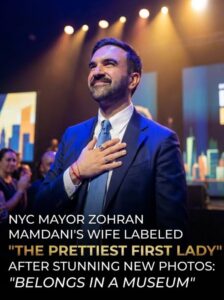
Rama Duwaji never expected her life to change overnight. Used to the quiet rhythm of creating illustrations and animations in her Brooklyn studio, she was suddenly thrust into public view after a series of carefully styled images appeared in collaboration with The Cut. The internet reacted instantly, dissecting her look, her presence, and her demeanor. What appeared to many as a moment of celebration felt far more complicated from the inside. Duwaji has described the experience as vulnerable—being widely seen before having the chance to be fully understood—highlighting how quickly attention can shape a narrative that rarely captures the full story.
That visibility was inseparable from the rise of her husband, Zohran Mamdani, whose election as New York City’s mayor placed Duwaji in a public role she never sought. Much of the early attention framed her primarily through that connection, despite her long-established creative career. While grateful for the warmth and support she received, Duwaji has been open about the discomfort of being introduced first as a political spouse rather than as an artist in her own right. The experience prompted reflection on how women connected to public figures are often defined by proximity before individuality, regardless of their professional achievements.
As public interest continued to grow, Duwaji and Mamdani made intentional decisions about privacy. They shared only a small glimpse of their courthouse wedding, favoring sincerity over spectacle. Even with these boundaries, Duwaji has spoken about the subtle pressure that comes with large-scale attention, particularly for creatives who fear losing their edge under scrutiny. To stay grounded, she has chosen to measure her work against the standards of her peers rather than the reactions of a mass audience, leaning on humor and self-awareness to navigate the balance between exposure and authenticity.
Looking ahead, Duwaji approaches her new visibility with thoughtfulness rather than resistance. While she does not see herself as a political figure, she recognizes the opportunity to uplift working artists and creative communities that often struggle for recognition. She remains deeply committed to her own practice, continuing to explore illustration, animation, and ceramics rooted in themes of identity and connection. As New York enters a new chapter, Duwaji’s focus is clear: maintaining her creative independence, setting firm boundaries, and using visibility as a tool—not a definition.