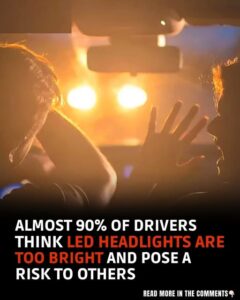
The glare hits before you even see the car. For a split second, your vision is obliterated. Your heart races, and you find yourself driving at highway speeds almost blind, struggling to maintain control of your vehicle. This sudden, disorienting burst of light is not a rare phenomenon; it has become a near-universal complaint among drivers worldwide. From bustling urban centers to rural backroads, motorists increasingly report that modern headlights—particularly those using LED and high-intensity discharge (HID) technology—are no longer merely bright; they can be dangerously blinding under certain conditions.
Reports from traffic safety organizations, driving forums, and news outlets reveal a pattern. Drivers describe moments of temporary blindness as startling, sometimes leaving them swerving slightly, braking abruptly, or turning their gaze away from the road entirely. Even a brief lapse in vision can carry severe consequences when traveling at high speeds. With the proliferation of LED headlights, what was once considered a technological convenience has now become a topic of public safety concern, with legal, technical, and human factors all intersecting in complex ways.
The Rise of LED Headlights
LED headlights were introduced as part of a broader wave of automotive innovation. Automakers marketed them as a superior alternative to traditional halogen bulbs, offering a whiter light closer to natural daylight, improved energy efficiency, and a dramatically longer lifespan. Unlike halogen lights, which emit a softer, warmer glow, LED lights produce a concentrated, intense beam. This intensity provides excellent forward visibility for the vehicle equipped with them, reducing eye strain during nighttime driving and illuminating obstacles more clearly.
Initially, the automotive press and consumers celebrated the arrival of LEDs. Advertisements emphasized longevity, energy savings, and sleek design. Automakers claimed that drivers could experience a safer and more comfortable night-driving experience with minimal maintenance costs. However, as adoption increased, an unforeseen consequence became evident: the concentrated light produced by LEDs, especially when installed in high-mounted vehicles like SUVs and pickup trucks, creates substantial glare for oncoming drivers.
The Glare Problem
Glare from high-intensity headlights can temporarily blind drivers, even for a few seconds. At highway speeds, this momentary impairment can translate into hundreds of feet traveled without proper visual perception. A vehicle moving at 65 miles per hour, for instance, covers nearly 95 feet per second. A three-second period of flash blindness, induced by the glare of an oncoming LED or HID headlight, results in traveling approximately 285 feet with severely compromised vision. For longer exposures, the distance traveled without clear sight can exceed the length of a football field, significantly increasing the likelihood of collisions.
The problem is exacerbated by the increasing height of modern vehicles. SUVs, trucks, and crossovers dominate contemporary roads, and their elevated headlights often sit above the natural line of sight for drivers in smaller passenger cars. Even a misalignment of a few degrees can dramatically amplify the intensity of glare experienced by other road users. When driving on winding roads or uneven terrain, the effect becomes unpredictable. Slight changes in road elevation redirect the beam, potentially catching an approaching driver entirely off guard.
Human Perception and Safety Risks
Human vision is not designed to instantly recover from intense, focused bursts of light. Studies in visual perception demonstrate that sudden exposure to bright lights reduces contrast sensitivity, diminishes color perception, and temporarily hampers depth judgment. The phenomenon, often referred to as “flash blindness,” leaves drivers unable to accurately detect obstacles, signs, or lane markings. For elderly drivers or individuals with preexisting eye conditions, such as cataracts or macular degeneration, recovery time can be significantly prolonged, compounding the risk of accidents.
Even beyond age or medical conditions, the intensity of modern headlights poses challenges to the average driver. The glare can trigger instinctive, protective reactions—looking away, braking suddenly, or swerving—which themselves can lead to secondary hazards. A car might veer into another lane, a pedestrian may be missed in the driver’s peripheral vision, or a driver may fail to adjust to a curve in time. Over time, repeated exposure to high-intensity headlights can contribute to chronic night-driving anxiety, changing behavior and potentially discouraging travel after dark.
Regulatory Frameworks and Gaps
Headlight regulations in most countries were designed decades ago, primarily for halogen lighting. These standards specified maximum beam intensity, alignment angles, and permissible glare levels. Yet they largely fail to account for modern vehicle design, LED technology, and varying road conditions. As a result, there is a significant gap between current vehicle capabilities and regulatory oversight.
Organizations such as the U.S. National Highway Traffic Safety Administration (NHTSA) and the European Union’s Economic Commission for Europe (ECE) are actively reviewing and updating standards, but progress is slow compared to the rapid adoption of new lighting technologies. In practice, drivers may encounter vehicles on the road that exceed recommended glare limits, either due to aftermarket modifications, manufacturing variances, or natural misalignment during vehicle use.
Without consistent enforcement or updated testing protocols, many drivers are left to contend with intense glare on their own. Safety advocates argue that the current system relies too heavily on individual caution and responsibility, rather than proactively reducing hazards at the source.
The Role of Vehicle Design
Vehicle design is critical in determining how headlights impact both the driver and oncoming traffic. Modern automakers increasingly adopt elevated headlamp placements, angular lenses, and projector-style housings that focus light more narrowly. While these features improve visibility for the driver of the vehicle, they also concentrate the beam in a way that is often harsh for other road users.
Adaptive front-lighting systems (AFS) have emerged as one solution. These systems adjust the angle and intensity of headlights automatically based on vehicle speed, road curvature, and oncoming traffic. In practice, AFS can mitigate glare while maintaining visibility, yet the technology remains costly and primarily available on luxury models. Most vehicles still rely on fixed, high-intensity beams, leaving the glare issue unresolved for the majority of drivers.
Aftermarket Modifications
The rise of aftermarket LED and HID kits has introduced additional risks. Enthusiasts seeking brighter lights or a more aggressive aesthetic often install kits that exceed manufacturer specifications. Misaligned or overpowered lights increase glare significantly, putting both the vehicle owner and oncoming drivers at risk.
Safety experts caution that even minor modifications can have outsized consequences. A slight tilt of a few degrees, an incorrect mounting height, or a non-standard bulb can transform a safe headlight into a temporary hazard. Education and awareness are critical; drivers should be instructed on proper installation, alignment, and adherence to manufacturer guidelines to minimize potential harm.
Environmental and Roadway Factors
The impact of glare is not solely a function of technology; environmental and roadway conditions play a crucial role. In urban settings, reflective surfaces—wet asphalt, glass storefronts, metal signage—can amplify the effects of intense lights. Secondary glare, created when beams bounce off reflective surfaces, further impairs vision.
Rural roads present a different but equally concerning scenario. Higher average speeds, limited ambient lighting, and long, straight stretches make momentary blindness particularly dangerous. Drivers have less margin for error, and emergency response may be delayed in sparsely populated areas. Glare-related disorientation has been linked to near-misses, delayed braking, and reduced reaction times, highlighting the broader public safety implications of the issue.
Public Health Considerations
Beyond immediate driving risks, glare from high-intensity headlights intersects with public health concerns. Temporary vision impairment contributes to stress, anxiety, and fatigue among drivers, particularly those with preexisting eye conditions. Pediatric drivers and the elderly are more susceptible to prolonged recovery times after exposure, making glare a multifaceted health issue.
The psychological impact of repeated glare events can influence long-term driving habits. Drivers may avoid nighttime travel altogether, leading to altered commuting patterns, reduced mobility, and potential socioeconomic consequences. Public health experts advocate for a holistic approach that combines technology, regulation, education, and roadway design to minimize these risks.
Economic Implications
The economic cost of glare-related incidents is substantial. Nighttime collisions often result in higher property damage, medical expenses, and insurance claims. Additionally, the indirect costs—such as traffic congestion, delayed deliveries, and reduced consumer activity during evening hours—can affect local economies. While precise quantification is challenging, traffic economists emphasize that preventing glare incidents can yield meaningful financial benefits, in addition to improving safety.
Technological Solutions
Automotive technology is evolving to address glare concerns. Matrix LED headlights, for example, allow precise control over individual diodes, enabling selective dimming to reduce glare while maintaining forward visibility. Automatic high-beam assist detects oncoming traffic and ambient lighting to dynamically adjust intensity. These innovations demonstrate significant potential for reducing glare-related accidents.
Wider adoption of such technologies is limited by cost, inconsistent regulatory standards, and low consumer awareness. Advocates argue for mandatory implementation, standardized testing, and incentives to accelerate adoption. The goal is to make high-intensity headlights safer for everyone, without sacrificing the benefits they provide to drivers.
Driver Education
Education is another crucial component. Many drivers are unaware of how to properly adjust headlights, the dangers of misalignment, and the risks associated with aftermarket modifications. Driving schools, dealerships, and manufacturers should prioritize instruction on safe headlight use, alignment procedures, and maintenance practices.
Simple measures, such as regular lens cleaning, alignment checks, and adherence to low-beam usage in dense traffic, can significantly mitigate risk. Defensive driving techniques, including reducing speed and increasing following distances at night, further enhance safety. Awareness campaigns, public service announcements, and in-car guidance systems can reinforce these behaviors.
Legal and Regulatory Efforts
Legislative and regulatory bodies are increasingly addressing glare issues. In the United States, NHTSA is reviewing headlight standards, testing protocols, and penalties for non-compliant aftermarket installations. In the European Union, ECE regulations specify limits for glare and beam intensity, though critics argue that laboratory testing does not fully capture real-world driving conditions.
Harmonizing global standards could improve safety for drivers traveling internationally, ensuring consistent glare limits and headlight performance across borders. Regulatory reform must balance innovation, driver convenience, and safety to reduce glare-related hazards effectively.
Conclusion
Glare from modern headlights represents a complex intersection of technology, human perception, road design, and regulation. LED and HID lights provide superior forward visibility for the driver, but if improperly aligned or regulated, they can create a significant hazard for oncoming traffic.
Solutions—including adaptive lighting, stricter alignment standards, driver education, and thoughtful roadway design—exist but require widespread implementation. Until these measures are fully adopted, drivers must remain vigilant. Momentary blindness from bright headlights is not a matter of sensitivity; it is a real and measurable risk.
Balancing innovation with safety is essential as automotive technology evolves. With coordinated efforts among manufacturers, regulators, educators, and drivers, it is possible to reduce glare-related accidents, enhance public health, and preserve the benefits of modern lighting technologies for all road users.
The glare problem is not going away, but awareness, regulation, and technological innovation offer a pathway to safer nighttime driving, ensuring that headlights remain a tool for visibility rather than a source of hazard.