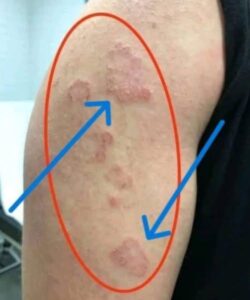
Noticing red round patches on your arm can be alarming, especially when they expand over time. People often wonder if these marks can spread to others. The answer depends on the underlying cause, as some rashes spread easily while others are harmless to touch. One common reason for a red circular patch is a fungal infection known as ringworm, or tinea corporis. Despite the confusing name, ringworm is a fungus that thrives in warm environments, not an actual worm. It appears as an itchy oval shape with raised edges and a clearer center. Ringworm is highly contagious and spreads through direct skin contact, sharing towels, touching contaminated surfaces, or interacting with infected pets.
You should know that not all red circular patches are infectious. Two common noncontagious skin conditions that closely resemble ringworm are eczema and psoriasis. Nummular dermatitis is a specific type of eczema that creates itchy coin shaped patches on the arms. Unlike fungal infections, eczema is related to a skin barrier dysfunction and inflammation rather than a transmissible illness. Psoriasis is another condition that causes red plaques with thicker silvery scales. It is an autoimmune condition stemming from an overactive immune system. Even with close physical contact, neither eczema nor psoriasis will spread to another person. These specific inflammatory conditions are entirely safe to be around and will never infect your loved ones.
While the physical appearance of the skin provides helpful clues, diagnosing the exact problem based on looks alone is difficult. There are a few general hints to help you understand what might be happening. Ringworm tends to have a defined outer border and gradually expands outward. In contrast, eczema patches often feel dry to the touch and may crust over in severe cases. Psoriasis plaques are usually much thicker and frequently appear on elbows or knees at the same time. If the rash worsens after applying an over the counter steroid cream, that reaction strongly suggests a fungal infection. Steroids can suppress the local immune response and accidentally make fungal rashes spread more easily.
You should seek a professional medical evaluation if the rash continues spreading, becomes painful, or causes severe itching that disrupts your life. A doctor can perform a simple skin scraping test to confirm a fungal infection if you remain unsure. If a fungal infection is suspected, taking prompt action prevents it from spreading. Keep the affected area clean and dry while avoiding the urge to scratch. It is important to avoid sharing personal clothing and to wash your bedding regularly. You should also have a veterinarian treat your pets if they carry the infection. Starting a proper antifungal treatment usually clears up ringworm entirely within a few short weeks.