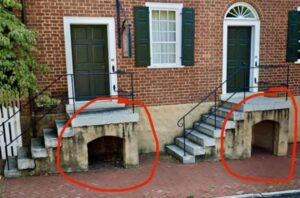
While walking through a historic neighborhood, especially in cities like Charleston, Philadelphia, New York, or Boston, you may come across an odd little space beneath the front steps of an old home. It might appear as a bricked-in archway or a sunken, chamber-like nook. It’s not just a quirky architectural feature—it has a name and a purpose. These unusual spaces are called stoop vaults. They’re also known as areaways or under-stoop vaults, and once upon a time, they played an essential role in urban life.
If you’ve ever wondered what they were used for, you’re not alone. Stoop vaults are now hidden in plain sight, often overlooked as relics of a bygone era. But these small, tucked-away areas were far from insignificant. Let’s take a step back in time to uncover the fascinating history and purpose of these mysterious architectural features.
What Are Stoop Vaults?
A stoop vault is essentially a tiny, often forgotten room tucked beneath the raised front steps (or “stoop”) of older urban homes. The term “stoop” refers to a set of steps leading up to a home, particularly common in densely built cities with narrow streets. In the 18th and 19th centuries, urban dwellings were frequently constructed with raised entrances to protect against flooding and water accumulation, especially in cities with subpar drainage systems.
These raised entrances created a hollow, open space between the house and the ground. In many cases, this space was converted into a vault—a functional area that was typically surrounded by stone, brick, or concrete.
So, what did homeowners do with this space? For many, the vaults served a very practical purpose. The most common use? Coal storage. Coal was the primary fuel source for heating homes, and in cities where space was limited, these vaults provided a secure and convenient place to store it.
Back in the day, deliveries of coal were made through a sidewalk hatch, allowing it to be dropped directly into the vault beneath the stoop. Homeowners could then retrieve their stock of coal, often through a small door or hatch that was part of the vault. These vaults were a vital part of a home’s infrastructure, especially in the cold winter months when heating was a matter of survival.
A Feature Born from Necessity
In densely packed urban areas like Boston, Philadelphia, and New York, city dwellings were often small, and yard space was practically nonexistent. Every inch of available space had to be utilized, and the stoop vault was a perfect example of pragmatic urban design.
Stoop vaults were born out of a need for functional storage. Without large backyards or ample room inside their homes, residents in these urban settings had to find creative ways to store coal, firewood, tools, and seasonal items. The vaults provided a secure, out-of-the-way space to stash these items, keeping them away from the main part of the house and, more importantly, keeping the home cleaner.
But it wasn’t just coal that found a home in these vaults. They were also used for storing firewood, tools, and even logs for those who didn’t rely on coal for heat. The vaults were versatile, often serving as a general-purpose storage area that helped people keep their homes neat and organized.
Hidden in Plain Sight
Despite their practicality, many stoop vaults are now hidden in plain sight, often forgotten or bricked over in modern renovations. As cities expanded and modern heating systems replaced coal stoves, these vaults became obsolete. But the presence of these spaces is still felt in many older neighborhoods, where they stand as silent testaments to a time when life was much more about resourcefulness and practicality than convenience.
A Reddit user shared a fascinating example of a stoop vault’s evolution. In Bremerton, Washington, a house built in 1939 boasted a vault beneath the stoop. Over the decades, the space underwent many changes: bricked over in the 1970s and ‘80s, re-exposed in the 1990s, and finally, in the 2020s, repurposed as a storage space for firewood. This vault’s journey perfectly mirrors the changing needs and evolving landscape of urban living.
Despite their obscurity, stoop vaults continue to be an important part of the architectural heritage of many cities. Whether bricked over or repurposed for new uses, they’re still part of the fabric of these neighborhoods, often waiting quietly beneath the front steps of rowhouses and townhomes.
More Than Just Storage
Today, most stoop vaults are no longer used for coal or firewood, but that doesn’t mean they’ve been entirely forgotten. In fact, some homeowners have chosen to preserve these spaces, using them for more modern purposes.
Some repurpose their vaults for utility access or garden beds, turning these once-functional spaces into miniature storage nooks or decorative planters. The idea of reusing these vaults as small-scale gardens or functional storage areas has gained popularity among city dwellers looking to maximize every inch of their homes and outdoor spaces. It’s a creative way to preserve the charm of these old homes while making them relevant to modern life.
In other cases, historically conscious renovations have sought to maintain the original character of the house by restoring or exposing these vaults as a nod to the past. In doing so, homeowners keep alive a piece of architectural history and remind us of the practical needs that shaped the homes of our ancestors.
A Niche Relic with a Big Story to Tell
These small spaces may seem insignificant, but they carry a rich history. The existence of stoop vaults speaks volumes about life before the advent of central heating and modern delivery systems. They represent an era when people had to plan for the cold winter months, storing coal, firewood, and other essentials within arm’s reach.
For anyone interested in the evolution of urban architecture, stoop vaults are an intriguing symbol of the resourcefulness that defined early city living. They are a reminder of a time when every square inch of space mattered, and nothing went to waste.
When walking through older neighborhoods, take a moment to stop and look at the front steps. Beneath those stoops, there’s more than just old stone or brick—there’s a storied history waiting to be uncovered. These vaults tell the story of urban life before modern conveniences, where fuel storage, seasonal upkeep, and home maintenance were closely intertwined with the design of the home itself.
So, the next time you spot one of these peculiar archways or sunken spaces, consider what they represent. That small, hidden vault beneath the stoop once stored the fuel that heated a home all winter long. It’s a small space with a big story to tell, offering a glimpse into the everyday realities of city living in centuries past.
The Lasting Legacy of Stoop Vaults
Though most modern homes no longer rely on coal for heating, stoop vaults continue to serve as important reminders of a different era. As cities grow and evolve, it’s important to remember the ways in which past generations adapted to their environments and the limited resources available to them. These small architectural details not only serve as a window into history, but they also help to maintain the character and authenticity of our urban landscapes.
In an age of rapid urban development and gentrification, it’s crucial to preserve and appreciate these subtle aspects of history. Whether or not they’re still in use, stoop vaults tell a story about how people once lived—how they made do with what they had, and how their homes were not just shelters, but careful systems designed to meet practical needs.
So, next time you pass a row of old townhouses or quaint city homes, keep an eye out for these architectural gems. Who knows what you might discover beneath your feet—an old vault, a piece of history, or a reminder of how far we’ve come.