It was a Thursday afternoon, 2:30 p.m., when I found myself parked in front of my daughter’s house, heart pounding with a mixture of anxiety and determination.
For months, I had been carrying a gnawing, persistent unease—a mother’s instinct whispering that something was wrong.
My daughter Laura, 29, had always been fiercely independent, but the tone of her recent calls, the way she avoided questions, and the subtle tremors in her voice had set off alarms in my mind. Today, I could no longer ignore them.
I sat in the car for a long minute, my fingers trembling over the steering wheel. I had tried reasoning with myself. “Maybe I’m overreacting,” I whispered. “Maybe she’s just stressed.”
But deep down, I knew better. My intuition had never failed me. I remembered the phone call that morning—Laura had answered breathlessly, a sharp, clipped tone in her voice as if someone was watching her.

“Yes, I’m coming,” she had said quickly, almost too quickly, before the line went dead. Something about that interruption had chilled me to the bone.
Now, standing before the white siding and black shutters of her house, everything looked perfect. The lawns were neat, the hedges trimmed with geometric precision, and the curtains pulled just so.
A postcard home, if anyone else had seen it. But I had learned to trust the feeling that lay beneath appearances. Something was off. Too still. Too quiet.
I pressed the doorbell. The chime echoed faintly through the house, swallowed quickly by the silence inside. No footsteps. No response. Only a faint shuffling sound, almost mechanical, coming from deeper within.
The door creaked open. Cold air hit me immediately—not the crisp, refreshing chill of an air-conditioned room, but a penetrating, bone-deep cold that made my breath cloud in the air.
My fingers tingled as I stepped inside, the sudden drop in temperature shocking my senses. The kitchen, the heart of any home, was the source.
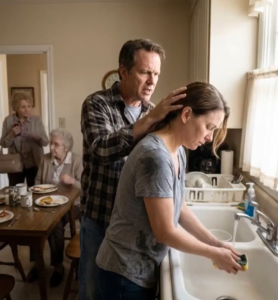
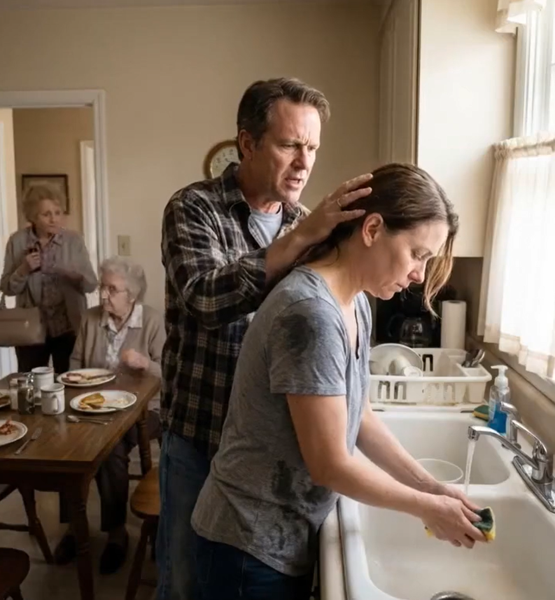
I could see her then. Laura, standing at the sink, scrubbing dishes with relentless intensity. Her hands were raw and red from the scalding water, her thin cardigan offering no warmth against the chill of the kitchen.
Steam rose faintly from the sink, disappearing into the frigid room. She had not noticed me. She was trapped in her task, as though the act of cleaning was both a shield and a punishment.
At the table sat Daniel, her partner, and his mother, Margaret. They were wrapped comfortably in thick sweaters, sipping tea and eating sandwiches.
A small space heater glowed warmly beneath Margaret’s feet, its orange light a stark contrast to the cold aura surrounding Laura. The disparity was jarring—Laura frozen and working endlessly, while others basked in comfort.
Margaret’s eyes landed on me first. Her smile was polite but distant, almost rehearsed.

“Laura didn’t mention you were coming,” she said, her tone casual, carrying an edge of thinly veiled control.
“That’s because I didn’t tell her,” I replied, my voice steady, but with an undercurrent of urgency. “I was worried.”
Daniel glanced at me, expression unreadable, his hands resting idly on the table. My eyes moved to Laura. She had not turned, not even to acknowledge my presence, hands gripping the sink as though it were the only anchor she had.
“Sweetheart,” I said softly, stepping closer, “are you okay?”
Margaret interjected, her voice light and dismissive. “She’s fine. Just finishing dishes. Laura, dear, bring more tea for everyone.”
I shook my head firmly. “No. Laura, sit down. You’re exhausted. That’s enough for now.”
For the first time, Laura’s eyes met mine. Her smile was fragile, barely there, like a candle flickering in the wind. In that moment, every suspicion I had carried for months crystallized into certainty: my daughter was in distress.
I stepped aside to make a call. My fingers trembled slightly as I dialed Javier Martinez, a trusted family friend and lawyer who had experience handling sensitive domestic matters. Within twenty minutes, he arrived, accompanied by two police officers, calm but alert.
“Good afternoon,” Javier said, his voice steady and professional. “We received a concern regarding the welfare of a resident here.”
Margaret and Daniel tried to laugh it off, brushing their hands down as if dismissing the intrusion, but Laura’s face told another story. She froze, caught between fear and relief, the dam of her suppressed emotions ready to break.

Officer Sarah Chen knelt slightly, meeting Laura at eye level. “Are you safe?” she asked gently.
Laura shook her head, the weight of months evident in the quiver of her lips.
“I… I’m not all right,” she admitted, the words barely audible but carrying the force of a long-held truth finally spoken.
Then came the torrent of confession—months of hidden suffering spilled in a voice small but steady:
“I’m cold all the time.”
“I cook all their meals but eat standing in the kitchen.”
“I clean endlessly, but it’s never enough.”
“I can’t see friends. I can’t access my own money. I can’t even call my mother without asking permission.”
Javier and the officers listened attentively. They recognized the signs immediately—emotional and financial abuse, a carefully controlled environment, manipulation hidden beneath everyday routines. Laura had the right to leave, and for the first time in months, she realized she could exercise it.
The atmosphere shifted. The cold kitchen felt even more oppressive as reality sank in. Yet amid the tension, a quiet determination emerged in Laura’s eyes. She had been invisible for too long; now, she was being seen.
The next hour unfolded like a tense, delicate dance. Laura moved slowly, deliberately, as if every action required conscious courage.
With trembling hands, she began to pack a small bag, carefully folding clothes, tucking away personal items, and gathering essentials she had not been allowed to control for months.
Each item she placed into her bag marked a symbolic step toward reclaiming her autonomy, a small victory over the control that had loomed over her life for far too long.
I stayed close, offering quiet support, my hand brushing hers to remind her that she was no longer alone. She whispered, almost to herself, “I thought no one would ever believe me.”
“You never needed them to,” I reassured her. “I always believed you, even when I didn’t fully understand.”
Javier Martinez and the officers remained patient, allowing Laura the space to take control of her own exit. Their presence was firm yet unobtrusive, a stabilizing factor amid the whirlwind of emotion.
Margaret and Daniel attempted to interject, offering polite, but hollow reassurances, trying to assert their version of normalcy. But Laura, standing a little taller with each passing moment, ignored them. She had found her voice, and it carried with it a quiet, resolute authority.
When the last piece of clothing was folded and her bag zipped closed, Laura looked at me. Her eyes, previously clouded with exhaustion and fear, now gleamed with something else: determination. “I’m done,” she said softly, but with unwavering conviction.
We left the house together, stepping into the crisp afternoon air. For the first time in months, Laura moved without the invisible chains that had weighed her down. Each step was deliberate, measured, yet imbued with the kind of relief that only comes from escaping long-term oppression.
The Long Road to Recovery
The first few days outside the house were filled with a mix of euphoria, exhaustion, and cautious anxiety. Emotional abuse leaves scars invisible to the eye—scars that can shape a person’s sense of reality, self-worth, and trust in others. Laura’s initial nights in a safe environment were restless.
She found herself waking frequently, startled by imagined reprimands or the echo of commanding voices she had internalized.
I reminded her gently, repeatedly: “You’re intelligent, capable, and financially independent. You were just too tolerant of people breaking you down.”
With Javier’s guidance, we began untangling the complex financial web that had kept Laura under subtle control. Accounts were opened in her name, passwords were changed, and she gained secure access to funds she had never been permitted to manage.
Each step was a reinforcement of her independence, a tangible reclaiming of the freedom she had been denied.
Therapy became a cornerstone of her recovery. Initially hesitant, Laura learned to identify and articulate the patterns of control she had endured. Cognitive-behavioral exercises, emotional processing, and gradual exposure to social situations helped her rebuild confidence.
Sessions focused on recognizing red flags, setting personal boundaries, and asserting needs without guilt—skills that had been systematically eroded over the preceding months.
Reclaiming Everyday Life
Three months later, Laura signed the lease for a small, sunlit apartment. The space was simple but warm—a blank canvas she could fill with her own choices, her own rhythm, and her own life.
The moment she turned the key and stepped inside, I could see the transformation. For the first time in years, she had full control over her environment.
She cooked her own meals, adjusted her thermostat without hesitation, and decorated the apartment according to her taste.
There was laughter again, spontaneous and unguarded, filling spaces that had previously been silent or tense. Even the small rituals, like choosing what to wear, or how to arrange her kitchen, became profound symbols of autonomy.
“I can breathe here,” she said one evening, sipping tea at her new kitchen table. “I never realized how much I’d forgotten what freedom feels like.”
“You saved your life, Laura,” I told her. “Not because of some grand heroic act, but because you didn’t allow yourself to be invisible anymore. You refused to look away from what you needed.”
The statement resonated deeply. For Laura, reclaiming autonomy was not just about leaving a physically oppressive space—it was about regaining control over her own narrative, her own body, and her own choices.
The Emotional and Psychological Recovery
Recovery from emotional and financial abuse is often nonlinear. Laura experienced moments of triumph followed by waves of doubt. Old habits, fear responses, and ingrained self-blame would occasionally resurface.
During these times, supportive networks became essential: weekly therapy, regular check-ins with family and friends, and the steady presence of advisors like Javier created a scaffolding upon which she could rebuild her sense of self.
Community and social reintegration were also critical. Slowly, Laura began reconnecting with friends she had not seen for months, attending social events, and re-engaging in hobbies that had been prohibited or discouraged. Each reconnection reinforced her identity outside the controlling environment she had left behind.
Financial Empowerment and Independence
A significant part of Laura’s recovery involved reclaiming her financial independence. Javier guided her through opening personal accounts, securing credit lines in her name, and establishing online banking—steps that had previously been restricted.
Financial literacy workshops provided her with tools to budget, invest, and manage her money confidently. These small but crucial steps offered Laura more than security—they provided tangible proof of her regained autonomy.
Rebuilding Confidence and Self-Worth
Perhaps the most profound transformation occurred in Laura’s self-perception. Through therapy, mentorship, and daily acts of agency, she began to recognize her worth outside the shadow of abuse.
Affirmations, small accomplishments, and the support of family helped counter the internalized messages of inadequacy that had plagued her for months.
“I feel like I’m rediscovering myself,” Laura confided one evening. “It’s not that I forgot who I was, but I had been forced to shrink, to be invisible.”
“Yes,” I said softly. “Now you can expand again. You can take up space. You can exist fully—without permission.”
A New Life Begins
By the six-month mark, Laura’s apartment had become a vibrant reflection of her personality. Bright curtains, shelves filled with books and plants, a kitchen stocked with ingredients she enjoyed—each detail was a testament to her reclaimed life.
She hosted small dinners for friends, cooked freely without fear of scrutiny, and laughed easily, without the tension that had once shadowed her presence.
She enrolled in continuing education courses, pursued a passion for photography, and started volunteering with organizations supporting survivors of abuse.
Her story, though deeply personal, became a beacon for others in similar situations, demonstrating that recovery, while challenging, was possible.
Reflections and Lasting Lessons
Looking back, the intervention that day—the combination of maternal instinct, timely support from Javier, and the presence of law enforcement—proved decisive. It not only removed Laura from immediate harm but also created a foundation for long-term recovery.
Emotional and financial abuse can be invisible to the outside world, masked by appearances, politeness, or denial. The cold kitchen that day was more than a physical space—it symbolized control, oppression, and suppressed autonomy.
Laura’s journey reminds us of the importance of vigilance, intuition, and decisive action in protecting loved ones.
Her recovery demonstrates that empowerment is multifaceted: reclaiming a home, regaining financial independence, rebuilding self-esteem, and reestablishing social connections. Each element contributes to the restoration of dignity and the creation of a life unbound by fear.
A Mother’s Love: The Catalyst
At the heart of Laura’s story lies a simple truth: a mother’s instinct, when trusted, can be life-saving. My refusal to ignore the subtle signs, the months of unease, and the courage to step forward turned into a moment that changed everything.
“You saved my life,” Laura said one night, tears glistening in her eyes. “Not in a movie way, but in the real way.”
“Yes,” I whispered, pressing my hand over hers. “Sometimes the most loving act is refusing to look away.”
Her voice returned, her autonomy restored, and her life began anew. She had found herself again—and that, more than anything, was everything.