I’ve always been drawn to extreme adventures. There’s something in the adrenaline, the unpredictability, and the raw confrontation with nature that speaks to me.
Skydiving at dawn, climbing jagged mountain peaks in freezing winds, and navigating dense forests alone have been my playgrounds for years.
The sense of risk, the isolation, and the ultimate challenge of testing my limits excite me in ways that few other experiences can.
Yet, every adventure carries an element of the unknown, a reminder that nature, no matter how well prepared we are, is always in control.

That winter, my friends and I decided to push this thrill-seeking instinct to a new extreme: we planned to spend a night in the forest during the coldest stretch of the season.
Snow had already blanketed the ground, covering the forest floor in a pristine layer of white, and the trees were heavy with frost.
The wind was sharp, cutting through layers of clothing like icy knives, and the entire world seemed silent, almost suspended in a frozen stillness. It was exactly the kind of environment that promised both beauty and danger, a combination I usually craved.
We set out in the late afternoon, hauling backpacks filled with essentials: heavy-duty sleeping bags, insulated pads, thermoses of hot drinks, small portable stoves, and enough food for the night.
No tents with floors or modern conveniences—just simple canvas shelters pitched directly on the snow-covered ground.
The plan was simple: immerse ourselves completely in nature, record the experience, and, as usual, I hoped to capture some “cool footage” for later reflection.
My friends were equally enthusiastic, though they occasionally expressed minor doubts about how harsh the night might get. I brushed them off with confidence, assuring them that the cold, the dark, and even potential wildlife encounters were part of the thrill.
As night began to fall, the forest transformed. Shadows stretched long across the snow, and the pale glow of the moon reflected off icy branches, creating a magical yet eerie landscape.
The only sounds were the crunch of snow underfoot, the occasional snap of a frozen branch, and the distant howl of wind weaving through the trees. I set up my night-vision camera inside my tent, propped to catch a wide view of the entrance.
The camera had a subtle red LED that blinked quietly, a small reassurance that it was working without attracting attention from the wildlife.
I opened the tent flap slightly, turned the camera on, and crawled inside my sleeping bag. The night was calm—or so I thought.
For the first few hours, nothing unusual happened. The wind whistled between trees, branches swayed as if the forest itself was breathing, and every so often, I heard the rustle of small animals moving through the underbrush.
Deer, rabbits, and foxes are common in that region, but they usually stay clear of humans. I felt a sense of peace, mixed with mild boredom. I almost considered turning off the camera, thinking that tonight might be another quiet, uneventful night like so many others I had spent in the wilderness.
The snow reflected a soft glow, the tent walls shivering with the breeze, and I began to doze off, comforted by the rhythmic sound of the wind.
Around three in the morning, however, something shifted. The subtle noises of the forest seemed to intensify. The wind’s pattern changed, branches scraped in unfamiliar ways, and the rustling outside the tent grew louder.
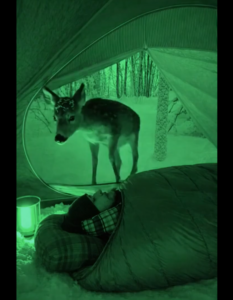
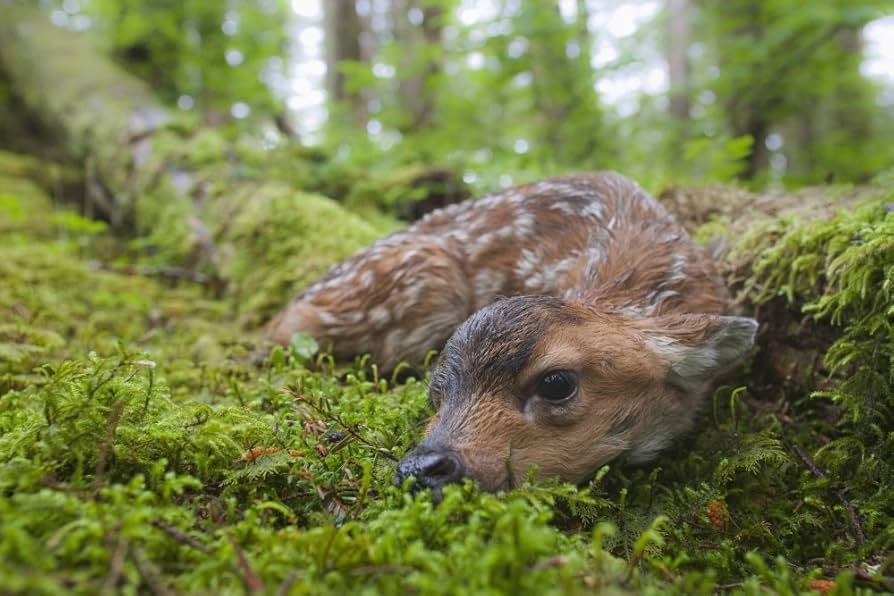
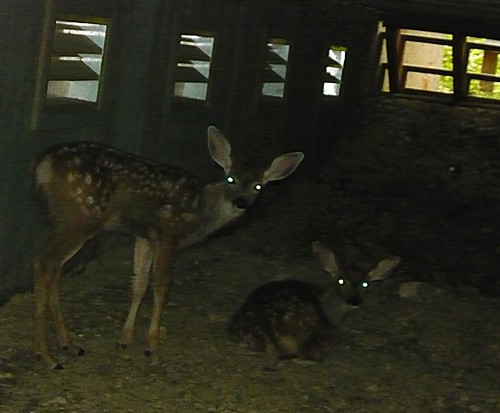
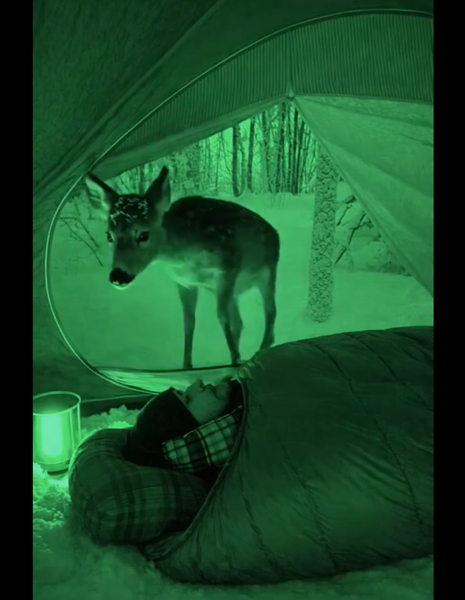
At first, I assumed it was another animal passing through, perhaps a fox or a rabbit, but then a small figure appeared in the night-vision footage: a deer—or more accurately, a fawn.
Its eyes reflected the camera’s infrared light, giving them an otherworldly glow. Small, thin, and cautious, it froze as it noticed the tent.
I held my breath, knowing logically that the creature was harmless, yet my instincts screamed a mix of excitement and apprehension.
The fawn sniffed the air, taking hesitant steps closer. It hesitated, then in a moment of surprising boldness, it approached the tent flap.
The way it moved suggested curiosity rather than fear, a quiet intelligence that seemed almost human. It lingered there for several seconds, as if assessing whether anyone—or anything—was inside.
Then, in a moment that would forever change my perspective on outdoor adventures, the fawn did the unexpected: it climbed into the tent.
I froze, heart racing, unsure whether to wake or remain perfectly still. The fawn’s delicate hooves touched the ground inside the tent lightly, careful not to disturb the surroundings, yet I could feel its presence just inches away.
I wanted to move, to see it with my own eyes, but I was paralyzed by a mixture of disbelief and fascination. My mind raced: “How is this happening? Animals don’t usually do this. This is insane!”
The fawn remained just a few steps from where I lay, its tiny body tense yet strangely calm. Its delicate nose twitched as it sniffed the air inside the tent, and its large, wary eyes seemed to study me intently.
I felt an odd mixture of awe and apprehension. Here I was, a seasoned wilderness adventurer, usually ready to face bears, wolves, and freezing blizzards—and yet, I was frozen by the presence of a small, seemingly innocent animal.
The forest had a way of humbling anyone who ventured into it alone, reminding me that even creatures that seemed harmless could surprise us in ways we never expected.

Then, in a moment that would forever change my definition of “unpredictable adventure,” the fawn did the most shocking thing imaginable:
it calmly relieved itself, right next to me. Small, black droppings fell onto my sleeping bag, onto my clothes, and even, unbeknownst to me at the time, near my face.
My first reaction, had I been awake, would likely have been horror and panic—but in my deep sleep, I remained completely unaware, smiling in my dreams, oblivious to the chaotic reality unfolding just inches away.
When I watched the footage later, the shock was immediate. My mind raced as I replayed the scene: the fawn had clearly sought warmth and shelter, and in its natural instinct to find a safe space, it had chosen my tent.
It was not malicious; it was simply nature acting according to its own rules. That realization did little to soothe my initial discomfort, however. Watching the footage, I felt a mix of amusement, disbelief, and genuine unease.
The surreal nature of the encounter reminded me that even the smallest creatures could create experiences that were unforgettable—and, at times, profoundly humbling.
I spent the remainder of the night awake, listening to the subtle sounds of the forest and reflecting on the encounter. My friends, who were in their own tents nearby, had no idea what had happened.
I debated whether to share the story immediately or wait until morning when the shock of the situation could be absorbed more fully.
I chose the latter, realizing that recounting it too soon might seem exaggerated or unbelievable. Even seasoned outdoor enthusiasts would have struggled to imagine the audacity of a fawn climbing into a tent at three in the morning and using it as a personal refuge.
The experience left me with a new perspective on adventure and curiosity. For years, I had sought out extreme situations, believing that the thrill of danger and the rush of adrenaline defined the essence of living fully.
I had scaled icy cliffs in subzero temperatures, jumped from airplanes thousands of feet above the ground, and camped alone in remote wilderness areas—yet nothing had prepared me for this intimate, unexpected encounter with a tiny creature.
The lesson was clear: no matter how experienced or prepared we believe ourselves to be, nature has its own rules, and those rules are not always aligned with human expectations.
By dawn, the forest was bathed in soft, golden light. Snow sparkled on the trees, and the once-intimidating shadows had transformed into gentle patterns of sunlight and frost.
I stepped out of the tent cautiously, inspecting the ground and my sleeping bag, and found evidence of the fawn’s presence: small droppings scattered in a surprisingly precise pattern.
I could not help but laugh at the absurdity of the situation. The forest, in its quiet and mysterious way, had reminded me that adventure is not always about danger or physical challenge—it is often about unpredictability, humility, and the acceptance that not all experiences can be controlled.
Reflecting further, I realized that this encounter taught me something important about curiosity itself. While curiosity drives exploration and discovery, it also carries risk, and sometimes the results are not what we anticipate.
In this case, my curiosity—to document the night, to observe the forest closely, to immerse myself fully in the environment—led to an experience that was both shocking and profoundly memorable.
Nature, in its infinite wisdom, provided a lesson I could not have learned in any other way: that the thrill of adventure often comes with moments of vulnerability and unpredictability, and that part of the excitement lies in surrendering to the unknown.
This night also reshaped how I view wildlife. The fawn was not an intruder; it was a living creature following its instincts. Its actions were a natural part of survival and comfort-seeking, yet the close proximity and unexpected behavior created an encounter that was unforgettable for me as a human.
I came to appreciate the balance of respect and caution that wilderness exploration requires, understanding that even seemingly benign interactions can leave a profound impact.
As the day progressed, I shared the footage with my friends, who were equally stunned and amused. The laughter that followed was cathartic, a release of the tension built up overnight.
We discussed how the experience had changed our perception of wilderness camping. Some admitted they might think twice before camping alone in extreme conditions, while others acknowledged that the unpredictability was part of the charm—but all of us agreed that the night had been unforgettable.
In the weeks that followed, I often revisited the footage. Each replay evoked a mix of emotions: amusement, disbelief, and a renewed respect for the natural world.
The experience became a story I shared repeatedly, a cautionary yet humorous tale that highlighted the unpredictable nature of wildlife and the humility that comes with true adventure.
It reminded me that the thrill of exploration is not always about physical feats or overcoming fear—it is often about embracing the unknown, learning from unexpected events, and appreciating the sheer unpredictability of life in its rawest form.
Ultimately, the night in the forest left an indelible mark on my perspective as an adventurer. I realized that some experiences are best observed rather than lived firsthand, that curiosity must be tempered with caution, and that even the smallest creatures can surprise us in ways that challenge our understanding of the natural world.
While I continue to seek thrills in skydiving, mountain climbing, and wilderness exploration, I now approach each adventure with a heightened awareness of the unexpected.
The forest, in its silent and majestic way, reminded me that true adventure lies not only in the physical challenges we undertake but also in the humility and wonder with which we witness the world around us.
That night taught me a lesson that I carry to this day: the wilderness has its own rhythms, its own rules, and its own surprises.
Some of those surprises are beautiful, some are terrifying, and some are downright absurd.
But all of them serve as reminders of why we venture into the wild in the first place—not to conquer it, but to encounter it, to learn from it, and to be reminded that life is far more unpredictable and extraordinary than we often imagine.