A Curious Detail That Sparks Big Questions
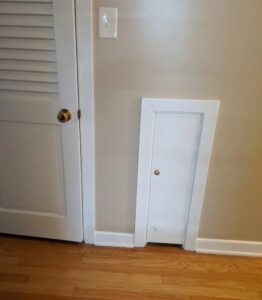
You’re walking through a house—maybe your neighbor’s, maybe your grandparents’—and something catches your eye. It’s small, almost easy to miss. A tiny door, set low into the wall, usually near a closet or tucked along a hallway. It doesn’t look decorative. It doesn’t match anything else. And most of all, it doesn’t make sense.
So naturally, your brain goes into overdrive.
Is it a secret compartment? A hidden passage? Some kind of vintage feature that nobody uses anymore?
That small, quiet detail has sparked confusion for decades. People have speculated endlessly about these doors, turning them into mini architectural mysteries. And honestly, it’s not hard to see why—they feel like they should lead somewhere important.
But as intriguing as they seem, the truth behind these tiny doors is both simpler and more fascinating than most people expect.
The Rise of Theories (And Why They’re So Convincing)
Before we get into the real answer, it’s worth looking at why these doors confuse so many people in the first place.
When you see something unusual in an older home, your mind naturally fills in the gaps. And over time, a handful of common theories have become surprisingly widespread:
- Secret hiding spots for valuables
- Hidden passageways between rooms
- Storage for suitcases or travel trunks
- Built-in compartments for linens or cleaning tools
- Even “panic rooms” (yes, really)
Each of these ideas has a certain logic behind it. After all, older homes often include design quirks that modern construction doesn’t. And historically, people did build hidden spaces for privacy or security.
But here’s the thing—those explanations don’t quite hold up when you look closer.
The size of these doors is usually too small for practical hiding. The placement doesn’t suggest secrecy. And the interior space? Often shallow, narrow, and oddly shaped.
In other words, they don’t behave like secret features at all.
They behave like something practical.
A Look Back: Life in Mid-Century Homes
To understand these doors, you have to step back into the mindset of mid-20th-century living—particularly in the 1950s and 1960s.
Homes from that era were designed very differently from today’s open-concept layouts. Space was more limited. Storage was more intentional. And furniture often had to serve multiple purposes.
Entertainment, too, looked different.
There were no smartphones. No streaming platforms. No endless digital distractions.
Instead, people gathered.
They played games. Hosted small parties. Invited friends over for evenings that revolved around conversation and shared activities.
And one of the most popular pastimes?
Card games.
The Real Purpose: Storage for Card Tables
Here’s the answer that surprises most people:
Those tiny doors were designed to store folding card tables.
That’s it.
No secret passages. No hidden chambers. Just smart, efficient storage.
At first glance, it might seem almost underwhelming. But once you think about it, it actually makes perfect sense.
Card tables were a staple in many households. They were used for:
- Playing games like bridge, poker, and rummy
- Hosting casual gatherings
- Providing extra surface space during events
- Serving as flexible furniture when needed
The only problem?
They were bulky.
Even when folded, card tables took up space—valuable space that smaller homes couldn’t afford to waste.
So designers came up with a clever solution: build storage directly into the walls.
Why the Design Was So Smart
These built-in compartments weren’t random. They were intentionally designed to solve a very specific problem.
Here’s what made them so effective:
1. Space Efficiency
Instead of leaning a table against a wall or stuffing it into a closet, homeowners could slide it neatly into a dedicated compartment.
2. Easy Access
Placing the door near a closet or hallway made it convenient to grab the table whenever needed.
3. Clean Aesthetic
When closed, the door blended into the wall, keeping the space uncluttered.
4. Multi-Functional Living
Homes could transform quickly—from everyday living spaces to entertainment areas—without extra furniture getting in the way.
It was a small design choice with a big impact.
Why These Doors Seem So Mysterious Today
If the purpose is so practical, why do they feel so strange now?
Because the lifestyle they supported has largely disappeared.
Today, most people don’t use folding card tables regularly. Entertainment has shifted toward digital experiences. Furniture trends have changed. Homes are designed with different priorities.
So when we encounter a feature built for a completely different way of living, it feels… out of place.
It’s like finding a rotary phone or a milk delivery box. The object itself isn’t complicated—but the context is gone.
And without context, even the simplest things become mysteries.
A Window Into the Past
What makes these tiny doors truly interesting isn’t just their function—it’s what they represent.
They tell a story about how people lived.
A time when:
- Evenings were spent around a table, not a screen
- Social gatherings happened at home, not online
- Furniture needed to be flexible and practical
- Design focused on maximizing every inch of space
These doors are small, but they reflect a much larger philosophy of living.
They remind us that homes weren’t just places to exist—they were places to gather, connect, and create shared experiences.
What If You Have One in Your Home?
If you’re lucky enough to have one of these little doors in your house, you might be wondering what to do with it.
The original purpose may not apply anymore—but that doesn’t mean the space isn’t useful.
Here are a few modern ways to repurpose it:
1. Extra Storage
Perfect for storing cleaning supplies, tools, or seasonal items.
2. Linen Compartment
Use it for towels, blankets, or bedding.
3. Hidden Pantry
A great spot for non-perishable food items.
4. Pet Supply Storage
Keep leashes, toys, and food neatly tucked away.
5. Decorative Feature
Embrace its vintage charm and leave it as-is.
The key is to see it not as an outdated feature—but as an opportunity.
The Charm of Unexpected Details
There’s something special about discovering a feature like this.
It breaks the predictability of modern spaces. It adds character. It sparks curiosity.
In a world where so many homes look the same, these small quirks stand out.
They remind us that design isn’t just about aesthetics—it’s about solving problems, reflecting lifestyles, and adapting to the needs of the time.
And sometimes, those solutions leave behind little mysteries for future generations to uncover.
Why We Love Mysteries Like This
Let’s be honest—part of the appeal isn’t just the answer.
It’s the question.
We enjoy wondering. Speculating. Imagining what something could be before we know what it is.
That tiny door invites imagination.
Even after you learn the truth, a small part of you might still like the idea that it could lead somewhere secret.
And that’s okay.
Because sometimes, the story we tell ourselves is just as meaningful as the reality.
Final Thought: Small Doors, Big Stories
At the end of the day, that tiny door isn’t hiding anything dramatic.
No secret tunnels. No hidden treasures.
Just a folded card table—and a piece of history.
But in its simplicity, it tells a bigger story about how homes were designed, how people connected, and how everyday life once looked.
So the next time you spot one of these little doors, don’t just see it as a strange detail.
See it as a quiet reminder that even the smallest features can carry a story worth remembering.
And sometimes, the most ordinary explanations are the ones that reveal the most.