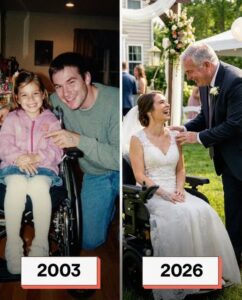
I thought the happiest day of my daughter’s life would be the moment I finally exhaled. After everything we’d survived together—loss, grief, years of therapy, and tiny victories that felt like miracles—I believed her wedding would be a clean, beautiful ending to our long story. But while the music played and the lights glowed softly over the reception hall, I noticed a woman standing near the exit, watching my daughter with an intensity that didn’t match the celebration. Something about her stillness made my stomach twist. Then she walked straight toward me and said the words no parent expects to hear: “You have no idea what your daughter is hiding from you.”
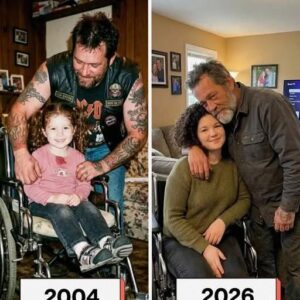
My name is Caleb, and I’m 55 now, but my life changed decades ago when I lost my wife and my young daughter in a sudden accident. I spent years moving through empty days, barely living, until one rainy afternoon I found myself at an orphanage—without a plan, without certainty, just searching for a reason to feel alive again. That’s where I met Lily, a quiet five-year-old girl sitting in a wheelchair, watching other kids play as if she had learned not to hope. Her file said she’d survived a serious crash, her father had passed away, and her mother had signed away her rights, unable to handle the grief and medical needs. But all I saw was a child who needed someone to stay. I started the adoption process, and when I finally brought her home with nothing but a small backpack and a stuffed owl, I promised her she’d never be abandoned again.
Raising Lily wasn’t always easy, but she had a strength you couldn’t teach. We celebrated every milestone—every therapy session, every step, every moment she proved the world wrong. She grew into a determined young woman who refused pity, worked hard in school, and built a life filled with purpose. Then she met Ethan in college, and it was like watching someone finally find the kind of love that felt safe. Their wedding was warm, intimate, and full of people who truly cared about her. That’s when the stranger approached me again, voice shaking, and said she was Lily’s biological mother. She claimed Lily had contacted her years ago, asked questions, and that there were things I “deserved to know.” But as she spoke, all I could think about was the truth I’d lived for 23 years: Lily didn’t become who she was because someone returned—she became who she was because someone stayed.
Later that night, after the speeches and dancing, Lily and I stood outside under the cool air, away from the noise. Before I could say anything, she looked at me and quietly asked, “She came, didn’t she?” I admitted it, and Lily’s shoulders sank—not in fear, but in a tired kind of understanding. She explained she had searched for answers a long time ago, not because she needed her past back, but because she needed peace. And then she made her choice: she walked away from what hurt her and held onto what healed her. I took her hand and told her what I’d always known in my bones—family isn’t decided by blood alone, but by love, effort, and the decision to show up every day. And when I watched her return to the dance floor with her husband, smiling freely beneath the lights, I realized that no secret could ever undo the life we built together.