When people hear the phrase five years, it sounds insignificant, like a brief passage of time, a few pages easily skimmed in the book of life.
But when those years are not marked by seasons or holidays, when they are counted instead in fluorescent hospital halls, pill organizers sorted by day and time, and the sharp, lingering smell of disinfectant that clings to your skin no matter how many times you shower, time behaves differently.
It thickens. It settles heavily in your lungs. It turns into a burden you haul forward instead of a space you inhabit.
My name is Marianne Cortez. I am thirty-two years old, and the woman staring back at me in the mirror feels like a complete stranger.
Her posture is curved inward, as though she is constantly bracing herself for the next crisis, the next demand, the next emergency.
Dark circles frame eyes that rest never seems to reach, no matter how many hours she sleeps.
And my hands reveal everything.
Raw from constant washing with hospital-grade soap. Calloused from lifting a body never meant to be carried alone. Shaped by wheelchair handles and hospital bed rails, the skin rough and permanently dry.
These are not the hands of a thirty-two-year-old woman. These are the hands of someone who has aged decades in just five years.
Once, my life was simple. Hopeful, even, in that naive way young people believe their dreams are guaranteed.
I met my husband, Lucas Cortez, at a local charity fundraiser in Boulder, Colorado, on a warm summer evening filled with string lights and laughter.
He had an ease about him that made people feel seen, singled out, like they were the only person in the room when he spoke to them.
When he talked, attention followed naturally. When he smiled, it felt personal, intimate, like a secret shared just between you and him.
We married fast, maybe too fast, driven by plans that seemed solid and mutual at the time.
Kids. Travel to places we had only seen in magazines. A bigger house somewhere quieter, away from the city noise.
A future that felt deserved, earned, waiting for us to step into it.
That future ended on a rainy October night on a bend of highway outside Golden, a curve everyone who lived in the area warned about and everyone thought they could manage.
Lucas was driving home from a regional sales conference, tired but confident, when a drunk driver crossed the median without warning.
The crash destroyed the car completely, turning it into twisted metal and shattered glass.
It spared Lucas’s life but took the use of his legs forever.
At Front Range Medical Pavilion, the neurologist explained the damage to us calmly, clinically, as if he were discussing weather patterns instead of the destruction of our future.
Spinal cord injury. Permanent paralysis from the waist down. No possibility of recovery.
His words carried absolute certainty, the kind that leaves no room for hope or negotiation.
When he finished, silence filled the small consultation room so completely it felt physical, pressing down on my chest.
I did not cry. Not then. I held Lucas’s hand and promised I was not going anywhere.
I said we would find a way forward together, that we were a team, that this did not change anything between us.
I believed love meant persistence, that devotion was measured in how much you could endure.
What I did not realize was how quietly sacrifice can erode a person, wearing you down like water on stone until there is nothing left of who you used to be.
The years blurred into repetition, each day a copy of the one before.
Pre-dawn alarms that went off before the sun rose. Medication charts taped to the refrigerator, color-coded by time and dosage.
Insurance calls that led nowhere, transferring me from department to department until I wanted to scream.
Sleeping on the couch instead of in our bed so I would hear Lucas if he needed me during the night.
I learned how to lift a grown man without injuring my back, the proper technique demonstrated by a physical therapist who spoke in cheerful tones that felt like mockery.
I learned how to smile through exhaustion so complete I sometimes forgot what day it was.
I learned how to swallow resentment while strangers at the grocery store or the pharmacy praised my strength and called me an inspiration.
They did not know what strength cost.
They did not see me crying in the shower, the only place I could be alone.
They did not hear Lucas snapping at me when I was ten seconds too slow bringing his medication, or when the food was not exactly how he wanted it.
They saw a devoted wife. I saw a woman disappearing.
One Tuesday morning, indistinguishable from the countless others that had come before, my alarm rang at four-thirty in the morning.
The city outside was dark, cold, silent enough to amplify every anxious thought rattling around in my head.
I dressed for practicality, not pride, pulling on clothes I had worn three days in a row because laundry felt impossible.
I mentally recited the day’s tasks like a prayer. Medications. Breakfast. Physical therapy exercises. Doctor’s appointment at eleven. Grocery shopping. Dinner. Evening medications. Bed transfer.
Lucas had been craving pastries from a small bakery near the hospital, the kind with real butter and hand-rolled dough.
He said hospital meals made him feel like a burden, a complaint that stung because everything made him feel like a burden lately, and somehow that was always my fault.
I convinced myself that something warm and familiar might lift his spirits, might make him smile at me the way he used to.
The bakery glowed when I arrived just after six, warm light spilling onto the sidewalk.
The smell of butter and sugar and cinnamon filled the air, and for a brief, precious moment, I pretended I was just another woman buying breakfast for someone she loved.
Not a caregiver. Not a nurse. Just a wife doing something kind.
The cashier smiled at me, genuinely friendly in that early morning way.
“What can I get you today?”
“Two cinnamon rolls, a box of plain pastries for later, and a large black coffee,” I said, trying to sound normal, trying to remember what normal even felt like.
I paid carefully, counting out bills from my wallet, and drove toward the hospital with the bag sitting on the passenger seat beside me.
I imagined Lucas’s reaction. Maybe he would thank me. Maybe he would remember why he married me.
Maybe today would be different.
Inside the hospital, the familiar bite of antiseptic hit me immediately, that smell that never quite leaves your nose.
I signed in at the front desk, nodding at the receptionist who knew me by name now.
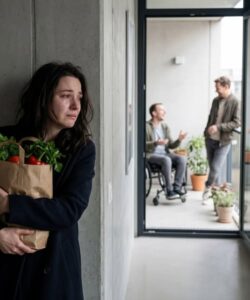
A volunteer in a pink jacket mentioned that Lucas was in the courtyard with another patient, getting some fresh air.
I headed toward the glass doors that led outside, smoothing my hair with one hand, trying to appear less worn down than I felt.
Then I heard him.
Lucas’s voice, clear and unmistakable, drifting through the open door.
“You adjust to it,” he was saying to someone. “People think it is tragic, but honestly, there are perks.”
I slowed my steps, confused. Perks?
The other man laughed, a sound that carried easily in the quiet morning air.
“Your wife does everything for you, right? That does not bother you?”
“Why would it?” Lucas replied easily, almost cheerfully. “Marianne is dependable. She does not leave. She has nowhere else to go, really.”
I stopped walking completely, just out of view behind a concrete pillar, my breath suddenly trapped in my chest.
The bag of pastries felt heavy in my hands.
“Sounds like you made out pretty well in this situation,” the man said, and I could hear the amusement in his voice.
“I did,” Lucas answered without hesitation. “Full care, no cost to me. No expensive facilities. No medical bills I have to worry about. Just patience and hope keeping her right where she is, doing exactly what I need.”
My heart started pounding so hard I thought they might hear it.
“What about your estate?” the other man asked, his voice dropping slightly. “Does she get everything when you are gone?”
Lucas lowered his voice too, though not enough to keep me from hearing every single word.
“That is all secured for my son from my first marriage and my sister. Blood stays blood, you know? Marianne thinks loyalty guarantees permanence, but legally she gets nothing. I made sure of that.”
They both laughed together, the sound echoing off the concrete walls.
I stood there holding a bag of pastries I had woken up at four-thirty to buy, pastries that suddenly felt grotesque in my hands.
What I thought was love had become convenience.
What I gave freely had turned into control.
What I believed was a partnership had been exploitation all along.
I did not confront him. Not then. I did not burst into the courtyard and throw the pastries at his head, though part of me wanted to.
I did not cry, though tears were building behind my eyes.
I simply turned away, my movements mechanical, and walked back through the hospital corridor.
I dropped the bag into a trash bin near the exit, watching it fall onto yesterday’s newspapers and empty coffee cups.
Walking back to my car through the cold morning air, something settled inside me.
Anger burned hot and fierce, but beneath it was something even stronger.
Clarity.
Crystal clear, undeniable clarity.
Reacting emotionally would cost me everything. Lucas would play the victim, the disabled man abandoned by his cruel wife.
His family would rally around him. Mutual friends would take his side.
I would walk away with nothing after giving everything.
But waiting, planning, being strategic, that would give me my life back.
My phone buzzed in my pocket as I reached my car.
Lucas, texting me, complaining about being hungry, asking where I was, why I was taking so long.
The entitlement in those messages, sent without a single please or thank you, made my hands shake.
I took a deep breath and typed back evenly, keeping my tone normal.
“Car had trouble starting. Running late. Be there soon.”
A lie. But lies were currency now in a marriage built on deception.
Instead of going to the hospital, I drove to the county library, a place I had not been in months.
I sat among the shelves in the quiet reading area, opened my laptop, and felt my hands steady for the first time in years.
I began to search. To research. To plan.
Divorce laws in Colorado. Spousal support. Caregiver compensation. Legal rights of unpaid caregivers.
Evidence needed to prove financial abuse.
The words on the screen felt like weapons I was finally learning to use.
Over the next weeks, I was precise and methodical.
I kept caring for Lucas exactly as I had been. Kept the routine unchanged. Kept playing the role he expected, the devoted wife who would never leave.
While quietly, secretly, I collected evidence.
Financial records showing every expense I had covered from my own dwindling savings.
Legal documents proving I was excluded from his will entirely.
Insurance policies that listed his sister as beneficiary, not me.
I recorded conversations legally, using my phone, capturing his casual cruelty, his dismissive comments, his assumptions about my devotion.
I kept meticulous notes. Dates. Times. Incidents. Everything documented with the care of someone building a case.
Because that is exactly what I was doing.
I called an old colleague from my previous job, before I became a full-time caregiver, a woman named Natalie Grayson.
She listened without interrupting as I explained everything, her silence more supportive than any platitudes could have been.
When I finished, she gave me the name of an attorney known for strategy, not sentiment.
“Evelyn Porter,” Natalie said. “She does not mess around. She will get you what you deserve.”
I called Evelyn the next day.
She did not offer comfort or sympathy. She did not tell me everything would be okay or that I was doing the right thing.
She offered a plan, cold and clinical and perfect.
“We build an airtight case,” Evelyn said during our first meeting, her office filled with law books and framed degrees. “Financial exploitation. Emotional abuse. Unjust enrichment. You have been providing professional-level care for five years without compensation while he has systematically excluded you from any financial security.”
She leaned forward, her eyes sharp.
“Colorado law allows us to claim compensation for services rendered. We document everything he owes you. Then we file.”
“How long?” I asked.
“Two months to build the case properly. Then we move fast.”
I nodded, feeling something like hope for the first time in years.
Not hope for the marriage. Hope for myself.
By the time Lucas understood what was happening, it was already done.
Accounts frozen by court order. Papers filed. Lawyers served.
The story reframed not as a wife abandoning her disabled husband, but as a victim escaping exploitation.
He called me from the hospital, his voice shaking with rage.
“How could you do this to me? After everything we have been through?”
“After everything I have done for you,” I corrected quietly. “There is a difference, Lucas.”
“I am paralyzed, Marianne. You are abandoning a disabled man. Do you know how that looks?”
“I know exactly how it looks,” I said. “Because I have five years of documentation showing exactly what happened. Including the conversation where you called me your free servant and bragged about cutting me out of your will.”
Silence on the other end.
“You recorded me?” he finally said, his voice hollow.
“I protected myself,” I said. “Something I should have done a long time ago.”
He called me cruel. His family called me disloyal, a monster, a gold-digger even though I had paid for everything.
His sister left voicemails calling me heartless.
None of it mattered anymore.
Their words bounced off me like rain off glass.
The day I moved out of the house we had shared, I felt no drama, no big emotional scene.
Only relief.
Pure, clean relief.
The door closing behind me was not an ending.
It was freedom.
And I was never looking back.
She Spent Five Years As An Unpaid Caregiver Before Discovering The Truth And Taking Back Her Life

Last Updated on February 10, 2026 by Grayson Elwood
The legal process moved faster than I expected, probably because Evelyn Porter did not waste time on emotions or second-guessing.
She moved through the case like a surgeon, precise and focused, cutting away every lie Lucas had built around our marriage.
“We are not asking for sympathy,” she told me during one of our strategy sessions. “We are presenting facts. Five years of full-time care. Market rate for professional caregiving in Colorado. Add it up.”
She did the math on a legal pad, her pen moving quickly.
“At forty dollars an hour for round-the-clock care, you are owed approximately one point seven million dollars.”
I stared at the number, my mouth dry.
“He does not have that kind of money,” I said.
“No,” Evelyn agreed. “But he has assets. The house. His disability settlement from the accident. His trust fund that he conveniently forgot to mention when he was playing poor. We take what we can get.”
The first court hearing was surreal.
I sat next to Evelyn at a polished table, wearing a suit Natalie had loaned me because all my clothes were stained scrubs and old t-shirts.
Across the room, Lucas sat in his wheelchair with his attorney, a man in an expensive suit who kept glancing at me like I was something distasteful.
Lucas would not look at me at all.
The judge, a woman in her sixties with sharp eyes, reviewed the documents Evelyn had submitted.
The silence stretched as she read, the only sound the rustle of paper.
Finally, she looked up.
“Mr. Cortez, did you exclude your wife from your will?”
Lucas’s attorney answered. “My client has the right to distribute his estate as he sees fit, Your Honor.”
“That was not my question,” the judge said coldly. “Did he exclude her, yes or no?”
“Yes,” the attorney admitted.
“And was Mrs. Cortez providing full-time care during your marriage?”
“She was fulfilling her marital duties,” the attorney said smoothly.
Evelyn stood. “Your Honor, we have documented evidence that Mrs. Cortez was providing professional-level medical care, including catheter management, wound care, medication administration, and physical therapy assistance. These are not marital duties. These are skilled services.”
She presented medical records, therapy schedules, pharmacy receipts, all with my signature, all showing the scope of what I had been doing.
The judge studied the documents.
“Mr. Cortez, were you aware your wife was working without compensation while you planned to leave her nothing?”
Lucas finally spoke, his voice tight. “I thought she was doing it out of love.”
“Love,” the judge repeated, her tone flat. “Did you love her enough to provide for her future security?”
Silence.
“I thought not,” the judge said. “We will proceed with discovery. Mrs. Cortez’s claim for compensation will be evaluated. Next hearing is in thirty days.”
Walking out of that courtroom, I felt my spine straighten for the first time in years.
Lucas’s family launched a campaign to destroy my reputation.
His sister, Patricia, posted on social media about the heartless woman who abandoned her disabled brother in his time of need.
She shared old photos of Lucas and me from before the accident, smiling and happy, with captions about betrayal and greed.
Friends from our old life, people I had not spoken to in years because caregiving left no time for friendships, began commenting.
Some supported me. Most did not.
The court of public opinion was brutal.
But Evelyn had prepared me for this.
“They will try to make you the villain,” she said. “Let them. We are not arguing in the comments section. We are arguing in court. That is the only place that matters.”
Still, it hurt.
It hurt to see people I once cared about calling me names, accusing me of cruelty, saying I was using Lucas’s disability for profit.
Natalie became my anchor during those weeks.
She showed up at my tiny apartment, the one I had rented with the last of my savings, with wine and takeout and fierce loyalty.
“They do not know what you went through,” she said, pouring wine into mismatched glasses. “They were not there at four in the morning when you were doing wound care. They were not there when he snapped at you for bringing the wrong brand of juice. They have no idea.”
“I know,” I said. “But it still hurts.”
“Of course it does,” she said. “You are human. But you are also right. And right wins in the end.”
I wanted to believe her.
The second court hearing brought new evidence.
Evelyn had hired a forensic accountant who tore through Lucas’s financial records with ruthless efficiency.
What he found was damning.
Lucas had received a settlement from the accident, over eight hundred thousand dollars, meant to cover medical expenses and living costs.
He had told me the settlement was small, barely enough to cover his hospital bills.
That was a lie.
He had invested most of it in accounts I knew nothing about.
He had purchased property in his sister’s name.
He had funded his adult son’s business venture with money he claimed he did not have.
All while I worked part-time from home, barely making enough to cover groceries, believing we were struggling financially.
The accountant presented a detailed report.
The judge’s expression grew colder with every page.
“Mr. Cortez,” she said, “you claimed financial hardship while hiding substantial assets from your spouse who was providing your care?”
His attorney tried to spin it. “My client was planning for his future security, Your Honor.”
“At the expense of the person ensuring he had a future at all,” the judge said sharply. “This court does not look favorably on deception of this magnitude.”
She ordered full asset disclosure and set a trial date.
Walking out, Evelyn was smiling for the first time.
“We have him,” she said. “He committed fraud. The judge sees it. This is over.”
Lucas tried to contact me directly after that hearing.
He called from a number I did not recognize. I almost did not answer.
“Marianne, please,” he said when I picked up, his voice different, smaller. “Can we talk?”
“Talk to my lawyer,” I said.
“I am sorry,” he said quickly. “I was angry. I was scared. The accident changed everything, and I just wanted control over something.”
“So you controlled me,” I said flatly.
“I did not see it that way,” he said. “I thought you wanted to help. I thought you were happy.”
I laughed, a bitter sound I did not recognize.
“Happy? Lucas, I have not been happy in five years. I have been surviving. There is a difference.”
“What do you want?” he asked. “Money? Fine. Tell me a number. Let us settle this and move on.”
“I do not want your money,” I said, surprised to find it was true. “I want fair compensation for services rendered. I want what I am legally owed. That is all.”
“You are destroying my life,” he said.
“No,” I corrected. “I am rebuilding mine.”
I hung up.
His attorney reached out to Evelyn with a settlement offer two weeks later.
It was insultingly low. Fifty thousand dollars and I drop all claims.
Evelyn laughed when she showed me.
“Fifty thousand for five years of professional care? Not even close. Counteroffer: one point two million, paid over three years, or we go to trial and let a jury decide.”
The negotiation dragged on.
Lucas’s attorney tried every tactic. Claiming I was exaggerating the care I provided. Suggesting I had ulterior motives all along.
Evelyn destroyed every argument with documentation.
Finally, they settled.
Eight hundred fifty thousand dollars. Paid immediately from the liquidation of assets.
Plus the house, which would be sold and proceeds split.
Plus my name cleared in a formal statement acknowledging my contributions.
It was not the full amount we had asked for, but it was enough.
Enough to rebuild. Enough to breathe. Enough to start over.
“Take it,” Evelyn advised. “A trial could go either way, and this is substantial. You win.”
I signed the settlement papers in Evelyn’s office, my hand steady.
Lucas was not present. He sent his attorney to finalize everything.
When it was done, Evelyn shook my hand.
“You should be proud,” she said. “Not many people have the courage to do what you did.”
“I did not feel courageous,” I admitted. “I felt desperate.”
“Sometimes those are the same thing,” she said.
The money hit my account three weeks later.
I sat in my apartment staring at the balance, a number I had never seen before.
For five years, I had counted pennies, stretched dollars, sacrificed everything.
Now I had freedom in the form of a bank account that did not make me panic.
I paid Evelyn’s fees first, gladly, because she had given me my life back.
Then I paid off the credit card debt I had accumulated buying medical supplies.
Then I sat in the silence of my apartment and cried.
Not sad tears. Release.
Months later, the hospital contacted me.
Lucas had been readmitted with complications. Infections, pressure sores, the kind of issues that happen when care is not consistent.
They asked if I could come in, if I could help, if I could provide information about his care routine.
I declined.
Politely, but firmly.
“I am no longer his caregiver,” I told the social worker. “You will need to contact his family.”
“His sister says she cannot take on that responsibility,” the social worker said, a note of desperation in her voice.
“That is unfortunate,” I said. “But it is no longer my concern.”
I hung up and felt nothing.
No guilt. No sadness. No obligation.
Just peace.
His care now rested with the people he had chosen to prioritize. His sister. His son.
The people who had gotten his money and his loyalty.
They could figure out what that was worth.
Natalie and I started talking about the future.
We met for coffee one Saturday morning, the first time in years I had a Saturday that belonged to me.
“What do you want to do now?” she asked.
I thought about it.
“Something that is mine,” I said. “Something I build. Something no one can take away.”
“Like what?”
“I do not know yet,” I admitted. “But I will figure it out.”
She smiled. “What if we figured it out together?”
That conversation became a business plan.
We opened a café six months later, a bright, warm space that smelled like coffee and fresh pastries.
Not a hospital. Not a care facility. Not a place of obligation.
A place of choice.
I worked the morning shift, greeting customers, making drinks, chatting with regulars.
Natalie handled the business side, the accounts, the inventory, the permits.
We were good together. Partners in something that mattered.
I started writing during the slow afternoon hours, sitting in the corner booth with my laptop.
Not a memoir. I was not ready for that.
Just thoughts. Observations. Stories about starting over.
One regular, an older woman named Gloria, asked what I was writing one day.
“Just working through some things,” I said.
“Looks like therapy,” she said with a knowing smile.
“Maybe it is,” I admitted.
She nodded. “Best kind there is. Cheaper, too.”
I laughed, and it felt real.
Lucas tried to contact me one more time about a year after the settlement.
An email. Not angry. Just sad.
He said he understood now what he had done. That he was sorry. That he wished things had been different.
He asked if we could talk sometime. Not about money. Just to talk.
I read it twice, then deleted it.
Not out of cruelty. Out of self-preservation.
There was nothing left to say.
He had shown me who he was. I had believed him. I had acted accordingly.
The story was over.
I ran into Patricia, Lucas’s sister, at a grocery store about eighteen months after everything was finalized.
She saw me first and her face went hard.
I prepared for a confrontation, but I was not afraid anymore.
She walked toward me, her cart blocking the aisle.
“I hope you are happy,” she said coldly. “Taking everything from a disabled man.”
I looked at her calmly.
“I took what I was owed,” I said. “Nothing more.”
“You abandoned him when he needed you most,” she said.
“No,” I corrected. “I left when I realized I was being used. There is a difference.”
“He is my brother,” she said, her voice shaking. “You were supposed to love him.”
“I did love him,” I said quietly. “Until I learned he did not love me. He loved what I could do for him. That is not the same thing.”
She had no response to that.
I moved my cart around hers and continued shopping.
My hands did not shake. My heart did not race.
I was just a woman buying groceries, living her life, unburdened by other people’s expectations.
Today, I sit in the café Natalie and I built together.
The morning rush has ended. The afternoon crowd has not yet arrived.
Sunlight streams through the windows. Jazz plays softly from the speakers.
I write during these quiet hours, watching strangers pass by outside, each carrying lives I no longer fear or envy.
I am no longer a shadow holding someone else upright.
I am no longer disappearing into someone else’s needs.
I am whole.
My hands are healing. The calluses are fading. The constant ache in my back is gone.
I sleep through the night now. I wake up without an alarm. I make plans that are just for me.
I am thirty-three years old, and I am finally learning who I am without the weight of sacrifice crushing me.
Some people still think I was wrong. That I should have stayed. That marriage means enduring, no matter the cost.
They are entitled to their opinion.
But they did not live my life.
They did not hear Lucas laugh while calling me his free servant.
They did not spend five years giving everything and being valued as nothing.
I did.
And I chose myself.
And once dignity is reclaimed, it does not ask permission to stay.
It simply exists, quiet and unshakeable, a foundation no one can take away.
I am Marianne Cortez.
And I am free.
She Walked Away From Five Years Of Unpaid Caregiving And Built A Life Where She Finally Mattered

Last Updated on February 10, 2026 by Grayson Elwood
Two years after the settlement, I barely recognize the woman I used to be.
Not physically, though my body has changed too. The weight I lost from stress has returned in a healthier way. The dark circles are gone. My hands are smooth again.
But the real change is internal, something that shows in how I move through the world.
I no longer apologize for existing. I no longer shrink myself to make room for other people’s needs.
I take up space now, deliberately and without guilt.
The café, which Natalie and I named “Second Chances,” has become more than a business.
It has become a community hub, the kind of place where people come not just for coffee but for conversation, for connection, for a sense of belonging.
We host a writing group on Tuesday evenings. I facilitate it, encouraging people to tell their stories without shame or fear.
Many of them are women my age or older, women who have spent years caring for others and are just now learning to care for themselves.
Their stories sound familiar. The sacrifices made. The identity lost. The moment they realized they had disappeared.
And the courage it took to come back.
One woman, Teresa, shared during a session about leaving her alcoholic husband after twenty-three years.
“I thought if I just loved him enough, he would change,” she said, her voice shaking. “But love is not magic. It cannot fix someone who does not want to be fixed.”
The group nodded, understanding in a way only people who have lived it can.
“When did you know it was time to leave?” someone asked.
Teresa thought about it.
“When I realized I was teaching my daughter that this was what love looked like. Exhaustion. Walking on eggshells. Disappearing. I did not want that for her, so I had to show her something different.”
I wrote her words in my notebook, adding them to the collection of truths I am gathering.
These stories matter. These voices matter.
And for so long, mine did not matter to anyone, including myself.
Natalie and I expanded the café six months ago, adding a small bookshop in the back corner.
We curate books carefully. Memoirs about resilience. Guides for starting over. Fiction about women who refuse to be broken.
A local newspaper did a feature on us, calling the café “a sanctuary for second acts.”
The reporter asked me about my story, why I started the business, what drove me.
I gave her the edited version. Former caregiver. Needed a change. Found purpose in community.
I did not mention Lucas. I did not mention the settlement. I did not mention the years I lost.
That story is mine. I choose who gets to hear it.
Lucas, I learned through mutual acquaintances, eventually moved into an assisted living facility.
His son, the one he left everything to, could not manage the responsibility of full-time care.
His sister, Patricia, visited occasionally but had her own life, her own family, her own problems.
The professional caregivers he hired kept quitting because he was difficult, demanding, impossible to please.
He burned through the remainder of his settlement paying for care that was never quite good enough.
I felt no satisfaction hearing this. No sense of justice or revenge.
Just a quiet acknowledgment that choices have consequences.
He chose to devalue me. To use me. To plan a future that excluded me.
And now he lived with the result of those choices.
I chose to value myself. To leave. To build something new.
And I lived with the result of that choice too.
The difference was, my choice led to freedom.
His led to isolation.
I started dating again about a year ago, something I never thought I would be ready for.
A man named Daniel came into the café regularly, always ordering the same thing, always sitting in the same spot, always reading thick history books.
We started talking one afternoon when the café was slow.
He asked what I was writing. I told him about the stories I was collecting, the voices I was documenting.
He listened with genuine interest, asking thoughtful questions, not trying to fix or advise, just listening.
It felt revolutionary.
We went on a first date to a small Italian restaurant. No expectations. No pressure. Just two people sharing a meal.
At the end of the night, he walked me to my car.
“I would like to see you again,” he said. “If you are interested.”
“I am,” I said. “But you should know, I am not looking for someone to take care of. And I am not looking for someone to take care of me. I am looking for a partner. An equal.”
He smiled. “That is exactly what I am looking for too.”
We took it slow. Dates once a week. Then twice. Then calls in between.
He met Natalie and passed her scrutiny. He visited the café and complimented what we had built without trying to offer unsolicited business advice.
He told me about his own past, a divorce five years earlier, a marriage that had slowly suffocated them both.
“I thought if I worked hard enough, made enough money, we would be happy,” he said. “But happiness does not work like that. You cannot buy it or force it. It has to be built together.”
I appreciated his honesty. The way he did not pretend to have all the answers.
Six months into dating, he asked about my marriage.
We were at his apartment, cooking dinner together, when he said gently, “You never talk about your ex-husband. You do not have to. But I want you to know I am here if you ever want to.”
I thought about brushing it off. Giving the short version. Protecting myself from vulnerability.
But something about Daniel felt safe.
So I told him.
Not everything. Not the worst parts. But enough.
The accident. The caregiving. The overheard conversation. The settlement.
He listened without interrupting, his expression serious.
When I finished, he was quiet for a moment.
“I am sorry that happened to you,” he said finally. “No one deserves that.”
“I survived it,” I said.
“You did more than survive,” he said. “You reclaimed yourself. That takes incredible strength.”
I felt tears prick my eyes.
“I do not always feel strong,” I admitted. “Sometimes I still feel like the woman who was not good enough. Who was only valuable for what she could do.”
“You know that is not true, right?” he said gently. “Your value has nothing to do with what you do for other people. It is inherent. It just exists because you exist.”
I cried then, not out of sadness, but because I needed to hear those words from someone who meant them.
Daniel and I have been together for a year now.
We do not live together. We both value our independence too much for that.
But we are building something honest and equal and sustainable.
He never asks me to shrink myself. I never ask him to be something he is not.
We show up for each other without keeping score.
That is what partnership should be.
The writing group at the café has grown.
What started as six women now regularly draws twenty or more.
We moved to a larger space in the café, rearranging tables to accommodate everyone.
People share their stories. Their pain. Their triumphs. Their ongoing struggles.
And we witness each other, which is sometimes the most powerful thing you can do.
One evening, a younger woman, maybe twenty-five, shared about leaving an emotionally abusive relationship.
“Everyone keeps asking why I stayed so long,” she said, frustrated. “Like it was obvious. Like I was stupid.”
“You were not stupid,” Teresa said firmly. “You were surviving. There is a difference.”
The young woman started crying.
“I just feel like I wasted so much time,” she said.
I spoke up then.
“I felt that way too,” I said. “Five years felt like a lifetime I would never get back. But you know what I learned? Time is not wasted if you learned something. If you grew. If you eventually chose yourself.”
She looked at me, tears still falling.
“Does it get better?” she asked.
“Yes,” I said without hesitation. “It gets so much better. But you have to do the work. You have to choose yourself every day until it becomes automatic.”
She nodded, writing something in her journal.
After the group ended, she came up to me.
“Thank you,” she said. “For saying that. For being honest.”
“Thank you for sharing your story,” I said. “You are braver than you know.”
She left smiling, and I felt that deep satisfaction that comes from helping someone see their own strength.
This is the work that matters now. Not caregiving born from obligation. But connection born from choice.
I received an unexpected message recently through the café’s social media account.
It was from Lucas’s son, Michael, the one Lucas had left most of his estate to.
The message was short.
“Ms. Cortez, I recently learned the full truth about what happened between you and my father. I wanted to apologize for believing his version of events. You deserved better. I am sorry for any pain my family caused you.”
I stared at the message for a long time.
Part of me wanted to ignore it. To leave it unread. To maintain the boundary I had built.
But another part recognized that this was a person trying to do the right thing, however belatedly.
I wrote back simply.
“Thank you for reaching out. I appreciate your honesty. I wish you well.”
Short. Polite. Final.
He responded with gratitude and did not push for more.
That boundary held.
I have learned that forgiveness does not require reconciliation. You can release anger without inviting someone back into your life.
Peace does not mean pretending the past did not happen. It means refusing to let it define your future.
Today is my thirty-fourth birthday.
Natalie threw a small party at the café after hours. Daniel came. The writing group came. Friends I have made over the past two years filled the space with laughter and warmth.
There was a cake with candles. Presents wrapped in colorful paper. Hugs and well-wishes and genuine affection.
Teresa gave me a framed quote she had calligraphed herself.
“She remembered who she was and the game changed.”
I hung it on the wall behind the counter, right where I can see it every day.
As people were leaving, Daniel pulled me aside.
“How does it feel?” he asked. “Being thirty-four. Being here. Being free.”
I thought about it.
“It feels like I finally know who I am,” I said. “Not who someone needs me to be. Not who I think I should be. Just who I actually am.”
“And who is that?” he asked, smiling.
“Someone who does not settle anymore,” I said. “Someone who knows her worth. Someone who builds instead of sacrifices.”
He kissed my forehead.
“I love who you have become,” he said.
“I do too,” I said, surprising myself with how much I meant it.
After everyone left and the café was clean, I sat alone in the quiet space.
I thought about the woman I was five years ago, exhausted and invisible, convinced that love meant endurance.
If I could talk to her now, I would tell her:
It is not your job to save people who do not want to be saved.
It is not noble to disappear for someone else’s comfort.
Love should not cost you yourself.
And the moment you realize you are being used, you have every right to leave.
I would tell her that the guilt will try to stop you, but guilt is not the same as responsibility.
I would tell her that other people will judge her choice, but their opinions are not her burden to carry.
I would tell her that freedom is worth fighting for, even when the fight is lonely and hard and uncertain.
And I would tell her that on the other side of that door she is too afraid to walk through, there is a life waiting.
A life where she matters.
A life where she is whole.
A life worth living.
I locked the café door and walked to my car through the cool evening air.
The city lights reflected off wet pavement. Somewhere, music played from an open window. Life continued, indifferent and beautiful.
I drove home to the small apartment I have made entirely my own, filled with books and plants and art I chose because I liked it.
Benny, the cat I adopted last year, greeted me at the door with his demanding meow.
I fed him, changed into comfortable clothes, and made tea.
I sat by the window with my journal, writing about the day, about the people who filled my life with meaning now.
And I realized something profound.
I am no longer surviving.
I am living.
Really, truly living.
Not for anyone else. Not out of obligation or fear or guilt.
But because I choose to, every single day.
My name is Marianne Cortez.
I am thirty-four years old.
I spent five years being someone’s unpaid servant, believing that was love.
And then I spent the next two years learning what love actually is.
Love is respect. Love is partnership. Love is choosing someone and being chosen in return.
Love is not sacrifice that goes unnoticed or unappreciated.
Love is not endurance for its own sake.
Love is what remains when everything else falls away and you still choose to stay, not because you have to, but because you genuinely want to.
I have that now. With Daniel. With Natalie. With the community I have built.
And most importantly, I have it with myself.
I finally love myself enough to never again accept less than I deserve.
And once you learn that lesson, once you truly internalize it, everything changes.
The game changes.
The rules change.
You change.
And dignity, once reclaimed, does not ask permission to stay.
It simply exists, quiet and unshakeable, a foundation no one can ever take away.