If you were to ask where I spend most of my time, the answer would be simple—my garden. It’s my quiet space, my routine, and, in many ways, my therapy. There’s something deeply satisfying about tending to plants, watching them grow from fragile seedlings into thriving life, and knowing that your patience and care made it happen.
But as any gardener knows, it’s not always peaceful.
Behind the beauty of blooming flowers and ripening vegetables lies a constant challenge—pests. And not just the obvious ones. Some are easy to spot and identify as harmful. Others… not so much. In fact, some of the strangest things you’ll ever see on your plants may not be threats at all.
That realization came to me one afternoon when I stumbled across an image that, at first glance, genuinely unsettled me.
The Mysterious Patterns on a Leaf
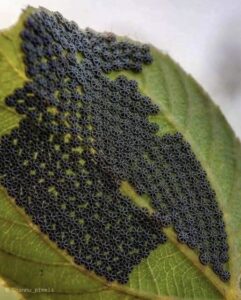
It started with a photo circulating online. A simple leaf—but covered in something I had never seen before.
Tiny, black, geometric shapes formed an intricate pattern across its surface. It looked unnatural, almost artificial. Like a delicate lattice or some kind of microscopic architecture.
My first thought?
“This can’t be good.”
It looked like a disease. Or an infestation. Or something entirely foreign. The kind of thing that makes you instinctively want to grab gloves, cut the leaf off, and throw it as far away as possible.
And I wasn’t alone. Many people who saw the image reacted the same way—confused, concerned, and a little disturbed.
But curiosity got the better of me.
Instead of panicking, I decided to dig deeper.
What Those Strange Shapes Really Are
After a bit of research, I discovered something surprising.
Those intricate black patterns weren’t damage. They weren’t disease.
They were eggs.
Specifically, the eggs of the Nymphalis antiopa—more commonly known as the Mourning Cloak butterfly.
And suddenly, what once looked alarming became something fascinating.
A Closer Look at These Unusual Eggs
Up close, these eggs are nothing short of remarkable.
They are laid in clusters, each one tiny and perfectly formed. Together, they create a pattern that resembles lace—delicate, detailed, and almost artistic.
At first glance, it’s easy to mistake them for something harmful. But once you understand what they are, it’s hard not to appreciate their beauty.
Nature has a way of surprising us like that.
What initially seems threatening often turns out to be part of a much larger, balanced system.
Meet the Mourning Cloak Butterfly
The Mourning Cloak butterfly is one of the most unique butterflies you might encounter in your garden.
Unlike the brightly colored species most people imagine, this butterfly has a darker, more subdued appearance. Its wings are deep brown—almost velvety—with a striking pale yellow border and small blue spots along the edges.
It’s elegant in a quiet, understated way.
But what makes it truly interesting isn’t just its appearance—it’s its behavior and lifecycle.
From Eggs to Caterpillars: The Transformation Begins
Once the eggs hatch, tiny caterpillars emerge.
They don’t look particularly friendly at first. In fact, they can appear a bit intimidating.
Black bodies, dotted with white spots, covered in small spines—it’s easy to assume they’re harmful.
And yes, like most caterpillars, they do eat leaves.
But here’s the important part: they’re selective.
These caterpillars typically prefer trees and shrubs such as willows, elms, and poplars. That means if your garden is filled with flowers or vegetables, they’re unlikely to cause significant damage.
In other words—they’re not the destructive force they might seem to be.
Understanding the Lifecycle of a Butterfly
Watching the full lifecycle of a butterfly is one of the most rewarding experiences a gardener can have.
After hatching, the caterpillars go through several growth stages, known as instars. During each stage, they shed their skin and grow larger.
Eventually, they prepare for one of nature’s most incredible transformations.
They form a chrysalis.
Inside this protective casing, everything changes.
Over time—sometimes weeks, sometimes months—the caterpillar undergoes metamorphosis, emerging as a fully formed butterfly.
It’s a process that never stops being fascinating, no matter how many times you see it.
A Butterfly That Defies the Seasons
One of the most remarkable traits of the Mourning Cloak butterfly is how it handles winter.
Unlike many other butterflies that migrate or perish when temperatures drop, this species hibernates.
Yes—hibernates.
It finds shelter in tree bark, woodpiles, sheds, or other protected spaces and remains dormant throughout the cold months.
Then, when spring arrives, it’s often one of the first butterflies you’ll see.
Even before flowers begin to bloom.
That early appearance is part of what gives the species its name. The dark wings against the still-bare landscape resemble mourning attire—hence “Mourning Cloak.”
Why These Butterflies Are Good for Your Garden
As gardeners, it’s easy to fall into a defensive mindset.
We see insects and immediately think: threat.
But not all insects are harmful.
In fact, many play important roles in maintaining a healthy ecosystem.
The Mourning Cloak butterfly is one of them.
While the caterpillars may consume some leaves, they rarely cause serious damage. And as adults, these butterflies contribute in subtle but valuable ways.
They often feed on rotting fruit, helping with decomposition and nutrient cycling.
This process enriches the soil and supports overall plant health.
So instead of being a problem, they’re actually part of the solution.
The Bigger Picture: Balance in Nature
Gardening isn’t about eliminating every insect or controlling every variable.
It’s about balance.
Every plant, insect, and organism plays a role. When that balance is disrupted—often by overuse of pesticides or unnecessary intervention—it can create more problems than it solves.
Learning to recognize which insects are beneficial and which are harmful is one of the most important skills a gardener can develop.
And sometimes, that means stepping back and observing before reacting.
What Should You Do If You Find These Eggs?
If you come across these unusual egg clusters on your plants, the best approach is simple:
Leave them alone.
Observe them. Watch what happens.
If you’re concerned about your plants, you can gently relocate the caterpillars to nearby trees or shrubs where they naturally prefer to feed.
But in most cases, there’s no need to intervene at all.
Instead, you get a front-row seat to one of nature’s most incredible transformations.
When Curiosity Replaces Fear
That moment of discovery—when something unfamiliar turns out to be harmless, even beneficial—is one of the most rewarding parts of gardening.
It reminds you that not everything needs to be controlled or fixed.
Sometimes, it just needs to be understood.
What once looked like a problem can become a source of wonder.
A Lesson Every Gardener Learns
Every season brings surprises.
Some are challenges—pests, weather, unexpected setbacks.
Others are opportunities—to learn, to grow, to see things differently.
This experience taught me something important:
Not everything that looks strange is dangerous.
And not every insect is an enemy.
The Joy of Letting Nature Do Its Work
There’s a certain peace that comes from trusting the natural process.
From allowing your garden to exist as part of a larger ecosystem rather than trying to control every detail.
When you embrace that mindset, gardening becomes more than just a task.
It becomes a relationship.
Between you, your plants, and the world around you.
Final Thoughts: Look Closer Before You React
The next time you see something unusual in your garden—something that makes you pause or even worry—take a moment.
Look closer.
Ask questions.
Because what you’re seeing might not be a threat at all.
It might be the beginning of something extraordinary.
From a cluster of tiny, intricate eggs to a butterfly emerging in early spring, the journey is one worth witnessing.
And in the end, that’s what gardening is really about.
Not just growing plants—but discovering the stories hidden within them.