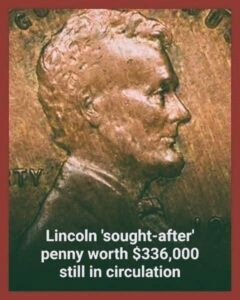
Most people toss coins into jars, leave them in car cup holders, or drop them absentmindedly on the sidewalk. A penny seems like nothing—just one cent. But every so often, a coin appears that is anything but ordinary. It’s a piece of history, a story in metal, and in some rare cases, a literal fortune. Among these, the 1943 Bronze Lincoln Cent stands apart—a coin so rare and valuable that one example recently sold for over $336,000. And it all started with a simple wartime mistake.
The Year of Change: 1943 and America at War
To understand why this penny matters, we need to go back to 1943. World War II was at its height, and copper—used in shell casings, wiring, and countless military essentials—was in high demand. The U.S. Mint suddenly faced a serious problem: pennies were made of copper. Every coin minted was using metal that could have gone to the war effort.
So, the Mint made a drastic decision: switch pennies from their traditional bronze composition to steel coated with zinc. These steel cents were lighter, gray in color, and prone to rust—but they solved a critical supply problem. Millions of Americans received steel pennies that looked and felt different, a small but tangible sign of the sacrifices of wartime life.
How a Simple Mistake Created a Legend
But in the midst of this transition, something extraordinary happened. During the equipment changeover in late 1942, a few bronze planchets—blank discs used to strike coins—were left in the coining presses. These were supposed to be removed and recycled, but a handful remained unnoticed.
When production began on the new 1943 steel pennies, these leftover bronze blanks were accidentally struck. The result? A tiny batch of 1943 pennies minted in bronze instead of steel—a coin that should never have existed.
When the first of these coins surfaced in 1947, collectors were stunned. Wartime minting was tightly controlled, and errors of this magnitude were extremely rare. Suddenly, ordinary Americans had a reason to check every coin they owned. Coin jars were emptied, piggy banks overturned, and collectors went hunting, hoping to stumble across a fortune hiding in plain sight.
Why the 1943 Bronze Penny Is So Valuable
There are a few reasons why this coin commands such high prices:
- Extreme Rarity – Experts estimate fewer than two dozen survive from all U.S. Mint facilities combined. That includes Philadelphia, Denver, and San Francisco mints. Some are in private collections, some in museums, and a handful may still be hiding in someone’s change jar.
- Historical Significance – This isn’t just a misprinted coin; it’s a snapshot of America during a world war. It tells a story of resource scarcity, government intervention, and the tension of a country fighting for survival.
- Condition Matters – Coins that are preserved in near-perfect condition sell for six figures, sometimes even surpassing $1 million. Worn examples are valuable too, but condition plays a huge role in pricing.
Each coin is a tangible piece of a pivotal moment in history—a reminder that even the smallest object can hold enormous significance.
A Coin That Tells a Story
There’s something poetic about the 1943 Bronze Lincoln Cent. On one hand, it’s ordinary—just a small copper penny with Lincoln’s familiar profile. On the other, it’s extraordinary. While the steel pennies of 1943 represented the practical demands of war, the bronze penny is a survivor, a ghost from a year when it shouldn’t have existed.
Collectors describe it as a collision of chance and history. It embodies the chaos of wartime production and the meticulous planning that almost erased its existence. It’s not flashy; it’s humble and familiar—but that’s part of its charm. It’s a reminder that sometimes, rarity is hidden in plain sight.
Stories of Discovery
Over the decades, a handful of these coins have emerged in the hands of ordinary people. One collector reportedly found a bronze 1943 penny tucked in a jar of coins he had inherited from his grandfather. Another surfaced at a flea market, mistaken for a common cent until a trained eye spotted the unusual bronze color.
Each discovery is a story of serendipity—a reminder that fortune can appear in unexpected places. For coin enthusiasts, it’s the thrill of the hunt. For casual Americans, it’s a glimpse into a piece of history they can actually touch.
How to Spot One
If you think you might have a 1943 Bronze Lincoln Cent, there are a few tips:
- Look at the Color – Steel cents are gray; the bronze penny is copper-colored.
- Magnet Test – Steel pennies are magnetic; bronze pennies are not.
- Mint Marks – Check for subtle details in minting. A true bronze cent will have the same details as a regular Lincoln penny but in a completely different metal.
Even if you’re not a coin collector, a careful glance at your spare change might be worth the effort. The right penny could be hiding in a jar, in a pocket, or at the bottom of a drawer.
Why Collectors Are Obsessed
For coin collectors, the 1943 Bronze Lincoln Cent is more than an object; it’s a story, a puzzle, and a connection to history. It combines rarity, beauty, and context. Each coin reflects the decisions, pressures, and oversights of the U.S. Mint during a tumultuous year. Owning one is like holding a small piece of the 1940s in your hand—a tangible connection to the challenges and ingenuity of an earlier America.
The Legacy of the 1943 Bronze Penny
Even eight decades later, the legend of the bronze 1943 penny continues. It reminds us that history is not confined to books or museums; it can appear in our daily lives, often disguised as something ordinary. A coin tossed into a jar could be worth a fortune, yes—but more importantly, it’s a story waiting to be told.
This tiny penny is proof that even small mistakes can leave a mark that endures for generations. It connects ordinary Americans with the extraordinary circumstances of history. It bridges the gap between everyday life and monumental events.
What to Do Next
The next time you empty your change jar or fish for coins in your pocket, give each penny a second glance. Most will still be ordinary cents, of course. But in the rarest cases, you might just be holding a tiny piece of history—a 1943 Bronze Lincoln Cent, a coin that survived when it shouldn’t have, and a coin that could change your life.
Even if you don’t find one, the story is a reminder of curiosity and attention to detail. It’s a lesson in how the smallest things—an overlooked planchet, a stray penny—can become extraordinary. And for collectors, it’s a testament to the magic of chance, the allure of rarity, and the power of history hidden in plain sight.
So check your change. That simple penny jingling in your pocket might just be more than you ever imagined.