Sometimes, you come across an item that really confounds you. You have to scratch your head and turn to others (sometimes the internet) to figure out what it can be.
This item might also confuse you, but if you do not know what it is and you want to learn more about it, then you are in the right place.
Keep reading to learn more about the unsung hero of the construction world!
The nail punch is a modest tool with origins dating back to ancient civilizations, where building and crafting required innovative ways to manage nails. In its early iterations, craftsmen used rudimentary tools like chisels or hardened stones to drive nails below the surface of wood, achieving a smooth finish essential for decorative or functional purposes.
According to sources, “it is actually believed that these tools might be the first tools our prehistoric ancestors used to carve in wood and stone and create pieces of clothing. Although very simple in their constructions, these tools are highly versatile, which makes them indispensable in any tool collection.”
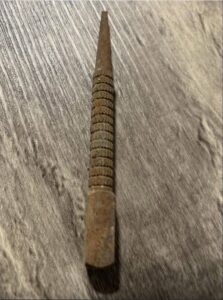
Also known as a nail set, a nail punch is a small, handheld tool designed to drive nails slightly below the surface of a material, typically wood.
The tool – commonly used for a smooth, finished appearance – features a pointed tip that aligns with the nail head and a blunt end, which is struck with a hammer to push the nail head beneath the surface.
Next, “the small depression remaining is filled in with putty,” according to Britannica.
Sinking nails
The Industrial Revolution brought a wave of innovation to tools and machinery, and the nail punch was no exception. Factories began mass-producing nails, and with them came the necessity for consistent tools that could cater to varying nail sizes and woodworking needs.
Over the years, the simple punch evolved and became a go-to item in every toolbox, allowing carpenters to sink nails below the wood surface with precision. Covering these nail heads with filler not only enhanced the visual appeal but also increased the longevity of the structure by preventing rust and wear.
Modern-day nail punches
Fast forward to the 21st century, the nail punch tool has undergone substantial evolution, embracing modern materials and ergonomic designs. Today, you can find nail punches made from high-carbon steel or titanium, often featuring cushioned grips for comfort during prolonged use.
Key features
- Material: Usually made from durable metals like steel or titanium to withstand repeated hammering.
- Design: Often cylindrical, with a tapered tip that matches the size of the nail head for precise placement.
- Sizes: Available in various sizes to accommodate different nail diameters.
Uses
- Aesthetic finishing: It allows nails to be recessed below the surface, enabling wood filler to be applied over the nail for a seamless look.
- Prevention of damage: Keeps the hammer from denting or scratching the wood surface during nail placement.
- Improved durability: By sinking nails, it protects them from exposure to elements that could lead to rust or wear.
A tool for everyone
Modern nail punches come in sets catering to a wide range of nail diameters. Some even include laser etching for size identification, making them ideal for both hobbyists and seasoned carpenters. Technological advancements have introduced automatic or spring-loaded versions, reducing the physical effort required to sink nails into hard surfaces.
Why it still matters
In an age dominated by power tools, one might wonder if a manual tool like the nail punch still has a place. The answer is a resounding yes!
Its simplicity, reliability, and affordability make it indispensable for tasks requiring precision, such as trim work, cabinetry, and restoration projects.
Whether you’re crafting a delicate jewelry box or building a deck, the nail punch ensures a clean, professional finish. It’s also a favorite among restorers who value traditional methods over contemporary alternatives.
The nail set may not boast the glamour of high-tech gadgets, but its evolution from a simple tool to a sophisticated instrument underscores its importance in construction and woodworking.