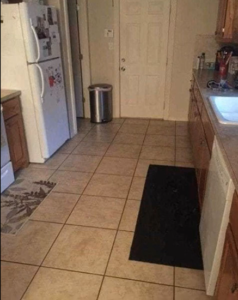
At first glance, this cozy kitchen seems perfectly ordinary, the kind of space anyone might expect in a suburban home. Clean countertops, neatly organized cabinets, and warm, ambient lighting create a welcoming, comfortable atmosphere.
However, a closer look reveals a delightful surprise: a large black Labrador lying within the kitchen. His coat blends almost seamlessly with the shadows and dark flooring, creating an optical illusion that has fascinated viewers worldwide.
The photograph was first shared by Christina Suvo and later circulated by 7 News Perth, quickly capturing attention across social media platforms. It went viral not for dramatic action but for a subtle, captivating visual trick.
Unlike most optical illusions, this one relies on natural camouflage. The Labrador isn’t hiding behind furniture or sneaking into a small corner; he is in plain view, yet his jet-black fur merges with the surrounding environment effortlessly.
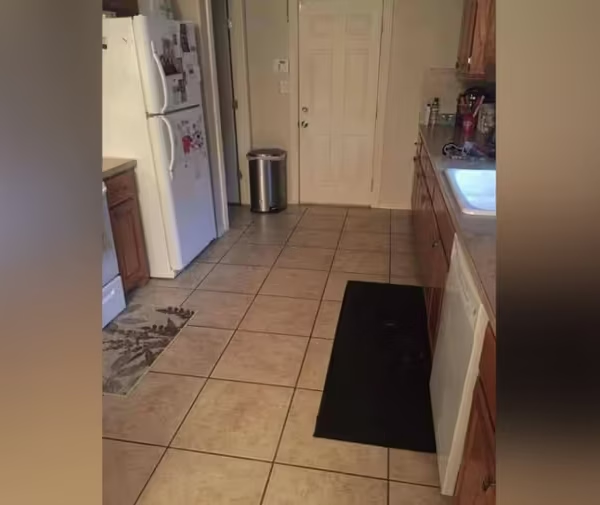
The interplay of lighting, shadows, and color contrast creates a scenario where the dog seems to vanish entirely. Viewers often overlook him on first glance because the mind assumes kitchens rarely conceal large animals in open spaces.
This illusion highlights how human perception operates. Our brains prioritize expected objects and shapes, filtering out anything that seems unusual. Since a Labrador blending into a kitchen is unexpected, our eyes easily pass over him without registering.
Subtle visual cues, such as faint highlights on the dog’s eyes or a lighter patch of fur on his belly, are the only indicators of his presence. Without these, even careful observers may initially miss the hidden canine.
People looking at the image report differing experiences. Some spot the dog almost immediately, while others require careful scanning of the floor, shadows, and corners, sometimes needing hints before realizing he is lying openly.
Dividing the image into sections proves effective. Observers often recommend scanning each area slowly, focusing on unusual shapes, slight reflections, or irregular textures that break the uniformity of the dark floor and cabinetry.
Once the dog is identified, however, the illusion collapses. The Labrador becomes unmistakable, and viewers often feel a mix of surprise and amusement at how completely he blended into the environment.
Psychologically, this image demonstrates selective attention. Our brains focus on likely objects, filtering out unexpected ones. This makes us prone to missing items even when they are clearly visible but contextually improbable.
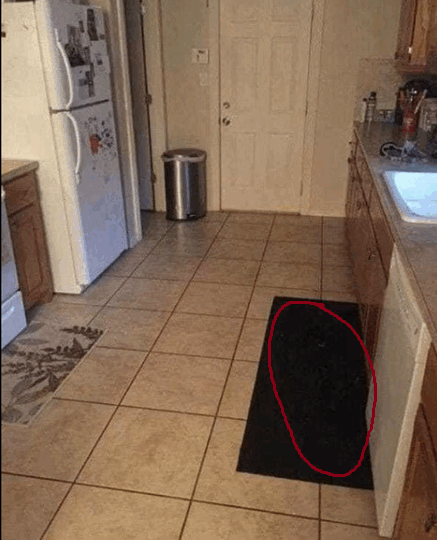
The photograph exemplifies a subtle type of hidden-object puzzle. Unlike intentionally deceptive images, it relies on natural camouflage and our perceptual biases, offering a playful challenge to the viewer’s observational skills and attention to detail.
Lighting plays a critical role. Soft, ambient illumination and the absence of harsh contrast allow the Labrador’s coat to merge smoothly with the shadows, while gentle highlights reveal just enough for determined viewers to notice.
This effect shows how context affects perception. In a living room, forest, or garden, a black Labrador might be instantly obvious, but in a kitchen setting, the unexpected location tricks our eyes and minds, creating a small yet powerful illusion.
Observers often describe a “click” moment when the dog becomes visible. This sudden recognition produces satisfaction and amusement, demonstrating the human brain’s capacity for pattern recognition and the joy of solving subtle visual puzzles.
The image’s popularity also highlights social media’s role in spreading engaging content. Its virality stems not from controversy but from a universal human fascination with perception, curiosity, and the surprising ways familiar environments can deceive us.
Some viewers attempt to explain the phenomenon through basic visual science. They note how the eyes detect contrast, edges, and movement more readily than uniform dark shapes, explaining why the Labrador is easy to overlook at first glance.
Interestingly, even experienced observers can be fooled multiple times. Because the dog occupies open space and isn’t partially obscured, the mind repeatedly fails to anticipate him, demonstrating the limits of visual expectation and attentional focus.
This kind of optical illusion encourages mindfulness. By slowing down and examining details carefully, viewers learn to notice subtleties in everyday life, reinforcing observation skills that extend beyond puzzles into real-world perception.
Families, pet owners, and dog enthusiasts especially appreciate the image for its charm. The Labrador’s calm demeanor and seamless blending remind viewers of how familiar animals can both comfort and surprise within domestic spaces.
For educators, the photo serves as a teaching tool. It demonstrates visual perception, selective attention, and the brain’s filtering mechanisms, illustrating concepts from psychology in a tangible, relatable, and enjoyable way.
The Labrador’s placement also emphasizes spatial reasoning. His positioning in the kitchen is carefully aligned with shadows and floor patterns, showing how environment and animal positioning interact to enhance the camouflaging effect.
Viewers quickly notice that the illusion is not forced. Unlike staged puzzles, the dog’s natural pose and relaxed body language make the scene feel genuine, enhancing its appeal and the sense of shared discovery among observers.
Comments on social media reflect delight and frustration in equal measure. Many describe initial failure to spot the dog, followed by a mixture of amusement and admiration when realizing how well he disappears against the kitchen floor.
Some people take a few minutes or more to locate him. The process becomes a mini-challenge, demonstrating patience, focus, and the way humans are wired to detect anomalies in familiar environments when prompted.
The image also demonstrates the importance of contrast. Without sufficient lighting or slight tonal differences in the floor and shadows, the dog might appear completely invisible, illustrating how small environmental factors shape perception.
Interestingly, optical illusions like this one remind us that even ordinary settings can contain surprises. Kitchens, living rooms, and bedrooms can host unexpected phenomena that challenge assumptions and teach careful observation.
The photograph encourages slowing down in a fast-paced digital world. In a society dominated by quick scrolling and fleeting images, it invites viewers to pause, examine details, and enjoy subtle moments of wonder and discovery.
It also underscores the relationship between expectation and perception. Our eyes often overlook what doesn’t fit preconceptions, showing that noticing the unexpected requires intentional observation and openness to surprise.
Many viewers report a sense of satisfaction after spotting the Labrador. This “aha” moment creates positive engagement, reinforces attention skills, and leaves a memorable impression, proving the appeal of simple yet clever visual tricks.
Beyond entertainment, the image provides insight into cognitive processes. It demonstrates how brains prioritize information, filter visual input, and sometimes miss clear evidence when it doesn’t align with anticipated patterns.
The photograph also highlights the role of storytelling in visuals. Even without text, viewers narrate a scenario: a calm dog, a cozy kitchen, and a playful mystery, blending visual art with subtle narrative that engages imagination.
Pet photographers and artists have praised the photo for its composition. The balance of lighting, shadows, and furniture placement creates the illusion naturally, showing how environment, color, and positioning interact to influence perception.
Interestingly, this illusion illustrates a broader truth about observation: humans often see what they expect rather than what is present, highlighting cognitive biases that affect daily life, decision-making, and interpretation of visual information.
Families with pets relate to the Labrador’s behavior. Dogs often blend into surroundings by lying in shaded areas or dark corners, demonstrating natural camouflage and animal behavior that people might overlook, making the image relatable and endearing.
The image also inspires repeated engagement. Many viewers return to it multiple times, sharing it with friends or attempting to spot the dog again, demonstrating social and cognitive appeal that encourages collaborative observation and discussion.
Importantly, the illusion is completely harmless yet educational. Unlike puzzles that rely on frustration or misleading cues, this photograph combines delight with genuine learning, teaching viewers about light, shadow, color, and human perception.
The Labrador’s subtle camouflage encourages mindfulness beyond the image. It reminds us to observe carefully, notice details, and recognize beauty and surprise in ordinary environments, cultivating curiosity and attentiveness in everyday life.
Even seasoned observers experience renewed surprise when re-examining the image. This suggests that perception is dynamic, context-dependent, and influenced by both attention and expectation, making the photograph a versatile example of cognitive phenomena.
Ultimately, the image of the hidden Labrador transforms an ordinary kitchen into a playful puzzle, delighting viewers while revealing fascinating truths about attention, perception, and the subtle ways our brains process visual information.
Whether spotted immediately or after careful scrutiny, the Labrador leaves a lasting impression. The illusion encourages reflection, slow observation, and appreciation for details we might otherwise overlook in daily life.
In a broader sense, the photograph exemplifies how simple visuals can captivate audiences globally. The combination of charm, subtlety, and cognitive engagement makes it a memorable and shareable example of perceptual wonder.
Even long after first seeing it, viewers remember the Labrador, often recalling the search process with amusement. This longevity demonstrates the effectiveness of subtle, engaging optical illusions in capturing attention and curiosity.