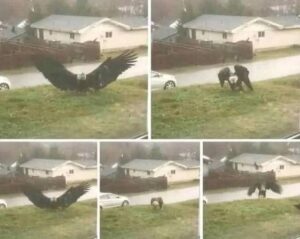
In late December, reports from the southern tip of Texas began circulating among wildlife observers, hikers, and local residents. The region near the Rio Grande River, close to the city of Brownsville, is well known for its rich biodiversity. Birdwatchers from across the country travel there to catch glimpses of rare species, migratory birds, and unique ecosystems that thrive in the borderland environment. Yet even in a place famous for unusual wildlife encounters, the story that began to unfold surprised nearly everyone who heard it.
Several independent witnesses described seeing what appeared to be an exceptionally large bird of prey flying above the landscape. The reports were consistent enough to draw the attention of wildlife officials and ornithologists who study birds professionally. People described a raptor with a wingspan that seemed far larger than those of species typically found in the region. Some observers said the bird glided high above fields and waterways, while others reported seeing it perched in distant trees.
Although unusual wildlife sightings are not uncommon in areas with rich ecosystems, the size described by witnesses immediately sparked curiosity. Experienced birdwatchers noted that even the largest birds normally found in the region rarely reach the dimensions that people were describing. Because of this, the reports quickly moved beyond casual conversation and into the realm of scientific inquiry.
Researchers did not jump to conclusions. Instead, they approached the situation carefully, following standard wildlife investigation practices. Their goal was not to prove extraordinary claims but to gather reliable evidence and determine whether the sightings could be explained through known species, natural variation, or simple misidentification.
The story that followed became a fascinating example of how science handles unusual observations in the natural world.
The Unique Landscape of South Texas
To understand why this sighting generated so much attention, it helps to look at the environment where it occurred. The lower Rio Grande Valley is widely considered one of the most ecologically diverse regions in North America. The area contains wetlands, river systems, coastal plains, farmland, and patches of protected wilderness that support a remarkable variety of plant and animal life.
Birdwatchers often visit wildlife refuges in the region because many species appear there that cannot easily be found elsewhere in the United States. The proximity to Mexico also means that some birds typically associated with tropical climates occasionally cross into the area.
Because of this rich biodiversity, researchers are accustomed to surprising discoveries. New bird records are added to local checklists regularly, and migrating species sometimes appear far outside their normal ranges. Still, even seasoned observers were intrigued by the descriptions of a bird whose wingspan seemed unusually large.
Many of the reports came from people who spend significant time outdoors. Some were hikers exploring nature trails, while others were residents familiar with the birds that typically fly over local farmland. Their accounts described a bird that appeared larger than familiar raptors such as the Bald Eagle or the California Condor.
Those species are already among the largest birds commonly discussed in North America, so hearing descriptions that suggested something even bigger naturally attracted attention.
Early Witness Accounts
The first reports were shared informally through local nature groups and community discussions. Witnesses described seeing a bird soaring high above fields or near the river corridor. A few individuals said the bird appeared to glide effortlessly with wings stretched wide, casting a noticeable shadow below.
Others described the bird perched on distant trees or structures, where its silhouette seemed unusually large compared with nearby birds. While most observers could not provide exact measurements, they repeatedly emphasized the bird’s impressive wingspan.
What made the reports noteworthy was their consistency. Although the sightings occurred on different days and at different locations around the region, the descriptions shared several similarities.
People mentioned:
-
A large bird of prey silhouette
-
Long wings suited for soaring flight
-
Slow, powerful wingbeats when it moved
-
A wingspan that appeared larger than familiar raptors
None of the witnesses claimed to know exactly what species the bird might be. Instead, they simply reported what they had seen.
In wildlife research, such reports are treated as preliminary observations. Scientists recognize that human perception can sometimes be misleading, especially when estimating size or distance in the sky. For that reason, early accounts are used primarily as a starting point for further investigation rather than as definitive evidence.
Scientists Begin a Careful Investigation
When wildlife officials became aware of the repeated sightings, they decided to take a closer look. Rather than treating the reports as speculation, they approached the situation through structured observation.
Researchers began collaborating with ornithologists—scientists who specialize in the study of birds. Together, they designed a monitoring effort aimed at collecting reliable visual data.
The team focused on areas where sightings had occurred most frequently. Because the region contains large stretches of open land and natural corridors along the river, they selected locations where cameras and observation equipment could be installed without disturbing wildlife.
Their goal was simple: document whatever bird was being seen.
Importantly, they chose noninvasive methods. This meant using tools that would allow them to observe wildlife without capturing, chasing, or interfering with animals in the area.
Some of the equipment used included:
-
Motion-activated trail cameras
-
Thermal imaging devices for nighttime detection
-
Long-range telescopes and binoculars
-
High-resolution photography equipment
These tools are commonly used in wildlife studies because they allow researchers to monitor animals that are difficult to approach.
Gathering Visual Evidence
Over several weeks, cameras and observation teams quietly monitored areas where the bird had reportedly appeared. The equipment was placed along riverbanks, near open farmland, and along tree lines where large birds might perch.
Patience is a central part of wildlife research. Animals do not appear on command, and researchers often spend long periods waiting for rare moments of activity.
Eventually, some footage captured by the monitoring equipment showed a large raptor flying across the landscape. The images were not perfect—distant wildlife photography rarely is—but they provided enough detail to confirm that the bird was indeed sizable.
Researchers reviewing the footage noted that the bird appeared larger than many raptors typically observed in the area. However, determining the exact species based on distant images proved difficult.
For this reason, scientists avoided making immediate claims about what the bird might be.
Instead, they labeled the subject simply as an “unidentified large raptor.”
This term reflects a standard scientific approach: describe what can be observed without assuming conclusions that have not yet been verified.
Possible Explanations Considered by Experts
Once the images were reviewed, scientists began discussing several possible explanations for the sightings. In scientific research, unusual observations are usually explored through a range of hypotheses before any final interpretation is reached.
Some of the most common explanations considered included:
1. Misidentification
Birds can appear much larger or smaller depending on lighting, distance, and viewing angle. For example, a familiar species flying closer to the observer than expected might appear enormous compared with birds farther away.
Large raptors soaring high in the sky can also be difficult to identify clearly. Their silhouettes sometimes resemble other species when seen at a distance.
Because of this, misidentification is often the first possibility researchers consider.
2. Natural Size Variation
Even within the same species, individual animals can vary significantly in size. Some birds grow larger than average due to genetics, diet, or environmental conditions.
It is entirely possible for a particularly large individual of a known species to create the impression that observers are seeing something unfamiliar.
3. A Rare Visitor
Bird migration can occasionally bring unusual species far outside their typical ranges. Strong winds, storms, or navigational errors may cause birds to appear in unexpected regions.
South Texas is already known for attracting rare migratory species, making this explanation another possibility.
4. Perspective and Environmental Factors
Environmental features such as open plains and reflective water surfaces can sometimes distort how large animals appear in the sky. Shadows, distance, and atmospheric conditions can all influence perception.
Because humans are not naturally skilled at estimating wingspans from a distance, these factors are always considered in wildlife investigations.
Why Scientists Avoid Sensational Claims
Whenever an unusual wildlife story captures public attention, it can quickly become exaggerated through speculation or rumor. Scientists work hard to prevent this by focusing strictly on verifiable evidence.
In this case, researchers emphasized that the available footage did not prove the existence of a previously unknown species. Instead, it confirmed that a large bird of prey had been observed and recorded.
This distinction is important because science relies on careful documentation and repeatable observations. Extraordinary claims require extensive proof, and responsible researchers avoid jumping to conclusions.
By describing the bird simply as an “unidentified large raptor,” scientists maintained accuracy while leaving room for further investigation.
The Role of Technology in Wildlife Discovery
The monitoring effort in South Texas also highlighted how modern technology has transformed wildlife research.
Tools such as motion-activated cameras allow scientists to observe animals that might otherwise remain unseen. Thermal imaging can detect creatures in low-light conditions, and high-resolution photography makes it possible to analyze details that once would have been impossible to capture.
These technologies have led to many important discoveries over the past few decades, including the documentation of rare species and new insights into animal behavior.
However, technology also reinforces the need for careful interpretation. Images must be analyzed critically, and researchers often compare them with known species to determine what they show.
Public Interest and Responsible Curiosity
News of the large bird sighting quickly spread beyond local communities. Nature enthusiasts and birdwatchers began discussing the reports, eager to learn more about what researchers might discover.
Wildlife officials encouraged people to remain curious while also respecting the scientific process. They reminded the public that wildlife studies can take time, and definitive answers often require months or even years of careful observation.
Officials also advised people not to disturb natural habitats while searching for the bird. Responsible wildlife observation involves maintaining distance, protecting ecosystems, and avoiding actions that might stress animals.
Why Regions Like the Rio Grande Valley Are Important
The investigation also highlighted the ecological importance of the lower Rio Grande Valley. This region supports an incredible range of species due to its diverse habitats and geographic location.
Conservation groups have long worked to protect wildlife corridors in the area so that animals can move safely between habitats. These efforts benefit birds, mammals, reptiles, and countless other organisms that depend on healthy ecosystems.
Even if the mysterious raptor eventually turns out to be a known species, the story still serves as a reminder of how vibrant and complex these natural environments are.
Lessons from the Investigation
The reports of a large raptor in South Texas illustrate several important principles about scientific research.
First, unusual observations should be documented rather than dismissed. Many discoveries in natural history began with simple sightings that encouraged further study.
Second, careful investigation is essential. Scientists rely on structured observation, reliable equipment, and multiple lines of evidence before drawing conclusions.
Third, uncertainty is a normal part of discovery. The natural world still holds many surprises, and researchers must remain open to possibilities while maintaining scientific discipline.
Continuing the Search for Answers
As monitoring efforts continue, researchers hope to capture clearer images of the bird. Additional sightings or photographic evidence could help determine whether the raptor belongs to a known species or represents an unusually large individual.
In wildlife research, patience is often the most important tool. Some animals are rarely seen, and confirming their identity may require years of observation.
Until more evidence emerges, scientists will continue studying the data they have collected while encouraging responsible wildlife observation in the region.
A Reminder of Nature’s Mystery
Stories like this capture the imagination because they remind us that nature still holds mysteries. Even in areas that have been studied for decades, unexpected sightings can spark new questions and renewed interest in the natural world.
Whether the bird eventually proves to be a rare visitor, an unusually large individual, or simply a case of mistaken identity, the investigation itself highlights the importance of curiosity, research, and respect for wildlife.
For residents and visitors near Brownsville, the story has already added a new layer of fascination to the skies above the Rio Grande Valley. And for scientists, it serves as another reminder that discovery often begins with something as simple as someone looking up and noticing something unusual.
In the end, the most valuable outcome may not be identifying a mysterious bird, but encouraging people to pay closer attention to the world around them—because the natural environment still has many stories waiting to be discovered.