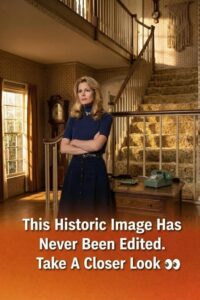
Some stars become popular for a season, but a rare few leave behind something deeper—an image that feels familiar no matter how many years pass. That’s exactly what happened with Elizabeth Montgomery, the actress forever linked to Samantha Stephens from Bewitched. Even today, people who stumble across a rerun often pause longer than they expected, drawn in by something that’s hard to explain at first. It isn’t just the show’s light fantasy or its nostalgic charm—it’s the way Montgomery made every scene feel warm, natural, and quietly powerful, as if there was a real person behind the magic. And the more you look closely, the more you realize her greatest strength wasn’t special effects at all…it was sincerity.
Born in Los Angeles in 1933, Montgomery grew up around the entertainment world, but she didn’t coast on it. Her father, Robert Montgomery, was already respected in Hollywood, yet she worked to build her own name through skill and discipline. She studied acting in New York, where she developed the kind of technical foundation that helps performers create depth—not just appearances. During the 1950s, she became known for strong work in television dramas and anthology programs, playing emotionally complex women with a realism that stood out in that era. Even early on, it was clear she wasn’t chasing easy roles—she was shaping a career with purpose.
Everything changed when she was cast as Samantha Stephens in Bewitched, which premiered in 1964. The concept was playful: a woman with extraordinary abilities trying to live an ordinary suburban life. But Montgomery didn’t treat Samantha like a one-note character. She gave her warmth, intelligence, and a calm kind of independence that made audiences connect instantly. Samantha wasn’t simply “magical”—she was relatable, balancing love, identity, and the pressure to fit expectations. That combination helped the series run for eight seasons, and it’s one of the reasons Montgomery’s performance still feels fresh decades later.
After Bewitched ended, Montgomery refused to stay trapped in one image. She moved into more serious made-for-TV films, proving how wide her range truly was. Projects like A Case of Rape and The Legend of Lizzie Borden showed her willingness to take on challenging stories with emotional bravery and control. Off-screen, she also became associated with humanitarian efforts, supporting causes that mattered to her beyond the spotlight. When she passed away in 1995, she left behind more than a famous role—she left a legacy of careful choices, strong performances, and a quiet authenticity that still shines through whenever viewers return to her work.