Inside the dimly lit motel room, the young girl sat cross-legged on the bed, her small frame dwarfed by the heavy quilt draped over her knees. A soft, pink glow emanated from a nightlight shaped like a unicorn.
Its horn casting delicate shadows that danced along the walls. The faint scent of lavender and old carpet filled the room, mingling with the sterile tang of paper and pencil shavings.
Her eyes, wide and unblinking, were fixed on a notebook in her lap. She wrote continuously, almost obsessively, the tip of her pencil scratching the paper with a mechanical precision that seemed unnatural for someone her age.
Her movements were methodical, robotic, almost rehearsed, as if she were performing under strict, invisible supervision.
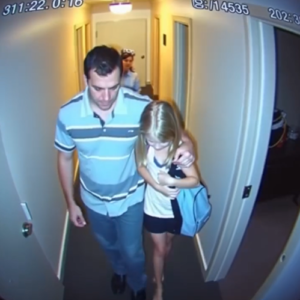
Across the room, Daniel Harper—if that was indeed his real name—stood with a rigid posture, his figure looming like a dark specter in the corner.

There was an unsettling coldness in his gaze, a meticulous scrutiny that left no detail unnoticed. Gone was the warm, suburban fatherly demeanor he had presented in public. Instead, his eyes flickered with an intensity that was almost predatory, calculating, and demanding.
Angela’s heart hammered in her chest as she tried to comprehend the scene before her. Every instinct screamed that something was wrong, but her mind raced to understand what she was witnessing.
Was this simply an overbearing tutor pushing a gifted child, or something far more sinister?
The walls of the room told a story all their own. Large sheets of paper were taped from floor to ceiling, each densely packed with symbols, strange mathematical equations, and diagrams far beyond what an eleven-year-old should reasonably understand.
Angular scribbles and carefully measured geometric shapes seemed to encroach on every inch of available space. Angela’s pulse quickened.
This was no ordinary homework session. Something about the precision and repetition felt unnatural, almost coercive.
Daniel moved closer to the girl, his movement smooth but deliberate, like a predator circling its prey. He leaned over her shoulder, pointing at the notebook with a finger that was firm, almost menacing in its subtlety.
His voice, muffled slightly by the thin window glass through which Angela observed, carried a tone laced with impatience and quiet threat. Each syllable was precise, yet heavy with an authority that went beyond instruction.
Angela’s stomach churned as she watched the girl’s fingers tremble, her pencil slipping slightly from her grasp. Without hesitation, Daniel’s hand guided the pencil back into her grip, his touch firm, almost correcting, leaving no room for error.
Angela felt a wave of nausea mixed with fear. Every fiber of her being wanted to act, to rush in and pull the girl out of the situation, but the uncertainty gnawed at her.

Could she be misinterpreting what she saw? Perhaps Daniel was just a strict teacher, a controlling parent, or a tutor with unconventional methods. The possibility of making a grave mistake held her in place, frozen as her mind spun through every scenario.
Then, it happened. The girl’s head lifted slowly, her gaze meeting Angela’s through the narrow sliver of window between the curtains.
The instant was fleeting, barely a heartbeat, yet it carried a weight that made Angela’s blood run cold. In the girl’s wide, terrified eyes, there was a silent plea, unmistakable and desperate.
A wordless cry for help, for rescue, for someone to see her suffering and act. In that moment, all doubt vanished. Angela knew she could not wait any longer.
She stepped back, her breath shallow and rapid. Her mind raced through the next steps with a sharp, instinctive clarity. She needed help, and she needed it fast.
Turning from the window, she retraced her steps down the narrow motel hallway, her heels clicking softly against the worn linoleum floor. Reaching the office, she drew in a deep breath, steadying her voice, and dialed 911.
“Hello,” she said, her voice shaking slightly but with a growing steeliness. “I need to report a child in danger at the Blue Haven Motel, Room 112.”
She paused to give the operator the address and floor, then described everything she had witnessed: the girl’s mechanical, repetitive movements, the strange and complicated papers on the walls, and the man standing over her, exhibiting behavior that was threatening and controlling.
Angela’s words were precise, every detail important, her mind refusing to leave anything out.
Once the call was complete, Angela’s instincts propelled her to the next step. She contacted the motel manager, a middle-aged man with a kind demeanor who had always trusted her judgment.
“Please, lock Room 112 from the outside,” she urged. “Do not let anyone enter until the authorities arrive. There is a child in danger.” The manager hesitated for only a moment, then agreed. He had seen Angela’s instincts in action before and knew she was rarely wrong.
Outside, the winter air bit at Angela’s cheeks as she watched the motel parking lot. Each passing second seemed to stretch into eternity.
Then, in the distance, the first flashing blue and red lights of a police vehicle appeared, reflecting off the wet asphalt. Angela’s heart ached with worry for the girl, and she whispered a silent prayer for her safety.
Minutes later, a team of officers approached Room 112 with measured, professional urgency. Angela remained back, keeping herself in the shadows as the authorities assessed the situation.
The officers spoke briefly, their voices low and serious, and a moment later, the door opened. Through the small gaps in the curtains, she saw them gently guide the girl away from the room, their hands protective and assuring. Relief washed over Angela, mingled with lingering fear and sorrow for the ordeal the child had endured.
In the aftermath, Angela stood outside the motel, her body trembling with adrenaline and the weight of the emotions she had held at bay.
She replayed every detail in her mind, ensuring she remembered exactly what she had seen: the girl’s trembling hands, the sheets covered in equations and symbols, the cold, controlling posture of Daniel Harper. Every image was seared into her memory, a record of the danger narrowly averted.
As the girl was taken to safety by social services, Angela reflected on the extraordinary complexity of the situation. What had initially appeared to be a simple act of observation had escalated into a critical intervention.
Her instincts, honed by years of experience and acute attention to detail, had made the difference. It was not luck that allowed her to act in time — it was the careful attention to subtle cues: the trembling pencil, the vacant yet precise movements, and the silent plea in the girl’s eyes.
Hours later, after the police had completed their report and the girl was in protective care, Angela returned to her own room, exhausted but resolute.
She could not shake the memory of the child’s expression, the way her wide, pleading eyes had reached across the distance, cutting through the uncertainty and fear.
It was a look that would remain with her forever, a reminder of why vigilance and courage are indispensable when it comes to protecting the most vulnerable.
That night, as she lay in bed, Angela replayed the events again, from the moment she first glimpsed the strange movements in the room to the arrival of the police.
Every detail was vivid: the cold gaze of Daniel Harper, the mechanical repetition of the girl’s actions, the overwhelming sense of control and intimidation that had pervaded the room.
Even though the immediate danger had passed, the memory of that oppressive atmosphere lingered, a haunting testament to the fragility of childhood in the wrong hands.
Angela also reflected on the broader implications of what she had witnessed. How many other children might be subjected to similar control, fear, or abuse, hidden behind closed doors, behind façades of normalcy?
She understood that vigilance is not only a moral obligation but a societal necessity. She vowed to remain alert, aware, and willing to act, knowing that even one small observation, one moment of courage, can change the course of a young life forever.
The motel, now quiet under the night sky, seemed almost peaceful in contrast to the tension that had unfolded hours earlier. The neon sign flickered gently, casting a dim glow over the parking lot, as if unaware of the ordeal that had taken place within its walls.
Angela stayed outside for a while, letting the cool night air calm her racing heart. She thought about the child’s future, the support systems she would need, and the professionals who would guide her through the recovery process.
Every thought reinforced her sense of duty, her belief that action, no matter how frightening, is always the right choice when a child’s safety is at stake.
By the time she finally returned to her own room, Angela felt a quiet sense of closure mixed with lingering concern.
The girl was safe, the authorities were involved, and she had done everything in her power to protect a life that had been at risk. Yet the memory of Daniel Harper’s cold, controlling gaze remained vivid, a chilling reminder of the dangers that sometimes hide behind familiar faces.
Angela lay awake long into the night, reflecting on courage, fear, and the invisible threads that connect observers to those in need.
She thought about the signs she had noticed — subtle, almost imperceptible — and how each had guided her to act decisively. She realized that her attention to detail, combined with instinct and empathy, had been crucial in averting a potential tragedy.
It was a lesson she would carry forward, a testament to the power of awareness and the importance of trusting one’s instincts in the face of uncertainty.
The young girl, meanwhile, was in safe hands. Social services and law enforcement would ensure she received the care, protection, and support she needed to begin healing.
The ordeal had been traumatic, but with intervention and attention, there was hope for recovery, for learning, and for reclaiming a sense of safety that had been stolen.
Angela’s experience that night would remain etched in her memory, not just as a story of danger and rescue, but as a profound reminder of the responsibility we all bear to the most vulnerable among us.
She had faced uncertainty, fear, and the paralysis of doubt — yet she had acted. And in doing so, she had changed the trajectory of a young life.