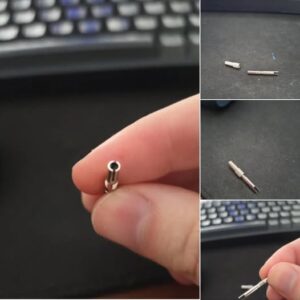
A parent recently opened an old drawer and discovered a tiny silver object with two delicate prongs. At first glance, it looked like it might belong to a bicycle repair kit or an electronic device. The shape was unfamiliar enough to spark curiosity, yet small enough to be overlooked for years. After a bit of investigation, the mystery was solved: it was a compass lead holder, a forgotten piece from a classic geometry set. Instantly, the little item became more than metal and screws—it turned into a quiet reminder of school days, sharpened pencils, and careful lines drawn on graph paper.
For many students, geometry kits were once an essential part of classroom life. Packed neatly inside a hard plastic case, they included a compass, ruler, protractor, sharpener, and several small tools that seemed confusing at first. Among all these pieces, the lead holder was the easiest to lose. It was tiny, easy to drop, and rarely noticed until it was suddenly missing. When it disappeared, the whole compass felt incomplete, leaving students improvising or borrowing parts from friends just to finish their assignments.
The purpose of the lead holder is simple yet important. It attaches to one arm of the compass and securely grips the graphite lead that draws precise circles and arcs. This small piece keeps the lead steady, balanced, and aligned, allowing smooth and accurate lines. Many traditional versions even feature a tiny screw to tighten the grip, giving users better control. Without this component, the compass struggles to function properly, showing how a small detail can make a big difference in a practical tool.
Although digital tools have replaced many classroom instruments, compass lead holders still exist in craft stores and school supply aisles. Their design has remained largely unchanged over the years, and replacement parts are still available for older sets. Some people keep them as nostalgic reminders, while others use them when restoring vintage kits or teaching hands-on geometry. This tiny object, once easily forgotten, represents the quiet importance of simple tools in learning—proof that even the smallest piece can help create something as perfect as a well-drawn circle.