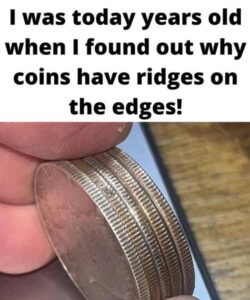
You’ve held them thousands of times without thinking twice. Quarters passed across counters, dimes dropped into parking meters, coins flipped in moments of indecision or scooped from the bottom of a pocket by muscle memory alone. Yet if you pause and run your thumb along the edge of a coin, you’ll feel something deliberate, precise, and intentional. Those tiny grooves circling the edge are not decoration and not an accident of manufacturing. They are a quiet survivor from a dangerous time when money itself was under constant attack, and trust in currency could collapse with a few careful shavings of metal.
Three hundred years ago, coins were made of real silver and gold, and criminals found a clever way to exploit that fact. The crime was known as coin clipping. Thieves would shave minuscule slivers of precious metal from the edges of coins, collecting the shavings to melt down later. The clipped coins still looked normal to the naked eye and could be spent at full value. One coin at a time, the damage was invisible. Across thousands of coins, it became economic sabotage. Governments lost metal, merchants lost trust, and entire monetary systems weakened. The crime spread so widely that it threatened national stability, forcing authorities to find a solution that criminals could not easily defeat.
That solution came from an unexpected figure. In 1696, Sir Isaac Newton, already famous for his work in physics and mathematics, was appointed Warden of the Royal Mint in England. Newton approached the problem with ruthless precision. His answer was reeded edges, those evenly spaced grooves pressed into the sides of coins. Once introduced, clipping became obvious. A shaved coin would instantly show broken or uneven ridges, while a genuine coin displayed a perfect, continuous pattern. At the time, no counterfeiter could replicate the exact spacing and depth of the mint’s grooves. The innovation worked so well that Newton personally pursued counterfeiters, helping dismantle a crime that had plagued the economy for decades. It was some of the earliest anti-fraud technology ever deployed, and it saved the integrity of money.
Today, coins are no longer made of silver, yet the ridges remain, and for good reason. They still play a role in preventing counterfeiting, as modern machines read edge patterns to help detect fakes. They also serve an important human purpose. For people who are blind or visually impaired, the texture of a coin makes identification by touch possible. A smooth-edged penny or nickel feels completely different from a ridged dime or quarter, allowing money to be recognized without sight. Tradition also plays its part. Ridged coins feel familiar, sound distinct when they clink together, and connect modern currency to centuries of history. Pennies and nickels remain smooth because they were never made from precious metals, so there was no incentive to clip them. Those tiny grooves, still circling your coins today, are not just design details. They are silent proof that even the smallest features can carry centuries of protection, trust, and human ingenuity.