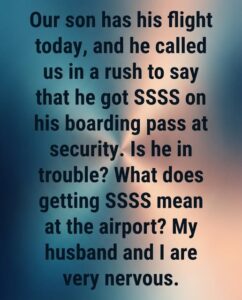
Air travel often tests patience long before a plane ever leaves the ground. Between packing limits, tight schedules, and long security lines, most passengers hope for one thing: to pass through the airport unnoticed and without delay. But for some travelers, that smooth routine is interrupted by four small letters printed on their boarding pass—SSSS. At first glance, it looks harmless, yet for those who notice it, the code signals that their journey through the airport will be very different from everyone else’s.
SSSS stands for Secondary Security Screening Selection. When this code appears on a boarding pass, it means the passenger has been selected for additional screening by the Transportation Security Administration (TSA). This extra step goes beyond standard security checks and usually involves more time, questions, and inspection. Seeing the code can be stressful, especially for travelers with short connections or packed itineraries, but it’s important to understand that it does not automatically mean someone is suspected of wrongdoing.
The designation is part of the U.S. government’s Secure Flight program, a system designed to assess risk before passengers arrive at the airport. Using basic booking information—such as name and date of birth—the system checks travelers against various databases and watchlists. In many cases, people receive the SSSS code due to random selection or routine security measures meant to keep screening unpredictable. The goal is to strengthen overall safety, not to single out innocent travelers unnecessarily.
Passengers selected for secondary screening typically cannot check in online and must receive their boarding pass from an airline agent. At the security checkpoint, they may experience a detailed inspection of carry-on items, additional screening of electronics, and a more thorough personal check. While the process can add extra time and frustration, staying calm, cooperative, and prepared helps it move more smoothly. Ultimately, SSSS is best viewed not as a warning, but as part of the layered security system that supports modern air travel—an inconvenience for some, but one intended to protect everyone in the skies.