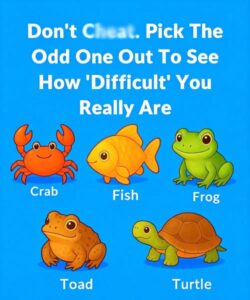
At first glance, this looks like just another quick online brain teaser—but don’t rush past it too fast. Spot-the-difference puzzles have a way of pulling us in, not because they’re difficult, but because they reveal how our minds naturally work. In this challenge, you’re shown five familiar cartoon animals: a crab, a fish, a frog, a toad, and a turtle. The task is simple: decide which one doesn’t belong. Yet the moment you pause to think, you’ll notice your brain immediately chooses a rule—shape, habitat, movement, or biology—often without you realizing it. That instant choice offers a surprisingly clear window into how you process information and make decisions.
If your eyes went straight to the crab, you may be someone who focuses on visual structure and form. Its claws, sideways movement, and unique body shape make it stand out from the others right away. Choosing the fish suggests you think in terms of environment and context, since it’s the only animal that lives entirely underwater. If the frog felt different to you, your thinking may center on life cycles and transformation, as frogs undergo dramatic changes from tadpole to adult. Picking the toad often reflects attention to fine details—texture, behavior, and subtle distinctions that others might overlook. And if the turtle was your choice, you likely organize information by classification, recognizing it as the only reptile in the group and the only one protected by a shell.
What makes this puzzle so engaging is that every answer can be correct, depending on the logic you apply. There is no single “right” solution, only different ways of reasoning. Some people instinctively rely on what they can see first, while others think in terms of categories, environments, or biological traits. These differences don’t indicate better or worse thinking—just different mental pathways. That’s why these puzzles spark so much discussion: they highlight how diverse human perception really is.
Ultimately, the value of this challenge isn’t in labeling your personality or defining your intelligence. It’s about awareness. The animal you chose—and more importantly, why you chose it—offers a playful glimpse into your natural problem-solving style. Whether you’re detail-oriented, big-picture focused, visually driven, or logically structured, your mind found a pattern that made sense to you. And that’s the real takeaway: even the simplest images can reveal how uniquely each of us sees the world.