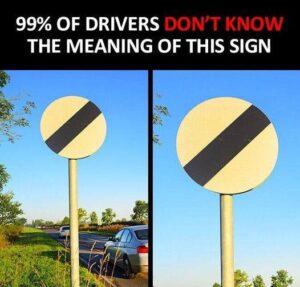
Every driver has experienced that split-second moment of doubt—glancing at a road sign and thinking, Wait… what does that one mean again? Recently, a lively online debate in the UK revealed just how common that uncertainty is, especially when it comes to one deceptively simple sign: a plain white circle marked with a bold black diagonal stripe. Most motorists encounter it regularly, and it even appears on the official driving theory test. Yet many drivers admitted they couldn’t confidently recall its meaning once they were out on the open road. When one motorist claimed that “99% of drivers” misunderstand it, the comment sparked hundreds of responses, proving how easily important rules can fade when everyday driving becomes routine.
The sign in question marks the start of the national speed limit, but its minimalist design often leads to confusion. In a popular Reddit thread, users joked that it meant everything from a “national drifting zone” to “go as fast as you want,” highlighting how unclear it feels to many drivers. Others expressed real concern, noting that some motorists interpret the sign as an immediate invitation to accelerate or overtake, even in situations where doing so may be unsafe. The mix of humor and worry revealed a deeper issue: while drivers may remember these rules during testing, they often rely on habit—not knowledge—once they’re on the road. And that disconnect can create risky situations.
The RAC clarified that the national speed limit sign simply means earlier posted limits are no longer in effect, and drivers must now follow the default limit for the type of road they’re on. However, those limits vary: cars may travel up to 60 mph on single carriageways and up to 70 mph on dual carriageways or motorways. But not every vehicle follows the same rules. Vans, vehicles towing trailers, and certain larger vehicles must adhere to lower limits—such as 50 mph on single carriageways and 60 mph on dual carriageways. In built-up areas with regular street lighting, the standard limit remains 30 mph unless signs indicate otherwise. The sign doesn’t provide a number, so drivers must rely on awareness of their surroundings and knowledge of the Highway Code to interpret it correctly.
Even with clear guidelines, road safety experts stress that speed limits should never be treated as targets. Conditions like heavy rain, road damage, fog, or traffic congestion may require far slower speeds to maintain safety. The recent online discussion serves as a reminder that learning to drive isn’t a one-time event. Rules evolve, habits slip, and refreshers are often necessary to stay safe. Many experts now argue that driver education should continue long after the test is passed. By understanding signs like the national speed limit indicator—and approaching them with caution rather than assumption—drivers can help create safer roads for everyone. A little extra awareness can make all the difference.