In the wealthy neighborhood of Pedregal, high above the crowded streets of Mexico City, stood a house that people whispered about. It was a brutalist mansion of concrete and glass, more like a fortress than a home.
Inside lived a billionaire’s son, a little boy named Leo, whose life had quietly turned into a constant struggle with pain no one could explain.
For months, this seven-year-old child woke up in agony. His father, Roberto, a powerful businessman who could fix almost any crisis with a phone call, was helpless when it came to his own son.
Specialists, scans, long hospital visits—nothing gave answers. But one day, a quiet nanny noticed something hidden deep in his scalp, and what she discovered changed not only Leo’s life, but the entire family’s heart.
The Scream That Shattered the Mansion
Just before sunrise, when the house was usually still and silent, a piercing scream cut through the cold air. It didn’t sound like a normal cry from a child. It sounded like pure, raw pain.
Maria, the new nanny, dropped the laundry she was folding and hurried toward Leo’s room. She found him twisted in his silk sheets, his small hands clawing at the pillow, his face pale and damp with sweat.
Roberto sat at the edge of the bed, his head bowed, his hands shaking. This man, who controlled companies and investments across continents, could only whisper his son’s name over and over, as if saying it might somehow calm the pain.
On the bedside table lay a folder full of medical reports. Just the day before, a team of neurologists had studied Leo’s MRI scans again. Their conclusion had been the same as always:
“There is nothing wrong that we can see,” they had said. “His brain looks perfect. This may be a psychological condition.”
Those words echoed in Roberto’s mind as his son trembled beside him.
A Child Wrapped in Rules Instead of Love
Leo’s stepmother, Lorena, had convinced herself she knew what her stepson needed. She insisted that his nerves were too fragile for touch, for noise, for ordinary life. Out of fear and anxiety, she built a world of rules around him.
No one was allowed to touch Leo without wearing gloves. Hugs were discouraged. His food had to be prepared in a specific way. His room smelled more like a clinic than a child’s bedroom.
And then there was the hat.
Leo wore a thick wool hat at all times. At breakfast, during lessons, even in the heat of the day, his head remained covered. Lorena said it was to “protect his sensitive scalp” and that only she was allowed to remove or adjust it.
Everyone in the mansion accepted her explanation. After all, she had spent hours online reading about rare conditions. She used scientific words that made her sound knowledgeable, and the doctors had already said the problem might be emotional.
But Maria, who had been hired only a few weeks before, saw something that didn’t appear on any report.
She noticed that when the sedatives wore off and Leo was more awake, his hand always drifted to the same place on his head, just under the edge of the wool hat. He would press there, wince, and then curl into himself as if bracing against an invisible blow.
To Maria, it didn’t look like a vague, unexplained sensitivity.
It looked like a specific, focused pain.
The Nanny Who Paid Attention
Maria was not a specialist. She wasn’t a neurologist, a psychologist, or a surgeon. She was a woman with calloused hands and a quiet, steady way about her. She came from a small rural community, where her elders taught her to watch carefully, listen closely, and never assume that the first explanation was the right one.
In the beginning, she moved through the mansion like a ghost, following the strict instructions she had been given: speak softly, avoid sudden movements, and never, under any circumstances, remove Leo’s hat.
But the more time she spent with the boy, the more troubled she became.
She saw how rarely anyone held him. How he flinched, not from touch itself, but from the coldness that accompanied it. She saw how his eyes softened when she hummed a lullaby in the old language of her village, how he relaxed when she sat nearby—even without speaking.
The turning point came one afternoon when she was changing the linens on his bed. Leo was half-asleep, breathing evenly. As she gently adjusted his pillow, the wool hat slipped back for just a moment.
That was when Maria saw it.
Near the hairline, at the top of his head, the skin looked red and irritated in a small, concentrated patch. It was clearly sore. It was clearly not normal.
Before she could take a closer look, Lorena appeared in the doorway.
“What are you doing?” she snapped, her voice tight.
“The hat moved,” Maria said quietly. “I was just—”
Lorena crossed the room in two quick steps and pulled the hat back into place, forcing a smile that didn’t reach her eyes.
“Don’t touch him without gloves,” she warned. “And do not remove his hat. It’s there for his protection.”
Maria lowered her eyes, but inside, her concern sharpened.
The Day She Couldn’t Wait Any Longer
A few days later, fate gave Maria a narrow window.
Roberto was on a conference call in his office. Lorena had left for a charity event across town. The doctor wasn’t due for another two hours. The house was quiet.
Then, from upstairs, that now-familiar sound ripped through the silence: Leo’s scream.
Maria ran to his room. He was doubled over, clutching his head, his small body shaking in pain. Tears streamed down his cheeks as he tried to tug off his hat with frantic fingers.
Last Updated on December 6, 2025 by Grayson Elwood
“Make it stop,” he gasped. “Please, make it stop.”
No one else was there. No one else could step in and decide.
Maria took a deep breath, made a choice, and gently turned the lock on the door.
She sat beside him on the bed and did something she had been told never to do: she removed her gloves and laid her bare hand on his trembling shoulder.
“I’m here,” she said softly. “I won’t hurt you, little one. I just want to help.”
Slowly, carefully, she eased the wool hat off his head.
The Hidden Pain in His Scalp
What she found was not a frightening medical mystery or an unspeakable secret. It was something far more ordinary—and, in its own way, far more tragic.
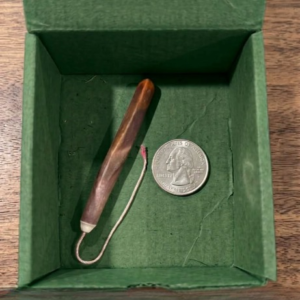
The inside seam of the wool hat had a hard plastic piece that helped it keep its shape. At some point, that plastic had snapped. A sharp edge now jutted out, pressing directly into the same small point on Leo’s scalp every time he moved.
The broken piece had been digging into his skin for weeks, maybe months.
The result was a painfully irritated spot, red and swollen. Every slight movement of his head would cause the edge to scrape against the same place again and again. To a child, that kind of constant, stabbing discomfort can feel overwhelming, almost unbearable.
It was no wonder he screamed.
It was no wonder he couldn’t sleep.
It was no wonder the doctors, seeing no obvious injuries, thought it might be psychological.
Maria gently removed the plastic fragment and set it on the nightstand. Then she went to her bag and took out a small cloth packet of dried herbs—plants her grandmother had used to soothe irritated skin and calm crying babies.
She warmed some water, made a mild infusion, and carefully dabbed the tender spot on Leo’s scalp with a soft cloth.
The boy’s breathing began to slow. His shoulders relaxed. A quiet, relieved sigh escaped his lips.
For the first time in a long time, his face showed something other than pain.
A Father Sees What Money Missed
While Maria was tending to Leo, Roberto ended his call early. Something in his son’s earlier scream had cut straight through the layers of business and obligation. He rushed to the bedroom, his heart pounding.
When he pushed open the door, ready to yell for help, he stopped.
There was Leo, resting quietly in Maria’s arms, his hair free, his face calmer than it had been in weeks. There was Maria, holding a broken piece of plastic in one hand and a damp cloth in the other.
“What is that?” Roberto asked, his voice hoarse.
Maria showed him the shard from inside the hat and the irritated patch on Leo’s head.
“This little piece has been hurting him,” she said gently. “Every time he moved, it pressed into the same spot. It looks like it has been doing this for a long time.”
Roberto stared at the plastic. The truth slowly dawned on him.
All the tests. All the specialists. All the complicated explanations. And yet the cause of his son’s suffering had been something as simple as a broken seam.
His eyes filled with tears—not just from relief, but from the weight of all those sleepless nights, all the moments when he had held his head in his hands, believing there was nothing left to try.
A Stepmother’s Fear, Not Malice
When Lorena returned and heard what Maria had discovered, she went pale. For a moment she couldn’t speak.
“I didn’t know,” she said finally, her voice shaking. “I thought… I thought his condition was something in his brain. I was so afraid of doing the wrong thing that I followed every warning I read, every suggestion I heard, without thinking.”
She sank into a chair, her carefully arranged composure crumbling. “I never meant to hurt him. I just didn’t want to fail him. I thought if I controlled everything, I could keep him safe.”
Tears spilled down her cheeks.
Roberto sat beside her and took her hand. “We were both so focused on fear,” he said quietly, “that we forgot to look at the simplest things. We forgot to listen to him. We forgot to trust the people who know him up close.”
He turned to Maria. “You saw what none of us saw,” he said. “Not because you had more technology, but because you were truly watching.”
A House That Finally Felt Like a Home
From that day on, life in the brutalist mansion began to change.
The strict rules loosened. The sterile smell of antiseptic slowly faded, replaced by the warmth of home-cooked meals and fresh flowers. The gloves were set aside. Hugs returned. Laughter returned.
The wool hat went into the trash.
Maria stayed on as Leo’s nanny, not just as a caretaker, but as a trusted member of the family. Her judgment and intuition were now valued alongside the opinions of doctors.
Leo’s headaches and sudden screams disappeared as the irritated skin healed. He still had checkups, of course, but the focus shifted from searching for hidden illnesses to rebuilding his strength, his confidence, and his joy.
Three months later, the transformation was clear to anyone who visited.
The garden, once silent and perfectly manicured, rang with the sound of a little boy chasing a soccer ball. Leo ran across the lawn, his hair flying in the breeze, a tiny scar on his scalp the only reminder of what he had endured.
Roberto watched from the terrace, his heart lighter than it had been in a long time. Lorena stood beside him, learning to let go of her fears and to love more gently, not through rules and restrictions, but through presence and attention.
Maria, standing under the shade of a nearby tree, smiled quietly. She knew she had done more than heal a sore spot on a child’s head.
She had helped this family rediscover kindness, closeness, and the courage to see what had been right in front of them all along.
What a Billionaire Couldn’t Buy
In boardrooms and business schools, Roberto had learned how to read numbers, predict markets, and negotiate with powerful people. Yet it took a nanny with simple clothes and wise eyes to teach him one of the most important lessons of his life:
Not every problem needs a complex answer.
Not every pain requires a machine to explain it.
Sometimes, the greatest healing comes from a pair of caring hands, a patient heart, and the willingness to look closely at what everyone else has overlooked.
And for little Leo, that simple truth made all the difference.