Edna had lived in her home for more than half a century, long enough to watch the neighborhood transform, homes rise and fall, families shift in and out like the changing seasons. She had laid every memory into that soil with her husband Harold, from their first spring planting roses together to the last winter he sat beside her on the porch, wrapped in a blanket, pointing toward the yard he loved so much. Every inch of it mattered. Every blade of grass felt sacred.
She was seventy-eight now, widowed for six years, and though her children visited often and her son Tom handled most of the heavy yard work, she still felt responsible for preserving what she and Harold had built. The house had grown silent since his passing, but it was the kind of silence that wrapped around her gently, like a familiar quilt. That quiet, that peace, meant everything to her.
Then one morning, all of it changed.
Edna had been sitting at her kitchen table, sipping chamomile tea, watching the golden line of morning sun stretch across her lawn. It was her favorite time of day. But as she lifted her cup, a sudden grinding roar shattered the calm. Startled, she turned toward the window — and her heart nearly stopped.
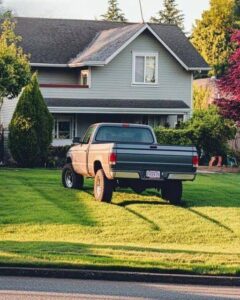
A massive, gleaming pickup truck was driving straight across her lawn.
Not beside it. Not along the street. Directly across the grass Harold had tended for decades. The young man behind the wheel didn’t even seem to notice. He angled the truck casually as though maneuvering into a store parking lot, then shut off the engine and hopped out, whistling.
Edna blinked, speechless. Tire tracks carved ugly scars across the emerald grass, ripping through the soft soil. Dirt mounded around the edges where the truck’s weight had shifted. Her lawn — her sanctuary — had been violated without a second thought.
The house next door had recently been sold to a young couple, loud, flashy, always surrounded by friends and commotion. She had tried to greet them politely when they moved in, but they’d barely acknowledged her. Fine, she had thought at the time. People were different these days. But she never imagined they would be the type to disrespect someone’s property so blatantly.
With a shaking breath, she stood, grabbed her cane, and walked outside. The sun was bright, the air crisp, but the destruction in front of her made everything feel gray.
The neighbor’s wife stepped out of her house, tall, confident, with a head full of glossy curls and an attitude that arrived ten seconds before she did. She looked at Edna, at the lawn, and then at the truck — and instead of embarrassment or apology, a smirk appeared.
Edna steadied herself. “Excuse me,” she said firmly, “your truck is parked on my lawn. Would you mind moving it?”
The woman arched an eyebrow. “It’s just grass,” she said. “Relax.”
Just grass.
Edna felt something ignite in her chest. She had taught sixth-grade English for thirty-five years, raised two children, buried the love of her life — she knew how to pick her battles, which fights mattered, and which could be ignored. This one mattered. This wasn’t about grass. It was about respect.
“My late husband planted and cared for this lawn,” she replied. “Please move your vehicle.”
The woman rolled her eyes. “My husband will move it when he’s done. He’s unloading. You can deal with it.”
The dismissiveness, the arrogance, the complete disregard sent a tremor through Edna that felt like fire beneath her ribs. But she said nothing else. She turned slowly, walked back to her house, and closed the door behind her.
Inside, she breathed deeply.
Some battles required patience. Others required strategy. And some demanded lessons.
Over the next week, the situation escalated. The young couple continued treating Edna’s grass like overflow parking. Sometimes it was the truck. Sometimes it was their friends’ cars. Once, on a particularly busy weekend, three vehicles were parked across her yard, leaving deep gouges in the soil. Each time, Edna asked them to stop. Each time, she was dismissed.
One afternoon, the husband shrugged and said, “There’s nowhere else to park. Your lawn’s just open space.”
Another time, the wife laughed and said, “It’s not like you’re using it.”
A few days later, Edna found trash tossed into her garden. Beer cans. A crumpled receipt. Crumbs spilled across her walkway. They weren’t just disrespectful — they were territorial, treating her property as though it were theirs.
But they had underestimated her. Terribly.
Edna was not abrasive or confrontational by nature, but she was intelligent. Methodical. And when pushed past her limits, she could be ruthlessly effective — a skill sharpened from years of teaching stubborn teenagers who thought they could outsmart her.
The couple next door was about to learn that.
She called her son Tom first to explain everything. At first, he was furious, ready to storm over and confront them, but Edna told him no. This wasn’t a shouting match she wanted. It wasn’t about ego or anger. It was about boundaries and justice.
Instead, she asked him a different question: “Do you still have that landscaping company contact from last year?”
Tom paused. Then he laughed — a low, delighted chuckle. “Mom,” he said, “are you planning what I think you’re planning?”
“Oh, I’m planning more than that,” she replied.
The next morning, a truck pulled up in front of her house — not the neighbor’s truck, but a long, flatbed contractor’s truck carrying stacks of wooden posts and metal fencing. The young couple was outside, as usual, milling around with friends, drinking coffee, showing off their new motorcycle.
They watched, confused, as two workers unloaded supplies and greeted Edna politely.
The wife crossed her arms. “What’s happening?”
Edna smiled serenely. “I’m putting up a fence.”
The husband scoffed. “A fence? For what?”
“To protect my lawn,” she answered. “Since some people can’t seem to respect property lines.”
The wife stepped forward. “You can’t block off that area! We need space to park!”
“No,” Edna said calmly, “you need to park in your driveway. Which you have. My yard is not your parking space.”
They sputtered and argued, claiming the fence would “ruin the neighborhood aesthetic,” that it wasn’t necessary, that she was being dramatic. But Edna had already filed the proper permits. She had already spoken with the HOA. She had already consulted city zoning.
Everything she did was legal. Precise. Unassailable.
Within hours, sturdy wooden posts stood between her property and theirs. By late afternoon, a clean, beautiful, four-foot-high fence ran along the entire boundary — not cheap fencing, but the kind that looked intentional, elegant, permanent.
The young couple’s faces reddened with disbelief and anger. Their friends whispered. But the fence stood tall, proud, and immovable.
Still, Edna wasn’t finished.
She instructed the contractors to add one final touch: a reinforced steel planter bed along the inside edge of the fence, filled with heavy soil and ready for flowers. The planter not only beautified the space — it made it physically impossible for a vehicle to mount the curb or push past the fence.
The couple next door stared at the finished barrier like it was a personal attack — and in a way, it was the lesson they had forced Edna to teach.
For several days, the neighbors tried to intimidate her. They scowled. They muttered. They made snide comments loud enough for her to hear. But Edna ignored every attempt. Her peace had returned. Her lawn was healing. Her husband’s memory felt protected again.
Then the universe delivered an unexpected twist.
A week later, as Edna sat on her porch reading a book, she heard shouting next door. The couple was arguing loudly — apparently about a citation they had received from the city. Their friends had been parking illegally in the street, blocking a fire hydrant, and now the couple was facing a hefty fine.
Edna did not smile.
But she didn’t feel sorry either.
Actions had consequences — some delivered by fences, others by their own stubbornness.
Later that evening, the young wife approached the fence. She stood there quietly for a few moments before finally speaking.
“Edna,” she said, her voice subdued, “we’re sorry. We shouldn’t have parked on your lawn. We didn’t realize how much it meant to you.”
Edna looked up from her gardening gloves. “It wasn’t just the lawn,” she said. “It was the disrespect.”
The woman nodded. “We understand. And… thank you for not calling the police on us.”
Edna considered this. “I didn’t want conflict,” she said softly. “I just wanted peace.”
There was a long pause. Then the young woman said, “Your fence looks nice.”
Edna smiled gently. “Thank you. I think so too.”
The apology didn’t erase the damage, but it restored something she valued even more: the feeling that she wasn’t invisible. That her home — and the memories within it — deserved to be honored.
Over the next few months, the young couple became noticeably more considerate. They waved when they saw her. They kept their noise down. They tended their own yard with a care she hadn’t seen before. Occasionally, the wife even came over to ask gardening advice.
Edna didn’t need to be friends with them. She didn’t need gratitude. What she needed was respect — and she had reclaimed it.
On a warm summer morning, Edna planted a row of rose bushes along the fence, pressing each root into the soil Harold once tended. As the petals unfurled in shades of blush and crimson, she whispered quietly into the breeze:
“We did it, Harold. The lawn’s safe.”
The wind rustled softly through the fence and across the grass. Peace — real peace — returned to her little sanctuary.
And Edna, cane in hand, walked slowly back to her porch, proud of the fierce, determined lesson she had taught:
Never underestimate a woman protecting the place she calls home.