A few days ago, I was doing something most parents know all too well: cleaning my teenager’s bedroom.
Usually, the process is fairly routine. I expect to find mismatched socks, old receipts, snack wrappers, tangled charging cables, and random items that somehow seemed important enough to keep.
But this time, I discovered something that completely caught me off guard.
Tucked into the back corner of one of my son’s drawers was a strange object I had never seen before.
At first glance, I had absolutely no idea what it was.
It wasn’t electronic. It didn’t look like a toy. And it certainly wasn’t anything I recognized from around the house.
Naturally, my curiosity kicked in immediately.
I picked it up and examined it more closely.
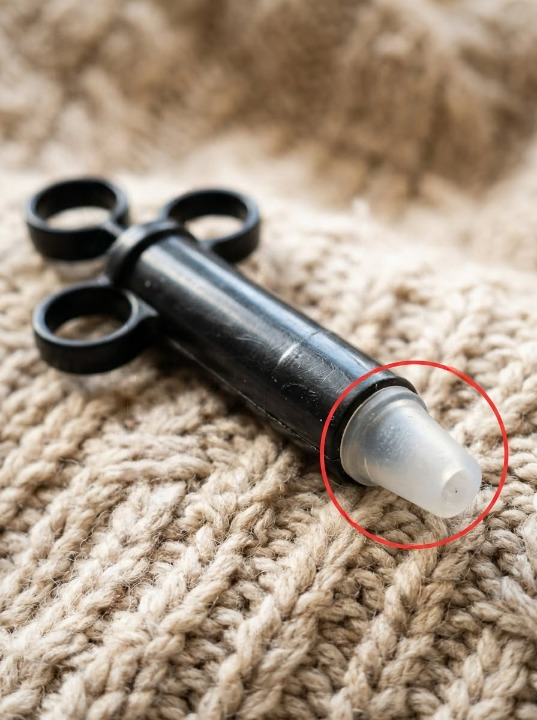
The object was made of a long black plastic piece attached to three circular finger loops, with a small white section on one end. It looked oddly specific, as though it had been designed for a very particular purpose.
The problem was that I couldn’t figure out what that purpose might be.
I turned it over several times, hoping something about its shape would suddenly make sense.
Nothing.
In fact, the longer I looked at it, the more confusing it became.
Usually when you find an unfamiliar object, your brain eventually connects it to something you’ve seen before. This wasn’t one of those situations.
Every angle only created more questions.
After several minutes of unsuccessful guessing, I decided to ask my husband for help.
I brought the object downstairs and placed it on the kitchen counter.
“Do you know what this is?” I asked.
He picked it up, inspected it carefully, and frowned.
“I honestly have no idea,” he admitted.
That answer somehow made the mystery even more interesting.
Now there were two adults standing in the kitchen, rotating a strange object in our hands like detectives examining evidence.
We started coming up with theories.
Maybe it belonged to a gardening tool.
Maybe it was part of exercise equipment.
Maybe it had broken off some appliance years ago.
For a few seconds, each explanation sounded believable—until we looked at the object again and realized it still didn’t quite fit.
The mystery continued.
At that point, neither of us was concerned about the object itself. It didn’t appear dangerous or alarming. It was simply unusual enough to become a surprisingly entertaining puzzle.
And once we started trying to solve it, neither of us wanted to give up.
By the time our son came home later that afternoon, the object was still sitting on the counter waiting for answers.
The moment he walked through the door, I held it up.
“Can you explain what this is?”
He took one look at it and immediately burst out laughing.
Not just a quick smile—full, uncontrollable laughter.
That reaction alone told me he clearly knew exactly what we were holding.
“What’s so funny?” I asked.
Still laughing, he explained that he had found the object outside during a walk through the neighborhood several months earlier. He thought it looked unusual, picked it up out of curiosity, brought it home, tossed it into his drawer, and completely forgot about it.
Honestly, that sounded exactly like something a teenager would do.
But the real surprise came when he finally revealed what the object actually was.
According to him, it was simply the plunger from a medical syringe that had become separated from the rest of the syringe.
For a moment, I just stared at him.
Then I looked back down at the object.
Suddenly, everything made sense.
The circular finger loops.
The shape.
The design.
Once you know what you’re looking at, it becomes completely obvious.
Without the rest of the syringe attached, however, the plunger looked strangely unfamiliar.
Medical syringes are designed with finger grips and plungers that allow users to measure and control liquids accurately. On their own, though, those individual pieces can appear surprisingly mysterious.
What made the situation especially funny was how much time we had spent trying to identify something so ordinary.
Two grown adults had carefully analyzed a common medical component as if it were some kind of ancient artifact.
We discussed theories.
Examined the design.
Debated possibilities.
All over an object millions of people have seen before.
The whole experience reminded me of something interesting about how our brains work.
When objects are removed from their usual context, they suddenly become much harder to recognize.
A zipper without a jacket.
A bicycle pedal without the bicycle.
A keyboard key without the keyboard.
Or in this case, a syringe plunger without the syringe.
Separated from the larger object, everyday items can suddenly look completely unfamiliar.
Looking back now, I probably spent far too much energy trying to solve the mystery.
But perhaps that’s part of parenting.
You discover something unusual, your imagination starts filling in possibilities, and before long, a simple object has turned into a full family investigation.
Fortunately, this mystery had a harmless explanation and gave us all a good laugh afterward.
There was no secret purpose.
No complicated story.
Just a curious teenager who found an odd-looking object outside and decided it was interesting enough to keep.
By the end of the evening, the whole family was laughing about how seriously we had approached the situation.
And honestly, those are often the best kinds of mysteries—the harmless ones that start with confusion and end with a funny story you’ll tell for years afterward.
The experience also served as a good reminder that things are not always as complicated as they first appear.
Sometimes the simplest explanation really is the correct one.
And sometimes ordinary objects can seem surprisingly mysterious when viewed from a completely different perspective.
So now I’m curious:
If you had found this object sitting alone in a drawer, would you have recognized it right away—or would you have been just as puzzled as we were?
Uncategorized