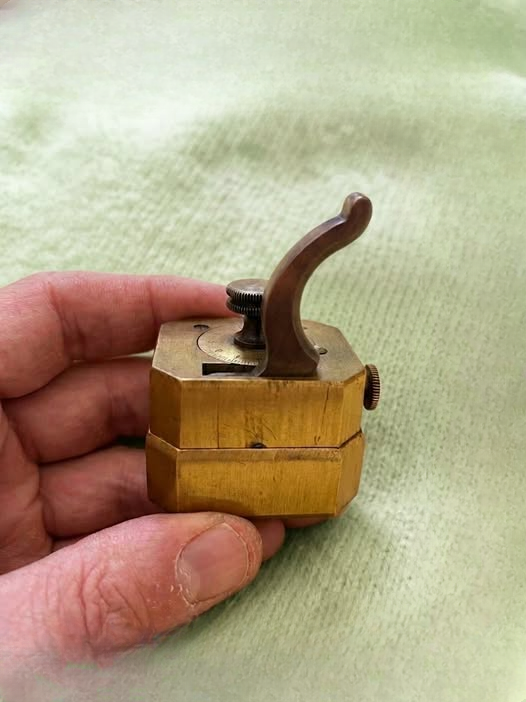
Flea markets are funny places. They’re a jumble of the ordinary and the strange, where yesterday’s junk and forgotten treasures sit side by side. I went that Saturday simply looking for something interesting, maybe a quirky addition to my bookshelf or a decorative oddity for my living room. But one small object caught my eye—a metallic device unlike anything I had seen before. Its polished brass exterior gleamed faintly in the sunlight, the small, precise components hinting at purpose and care. I picked it up. It felt heavier than I expected, but also strangely familiar, as if it had a story to tell. I bought it on a whim, curious about what it could be.
Once home, I examined it more closely. The device was compact, with a smooth handle and a hinged top that revealed a series of tiny, precisely aligned blades. At first, I assumed it was some sort of antique tool or perhaps a contraption from an old sewing kit. But there was a spring mechanism cleverly hidden inside. I twisted it gently, and the blades snapped forward and retracted almost instantaneously. My curiosity was piqued. What on earth was this for?
After hours of research, I finally uncovered its secret: it was a scarificator, a medical instrument used for bloodletting. The realization was both fascinating and a little unsettling. Bloodletting was once a cornerstone of medicine, practiced for centuries under the belief that removing a small amount of blood could restore balance in the body and cure disease. From ancient civilizations to Victorian-era doctors, bloodletting was a common remedy for everything from fevers to headaches. And here I held a precise, spring-loaded version of that practice, crafted with care and sophistication.
The design of the scarificator was remarkable. Unlike a simple lancet or knife, the spring mechanism allowed for multiple tiny blades to strike simultaneously, making several controlled cuts in a single motion. This reduced the chance of error and provided a relatively “safe” way to remove blood compared to older methods. Each component fit together with precision, a testament to the craftsmanship of its time. In its way, it was almost beautiful, a combination of engineering ingenuity and medical ambition.
Holding it in my hands, I couldn’t help but imagine the patients and practitioners of another era. How many nervous individuals had rolled up their sleeves, placing their trust in a tool like this? How many physicians had relied on its mechanisms, confident that they were performing a healing act? The idea that this small device had been a central part of someone’s healthcare routine was humbling. It reminded me that medical knowledge is not static; it evolves with observation, experimentation, and, sometimes, trial and error.
Bloodletting seems barbaric to us now, but in its time, it represented hope. Physicians believed they were restoring harmony within the body, correcting an imbalance of humors that supposedly dictated health and disease. This scarificator, precise and mechanical, was a symbol of the era’s best thinking. And yet, it also reflected the limits of that thinking. For all its sophistication, it addressed symptoms rather than causes, treatments rather than cures.
Holding this artifact was more than a curiosity; it was a lesson. It illustrated how far medicine has come and how human ingenuity has constantly sought ways to heal, even if some methods now seem misguided. Modern science and technology have transformed medicine, replacing guesswork and ritual with research and evidence. Yet, the scarificator also reminded me of something crucial: every era has its frontiers, every practitioner works with the best tools and knowledge available to them. Today’s breakthroughs may look quaint—or even dangerous—to future generations.
I found myself reflecting on the human element behind the device. There had been countless practitioners who believed wholeheartedly in its power. There had been patients, perhaps anxious, perhaps hopeful, who placed their trust in it. Each scratch, each spring, each tiny blade had been part of a story of life, illness, and care. I could almost see the clinic rooms, candlelit and quiet, where a physician carefully adjusted the instrument before performing the delicate procedure. In this way, the scarificator became a bridge, connecting me to the hopes and fears of people long gone.
It’s easy to dismiss such objects as mere oddities, but they carry lessons that go beyond novelty. They remind us to appreciate progress—not just in technology, but in understanding, empathy, and ethics. They teach patience, humility, and the importance of questioning what is accepted as truth. Holding the scarificator, I felt a sense of responsibility. Not to use it, of course, but to remember that curiosity, careful study, and the desire to help others are what drive innovation, even when the methods seem strange or primitive in hindsight.
What struck me most was how personal the device felt. Each scratch on its surface, each tiny mark or scratch in the brass, told a story. It had been used, cleaned, perhaps stored carefully, then forgotten. And yet here it was, centuries later, bridging the gap between past and present. I realized that antiques like this are more than decorative—they are narratives. They are time capsules, preserving the knowledge, beliefs, and aspirations of the people who created and used them.
In the end, the scarificator taught me an unexpected lesson: progress is a journey. What seems certain in one era may be reconsidered in the next. Medical science moves forward not only because of genius but because of trial, error, and reflection. Every outdated practice, every obsolete instrument, tells the story of human curiosity, resilience, and the relentless search for better solutions.
So next time you wander through a flea market, remember that hidden among the old books, dusty trinkets, and faded photographs may be a device that tells a story far larger than its size. My scarificator started as a strange curiosity and became a tangible reminder of humanity’s ongoing quest to understand, heal, and improve. It revealed a world of knowledge, belief, and care that might otherwise have been forgotten. And while I will never use it for its original purpose, I now hold it as a symbol—a small, powerful testament to the evolution of medicine and the enduring human desire to do better.
Sometimes, the smallest object in a flea market can connect you to centuries of human history, curiosity, and hope. For me, that strange little antique was worth every penny.
Uncategorized