For millions of viewers who grew up during the early 2000s, the girl on their television screens seemed to embody joy. She was bright-eyed, quick-witted, and radiated a spark that felt far too big for her small frame. Long before she understood what the entertainment industry could take from a person, she had already become a familiar face in homes across America.
She was talented. She was poised. She was loved. But what the world saw — and what she lived — were two entirely different stories. Born on June 26, 1992, in Southern California, Jennette grew up in Garden Grove, a modest community far from the glitz of Los Angeles.
Her family belonged to The Church of Jesus Christ of Latter-day Saints, and for much of her early life, she lived under a strict, sheltered environment governed primarily by her mother. What outsiders didn’t know was that the McCurdy household was filled with instability, emotional turbulence, and financial stress long before Jennette became a star.
Her mother’s battle with cancer created layers of trauma within the family. After surviving breast cancer once, her mother developed compulsive hoarding tendencies — a condition that soon consumed their living space. The rooms in the house became choked with clutter, piles of belongings reaching so high that Jennette and her siblings couldn’t access their own beds.
Instead, they slept on Costco tri-fold mats in the living room — a makeshift sleeping arrangement that became their normal. And yet, even in this chaos, the pressure to be perfect — to be obedient, grateful, hardworking, and emotionally available — never left Jennette’s shoulders.
Like many children raised in an environment of emotional instability, she learned early to become the “fixer,” the “good girl,” the “hope” of the household.
The Emotional Grip of a Controlling Parent
Jennette’s mother was the central force of the family — loving yet demanding, affectionate yet controlling, and at times deeply manipulative. She micromanaged her daughter’s daily routines, her diet, her activities, and even her physical development.
Homeschooling kept Jennette isolated from peers. Her mother insisted on monitoring nearly every detail of her life, leaving Jennette with almost no personal boundaries.
It was in this environment that the earliest seeds of her acting career were planted.
After watching Star Wars: A New Hope, Jennette became fascinated with the idea of acting. But it was her mother — not Jennette — who turned that admiration into ambition. She saw a future where her daughter’s success could lift the family out of hardship.
“I think she wanted me to have a better life than she had,” Jennette has said in adulthood — a statement loaded with both empathy and pain. Yet the path her mother placed her on wasn’t born solely from love; it was also born from desperation, financial fear, and a need for control.
A Career Begins — But Childhood Disappears
Jennette’s first professional role came in 2000 at just eight years old, when she joined the cast of Mad TV. For many families, a young child securing an acting job would be a moment of joyful celebration. But for Jennette, it signaled something else entirely — the beginning of her role as the family’s provider.
By age ten, she was contributing significantly to household income. By early adolescence, she was the sole breadwinner. The fame came quickly. The pressure came faster.
Her cheerful on-screen personality — confident, funny, rebellious — became both her identity and her mask. Underneath, she battled anxiety, self-doubt, and the fear that any misstep could cause everything she worked for to crumble.
Meanwhile, her mother’s obsession with controlling her daughter intensified. She micromanaged Jennette’s diet to an extreme, enforcing dangerously restrictive eating habits that would later lead to a long struggle with eating disorders. She insisted on conducting Jennette’s showers well into her teens and promoted body shame as a form of discipline.
To the outside world, Jennette was a rising star. Inside her world, she was a teenager who felt powerless in a life that was never her own.
The Confusing Reality of Fame
Jennette’s breakout role came on Nickelodeon’s iCarly, where she portrayed a bold, rebellious character beloved by millions. Fans connected with her comedic timing, her sharp delivery, and her chemistry with her co-stars. But privately, she felt trapped in a system where she had little control over her identity, her body, or her voice.

While the show delivered laughs to homes across the world, Jennette wrestled with an entirely different reality:
• Intense scrutiny
• Jealousy and manipulation within the industry
• The constant need to please everyone
• The emotional burden of financially supporting her family
• The pressure to maintain the image of a “perfect child star”
Her mother’s supervision remained tight. Every career choice, every relationship, every public interaction — all were managed, analyzed, and controlled. Jennette has described the experience as living in a glossy, polished world on-screen while her real life felt messy, lonely, and suffocating.
2013: A Year That Shattered and Saved Her
Everything changed when her mother, Debra, passed away after her cancer returned. Jennette was just 21. Losing a mother is devastating for anyone — but for Jennette, the grief was intertwined with relief, confusion, guilt, and unresolved trauma. Without her mother’s control, she was suddenly free — but also lost. Who was she without her mother’s expectations?
Who was she outside of scripted roles? Who was she when no one was telling her how to behave, eat, or think? Therapy became her lifeline. She began confronting the emotional wounds she had buried for years — the manipulation, the anxiety, the anger, the guilt.
But healing is never linear. She fell into unhealthy drinking. She entered relationships that mirrored the dysfunction she grew up with. She struggled with identity, trust, and self-worth. Yet with every breakthrough — every honest acknowledgment of her past — she regained a piece of herself.
Leaving Hollywood Behind
Five years after her mother’s death, Jennette made a decision most child stars never dare to make: she walked away from acting. She stepped away from a career that had made her famous and financially secure — because it had also taken her childhood, her autonomy, and her sense of peace.
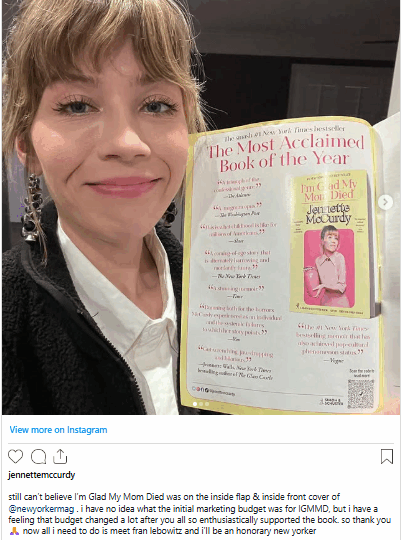
Her next chapter would be one she wrote for herself. In 2022, she published her memoir I’m Glad My Mom Died, a bold, raw, and shockingly honest book that stunned the world. Instead of hiding her trauma, she exposed it, offering a level of transparency rarely seen from former child stars. The book revealed the darkest parts of her upbringing:
• Her mother performed invasive exams under the excuse of “health checks”
• She was never allowed to shower alone
• She was encouraged to maintain eating disorders
• She was pushed into brink-of-collapse work schedules
• She was sexualized and pressured into situations that made her uncomfortable
• Her boundaries were ignored repeatedly
The hardest part for her to write, she said, was about the showers — a detail that exposed her mother’s extreme control and the deep psychological damage it caused. But writing the book wasn’t just cathartic. It was transformative.
A New Life Built on Truth and Healing
Today, Jennette McCurdy is a different woman. She is in her 30s, thriving on her own terms, free from the expectations that once enclosed her. Through her podcast and creative projects, she speaks openly about mental health, recovery, and the emotional realities of trauma. Her fans admire her not simply for who she was — but for who she became.
She turned pain into purpose. She turned silence into storytelling. She turned manipulation into meaning. Jennette now advocates for children in entertainment, speaks openly about psychological abuse, and encourages others to reclaim their identity. And she is far from finished. In 2025, she began adapting I’m Glad My Mom Died into a television series — a project viewers are already eagerly anticipating.
As Jennette continued to rebuild her life in the years after her mother’s passing, she began uncovering truths that would reshape her understanding of everything she once believed — including the very foundation of her family.
The Secret That Changed Everything
For most of her childhood, Jennette believed the man who raised her was her biological father — a quiet, hardworking man who held two jobs to keep the family afloat. Despite the dysfunction in the home, he was her constant, the one adult who seemed stable in a world that rarely was.
Then, after her mother’s death, Jennette learned a truth that left her stunned:
he was not her biological father.
The revelation came through a conversation with a relative, who informed her that her mother had engaged in a long-term affair and that three of the children — including Jennette — were fathered by someone else entirely.
Jennette described the moment as disorienting, painful, and surreal.
The man she had called “Dad” wasn’t her biological father, yet he had stayed through her childhood, through the hoarding, through the emotional chaos, through her mother’s controlling behavior.
“I get how complicated his role was,” Jennette reflected years later. “But I still can’t respect the way the adults in my household handled it.”
Finding out the truth didn’t give her clarity.
It gave her a different kind of grief — grief for the childhood she thought she had, grief for the lies she didn’t know she was living, and grief for the emotional stability she never truly had.
Eventually, she tracked down her biological father — a jazz musician named Andrew. Their early meetings were cautious, tender, and full of curiosity. For a few months, they spoke weekly, learning about each other slowly, quietly, without pressure. Though their relationship ultimately faded, Jennette has said the experience helped her understand parts of herself she never knew how to name.
The Industry That Exploited Her
While Jennette’s mother controlled and micromanaged her private life, the entertainment industry shaped her public one — and not always with the child’s best interests in mind.
In her memoir, Jennette described how Hollywood “exploited her entire childhood,” a statement that struck millions of readers for its brutal honesty. She said there were people who meant well but were negligent… and others who knew exactly what they were doing.
She described incidents that would horrify any parent:
• Being handed alcohol by a powerful authority figure
• Being encouraged to dress more maturely despite being underage
• Being photographed in a bikini as a teen without her mother intervening
• Being pushed into uncomfortable scenes, roles, or situations
• Being told that her value depended on how she looked and performed
These were not isolated moments — they were systemic, recurring, normalized.
Jennette referred to one influential person in particular as “The Creator,” a title used to describe a powerful figure who controlled much of her career. Her stories implied manipulation, intimidation, and emotional coercion — things she only fully understood years later in therapy.
Her mother didn’t protect her.
Hollywood didn’t protect her.
She had to learn to protect herself.
Walking Away: The Bravest Choice She Ever Made
After her mother’s death and years of emotional unraveling, Jennette realized that acting was tied to trauma — to control, to fear, to pressure, to pain. As her therapist helped her peel back the layers of her past, Jennette understood something life-changing: She had never chosen acting. Her mother had chosen for her.
So she did the unthinkable: she walked away. She left Hollywood behind. She quit pursuing roles. She stepped out of the public eye. For the first time in her life, she began asking herself questions she had never been allowed to ask:
What do I want?
What do I enjoy?
What do I believe?
Who am I when no one is controlling me?
These questions didn’t just change her career — they changed her life.
Finding Her Voice Through Writing, Not Acting
It was through writing that Jennette found her true power. Her memoir I’m Glad My Mom Died wasn’t just a book — it was a revolution. Raw, fearless, and brutally honest, it forced readers to confront the darker side of child stardom and the long-term consequences of parental control.
The memoir was a New York Times bestseller, but more importantly, it became a touchstone for millions of young readers who had survived emotional, physical, or psychological abuse. Jennette’s vulnerability created space for others to speak up.
She also launched a podcast where she shared insights on healing, therapy, mental health, self-awareness, and growth. Her listeners say she speaks with a clarity that comes only from someone who has lived a thousand emotional lives before reaching thirty.
Far from the smiling teen on Nickelodeon’s glossy sets, this Jennette is grounded, introspective, funny in a quieter way, and deeply compassionate.
Healing Is Not Linear — But It Is Possible
Jennette has said many times that healing isn’t something you complete — it’s something you practice. Therapy helped her unlearn patterns formed in childhood.
Boundaries became her armor.
Honesty became her freedom.
In her 30s, she embraced:
• Healthier relationships
• Greater emotional stability
• Independence from family dynamics
• A stronger sense of identity
• A deeper understanding of trauma
• Compassion for herself
• Courage to rewrite her story
For the first time, she wasn’t performing.
She wasn’t pretending.
She wasn’t surviving.
She was living.
The Series Adaptation: Reclaiming the Narrative
In 2025, Jennette began adapting her memoir into a television series. It was a full-circle moment — returning to the industry, but this time as the storyteller, not the story.
She wasn’t performing for the camera; she was shaping the narrative.
She wasn’t being controlled by others; she was taking control back.
She wasn’t masking her pain; she was transforming it into art.
Fans eagerly await the adaptation, not just because they loved the memoir, but because they want to witness Jennette’s triumph — her reclaiming the medium that once consumed her.
A Final Reflection: The Girl Who Survived and the Woman Who Emerged
When Jennette looks back at photos of herself at 8, 12, 15, she doesn’t see a young star.
She sees a child who deserved safety.
She sees a teenager who deserved boundaries.
She sees a girl who needed protection — not pressure.
Today, she speaks with tenderness toward that younger version of herself.
With empathy.
With pride.
With grief.
“I wish I could have shown my 20-year-old self me now,” she reflected. “I would have known what I was aiming for… something to be encouraged about.”
Jennette McCurdy’s story is more than a celebrity memoir.
It is a testament to the resilience of a child who grew into a woman capable of rewriting her destiny.
It is a reminder that healing is possible, even after years of silence.
It is proof that being honest — painfully, vulnerably, unapologetically honest — can change everything.
Jennette was once a child star who carried the hopes of her entire family.
Now she is a woman who carries her own heart, her own voice, and her own future.
And for the first time, she is living a life that truly belongs to her.
For millions of viewers who grew up during the early 2000s, the girl on their television screens seemed to embody joy. She was bright-eyed, quick-witted, and radiated a spark that felt far too big for her small frame. Long before she understood what the entertainment industry could take from a person, she had already become a familiar face in homes across America.
She was talented. She was poised. She was loved. But what the world saw — and what she lived — were two entirely different stories. Born on June 26, 1992, in Southern California, Jennette grew up in Garden Grove, a modest community far from the glitz of Los Angeles.
Her family belonged to The Church of Jesus Christ of Latter-day Saints, and for much of her early life, she lived under a strict, sheltered environment governed primarily by her mother. What outsiders didn’t know was that the McCurdy household was filled with instability, emotional turbulence, and financial stress long before Jennette became a star.
Her mother’s battle with cancer created layers of trauma within the family. After surviving breast cancer once, her mother developed compulsive hoarding tendencies — a condition that soon consumed their living space. The rooms in the house became choked with clutter, piles of belongings reaching so high that Jennette and her siblings couldn’t access their own beds.
Instead, they slept on Costco tri-fold mats in the living room — a makeshift sleeping arrangement that became their normal. And yet, even in this chaos, the pressure to be perfect — to be obedient, grateful, hardworking, and emotionally available — never left Jennette’s shoulders.
Like many children raised in an environment of emotional instability, she learned early to become the “fixer,” the “good girl,” the “hope” of the household.
The Emotional Grip of a Controlling Parent
Jennette’s mother was the central force of the family — loving yet demanding, affectionate yet controlling, and at times deeply manipulative. She micromanaged her daughter’s daily routines, her diet, her activities, and even her physical development.
Homeschooling kept Jennette isolated from peers. Her mother insisted on monitoring nearly every detail of her life, leaving Jennette with almost no personal boundaries.
It was in this environment that the earliest seeds of her acting career were planted.
After watching Star Wars: A New Hope, Jennette became fascinated with the idea of acting. But it was her mother — not Jennette — who turned that admiration into ambition. She saw a future where her daughter’s success could lift the family out of hardship.
“I think she wanted me to have a better life than she had,” Jennette has said in adulthood — a statement loaded with both empathy and pain. Yet the path her mother placed her on wasn’t born solely from love; it was also born from desperation, financial fear, and a need for control.
A Career Begins — But Childhood Disappears
Jennette’s first professional role came in 2000 at just eight years old, when she joined the cast of Mad TV. For many families, a young child securing an acting job would be a moment of joyful celebration. But for Jennette, it signaled something else entirely — the beginning of her role as the family’s provider.
By age ten, she was contributing significantly to household income. By early adolescence, she was the sole breadwinner. The fame came quickly. The pressure came faster.
Her cheerful on-screen personality — confident, funny, rebellious — became both her identity and her mask. Underneath, she battled anxiety, self-doubt, and the fear that any misstep could cause everything she worked for to crumble.
Meanwhile, her mother’s obsession with controlling her daughter intensified. She micromanaged Jennette’s diet to an extreme, enforcing dangerously restrictive eating habits that would later lead to a long struggle with eating disorders. She insisted on conducting Jennette’s showers well into her teens and promoted body shame as a form of discipline.
To the outside world, Jennette was a rising star. Inside her world, she was a teenager who felt powerless in a life that was never her own.
The Confusing Reality of Fame
Jennette’s breakout role came on Nickelodeon’s iCarly, where she portrayed a bold, rebellious character beloved by millions. Fans connected with her comedic timing, her sharp delivery, and her chemistry with her co-stars. But privately, she felt trapped in a system where she had little control over her identity, her body, or her voice.
While the show delivered laughs to homes across the world, Jennette wrestled with an entirely different reality:
• Intense scrutiny
• Jealousy and manipulation within the industry
• The constant need to please everyone
• The emotional burden of financially supporting her family
• The pressure to maintain the image of a “perfect child star”
Her mother’s supervision remained tight. Every career choice, every relationship, every public interaction — all were managed, analyzed, and controlled. Jennette has described the experience as living in a glossy, polished world on-screen while her real life felt messy, lonely, and suffocating.
2013: A Year That Shattered and Saved Her
Everything changed when her mother, Debra, passed away after her cancer returned. Jennette was just 21. Losing a mother is devastating for anyone — but for Jennette, the grief was intertwined with relief, confusion, guilt, and unresolved trauma. Without her mother’s control, she was suddenly free — but also lost. Who was she without her mother’s expectations?
Who was she outside of scripted roles? Who was she when no one was telling her how to behave, eat, or think? Therapy became her lifeline. She began confronting the emotional wounds she had buried for years — the manipulation, the anxiety, the anger, the guilt.
But healing is never linear. She fell into unhealthy drinking. She entered relationships that mirrored the dysfunction she grew up with. She struggled with identity, trust, and self-worth. Yet with every breakthrough — every honest acknowledgment of her past — she regained a piece of herself.
Leaving Hollywood Behind
Five years after her mother’s death, Jennette made a decision most child stars never dare to make: she walked away from acting. She stepped away from a career that had made her famous and financially secure — because it had also taken her childhood, her autonomy, and her sense of peace.
Her next chapter would be one she wrote for herself. In 2022, she published her memoir I’m Glad My Mom Died, a bold, raw, and shockingly honest book that stunned the world. Instead of hiding her trauma, she exposed it, offering a level of transparency rarely seen from former child stars. The book revealed the darkest parts of her upbringing:
• Her mother performed invasive exams under the excuse of “health checks”
• She was never allowed to shower alone
• She was encouraged to maintain eating disorders
• She was pushed into brink-of-collapse work schedules
• She was sexualized and pressured into situations that made her uncomfortable
• Her boundaries were ignored repeatedly
The hardest part for her to write, she said, was about the showers — a detail that exposed her mother’s extreme control and the deep psychological damage it caused. But writing the book wasn’t just cathartic. It was transformative.
A New Life Built on Truth and Healing
Today, Jennette McCurdy is a different woman. She is in her 30s, thriving on her own terms, free from the expectations that once enclosed her. Through her podcast and creative projects, she speaks openly about mental health, recovery, and the emotional realities of trauma. Her fans admire her not simply for who she was — but for who she became.
She turned pain into purpose. She turned silence into storytelling. She turned manipulation into meaning. Jennette now advocates for children in entertainment, speaks openly about psychological abuse, and encourages others to reclaim their identity. And she is far from finished. In 2025, she began adapting I’m Glad My Mom Died into a television series — a project viewers are already eagerly anticipating.
As Jennette continued to rebuild her life in the years after her mother’s passing, she began uncovering truths that would reshape her understanding of everything she once believed — including the very foundation of her family.
The Secret That Changed Everything
For most of her childhood, Jennette believed the man who raised her was her biological father — a quiet, hardworking man who held two jobs to keep the family afloat. Despite the dysfunction in the home, he was her constant, the one adult who seemed stable in a world that rarely was.
Then, after her mother’s death, Jennette learned a truth that left her stunned:
he was not her biological father.
The revelation came through a conversation with a relative, who informed her that her mother had engaged in a long-term affair and that three of the children — including Jennette — were fathered by someone else entirely.
Jennette described the moment as disorienting, painful, and surreal.
The man she had called “Dad” wasn’t her biological father, yet he had stayed through her childhood, through the hoarding, through the emotional chaos, through her mother’s controlling behavior.
“I get how complicated his role was,” Jennette reflected years later. “But I still can’t respect the way the adults in my household handled it.”
Finding out the truth didn’t give her clarity.
It gave her a different kind of grief — grief for the childhood she thought she had, grief for the lies she didn’t know she was living, and grief for the emotional stability she never truly had.
Eventually, she tracked down her biological father — a jazz musician named Andrew. Their early meetings were cautious, tender, and full of curiosity. For a few months, they spoke weekly, learning about each other slowly, quietly, without pressure. Though their relationship ultimately faded, Jennette has said the experience helped her understand parts of herself she never knew how to name.
The Industry That Exploited Her
While Jennette’s mother controlled and micromanaged her private life, the entertainment industry shaped her public one — and not always with the child’s best interests in mind.
In her memoir, Jennette described how Hollywood “exploited her entire childhood,” a statement that struck millions of readers for its brutal honesty. She said there were people who meant well but were negligent… and others who knew exactly what they were doing.
She described incidents that would horrify any parent:
• Being handed alcohol by a powerful authority figure
• Being encouraged to dress more maturely despite being underage
• Being photographed in a bikini as a teen without her mother intervening
• Being pushed into uncomfortable scenes, roles, or situations
• Being told that her value depended on how she looked and performed
These were not isolated moments — they were systemic, recurring, normalized.
Jennette referred to one influential person in particular as “The Creator,” a title used to describe a powerful figure who controlled much of her career. Her stories implied manipulation, intimidation, and emotional coercion — things she only fully understood years later in therapy.
Her mother didn’t protect her.
Hollywood didn’t protect her.
She had to learn to protect herself.
Walking Away: The Bravest Choice She Ever Made
After her mother’s death and years of emotional unraveling, Jennette realized that acting was tied to trauma — to control, to fear, to pressure, to pain. As her therapist helped her peel back the layers of her past, Jennette understood something life-changing: She had never chosen acting. Her mother had chosen for her.
So she did the unthinkable: she walked away. She left Hollywood behind. She quit pursuing roles. She stepped out of the public eye. For the first time in her life, she began asking herself questions she had never been allowed to ask:
What do I want?
What do I enjoy?
What do I believe?
Who am I when no one is controlling me?
These questions didn’t just change her career — they changed her life.
Finding Her Voice Through Writing, Not Acting
It was through writing that Jennette found her true power. Her memoir I’m Glad My Mom Died wasn’t just a book — it was a revolution. Raw, fearless, and brutally honest, it forced readers to confront the darker side of child stardom and the long-term consequences of parental control.
The memoir was a New York Times bestseller, but more importantly, it became a touchstone for millions of young readers who had survived emotional, physical, or psychological abuse. Jennette’s vulnerability created space for others to speak up.
She also launched a podcast where she shared insights on healing, therapy, mental health, self-awareness, and growth. Her listeners say she speaks with a clarity that comes only from someone who has lived a thousand emotional lives before reaching thirty.
Far from the smiling teen on Nickelodeon’s glossy sets, this Jennette is grounded, introspective, funny in a quieter way, and deeply compassionate.
Healing Is Not Linear — But It Is Possible
Jennette has said many times that healing isn’t something you complete — it’s something you practice. Therapy helped her unlearn patterns formed in childhood.
Boundaries became her armor.
Honesty became her freedom.
In her 30s, she embraced:
• Healthier relationships
• Greater emotional stability
• Independence from family dynamics
• A stronger sense of identity
• A deeper understanding of trauma
• Compassion for herself
• Courage to rewrite her story
For the first time, she wasn’t performing.
She wasn’t pretending.
She wasn’t surviving.
She was living.
The Series Adaptation: Reclaiming the Narrative
In 2025, Jennette began adapting her memoir into a television series. It was a full-circle moment — returning to the industry, but this time as the storyteller, not the story.
She wasn’t performing for the camera; she was shaping the narrative.
She wasn’t being controlled by others; she was taking control back.
She wasn’t masking her pain; she was transforming it into art.
Fans eagerly await the adaptation, not just because they loved the memoir, but because they want to witness Jennette’s triumph — her reclaiming the medium that once consumed her.
A Final Reflection: The Girl Who Survived and the Woman Who Emerged
When Jennette looks back at photos of herself at 8, 12, 15, she doesn’t see a young star.
She sees a child who deserved safety.
She sees a teenager who deserved boundaries.
She sees a girl who needed protection — not pressure.
Today, she speaks with tenderness toward that younger version of herself.
With empathy.
With pride.
With grief.
“I wish I could have shown my 20-year-old self me now,” she reflected. “I would have known what I was aiming for… something to be encouraged about.”
Jennette McCurdy’s story is more than a celebrity memoir.
It is a testament to the resilience of a child who grew into a woman capable of rewriting her destiny.
It is a reminder that healing is possible, even after years of silence.
It is proof that being honest — painfully, vulnerably, unapologetically honest — can change everything.
Jennette was once a child star who carried the hopes of her entire family.
Now she is a woman who carries her own heart, her own voice, and her own future.
And for the first time, she is living a life that truly belongs to her.