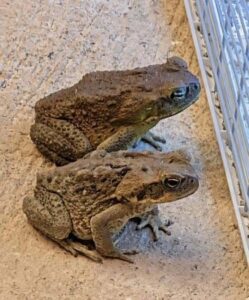
The sudden appearance of a toad on your doorstep or tucked into a quiet corner of your home can feel startling. One moment everything is ordinary, and the next, a pair of golden, unblinking eyes is watching you from the shadows. The instinct is immediate: grab something, move it out, restore order.
But that small, still creature isn’t just an intruder. It’s something far more interesting—both in what it does and what it has represented for centuries.
A Visitor With a Purpose
At its most basic level, a toad ends up in your home for simple, practical reasons: it’s looking for moisture, shelter, and food.
Unlike frogs, toads don’t need to stay right next to water, but they still depend on damp environments to survive. Your home—especially areas like bathrooms, laundry rooms, or shaded patios—can accidentally mimic the kind of cool, humid refuge they seek.
They’re not lost. They’re adapting.
And if one has settled near your porch light or doorway, there’s a good chance it has found something even better than shelter: a steady food source.
Nature’s Quiet Pest Control
Toads are incredibly efficient hunters. They feed on insects most people would rather not deal with—mosquitoes, flies, beetles, and other pests.
A single toad can eat hundreds of insects in a night.
That makes them less of a nuisance and more of a natural ally. Their presence often signals something important too: your environment is relatively healthy. Toads are sensitive to pollution and chemicals, so if they’re around, it usually means your yard or surroundings aren’t overloaded with toxins.
In a way, they’re a quiet indicator that your ecosystem is functioning the way it should.
More Than Biology: A Symbol Across Cultures
Beyond their ecological role, toads carry deep symbolic meaning in many traditions.
Because they transform dramatically—from water-dwelling tadpoles into land-living adults—they’ve long been associated with change, growth, and resilience. Seeing one unexpectedly is often interpreted as a sign that you’re moving through a transition of your own.
In practices like Feng Shui, the toad takes on an even more specific meaning. The well-known “Money Toad” symbolizes prosperity and protection, believed to attract abundance into a home.
Even outside of formal traditions, many cultures view toads as quiet cleansers of stagnant energy, drawn to overlooked spaces where things settle and linger.
A Lesson in Stillness
There’s also something to be learned just by watching one.
Toads don’t rush. They don’t chase endlessly. They wait, observe, and act only when necessary.
In a world that rewards constant motion, they embody the opposite: patience, presence, and precision.
That alone can make their presence feel… oddly grounding.
If You Find One Indoors
If a toad has wandered inside, it’s fine to move it—but gently.
Use a container rather than your bare hands if possible. If you do need to touch it, dampen your hands first. Their skin is sensitive, and oils or salts from human skin can harm them.
Place it somewhere shaded and moist outside—under a bush, near a garden bed, or along a wall—where it can continue doing what it does best.
A Different Way to See It
It’s easy to see a toad as something out of place.
But it might be more accurate to see it as a reminder—that your home isn’t separate from the natural world, just a part of it.
It represents a balance between the practical and the symbolic:
- A pest controller that works quietly through the night
- A signal of environmental health
- A symbol of transformation and resilience
So the next time you spot one sitting silently in the corner, pause before reacting.
It may not just be passing through.
It may be reminding you of something you hadn’t stopped to notice.