It started with a simple clean-up.
Arben had been going through his grandfather’s old belongings—boxes that hadn’t been opened in years. Inside were tools, photographs, and objects from a time when things were built differently.
Stronger. Heavier. Simpler.
Among them, one item stood out immediately.
An old iron.
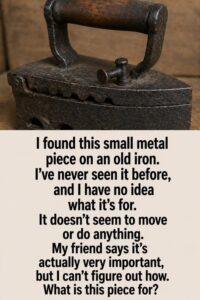
Not the kind you plug into the wall today, but a heavy, solid metal iron—the kind that looked like it belonged in another century.
Curious, Arben picked it up.
It was heavier than he expected.
And that’s when he noticed something strange.
A Detail That Raised Questions
On top of the iron, near the handle, there was a small metal piece.
It looked like a tiny knob or latch.
It didn’t move when he touched it.
It didn’t seem connected to anything obvious.
And yet, it looked like it had a purpose.
“I’ve never seen this before,” he said.
He turned the iron over in his hands, trying to understand it.
But nothing about it made sense—at least, not at first.
A Piece From the Past
Old irons like this were used long before electric ones existed.
They were often made of cast iron and heated using fire—either on a stove or directly in hot coals.
Once heated, they were used to press clothes, just like modern irons.
But they required more effort, more attention, and more understanding.
They weren’t just tools—they were part of a process.
And every part of them had a reason.
Including that small metal piece.
The Curiosity Grows
Arben showed the iron to a friend.
“Do you know what this is for?” he asked, pointing at the small metal knob.
His friend looked at it and smiled slightly.
“I think I’ve seen something like this before,” he said.
“It’s actually important.”
That answer only made Arben more curious.
“Important how?” he asked.
But his friend wasn’t completely sure.
So the mystery remained.
Looking for Answers
Determined to figure it out, Arben did some research.
He looked at similar irons online, read about how they were used, and eventually found the answer.
That small metal piece wasn’t random.
It was part of a clever and practical design.
The Real Purpose
The iron Arben found is known as a charcoal iron (or sometimes a box iron).
Unlike simple solid irons, this type could be opened and filled with hot coals inside.
The small metal piece on top?
 It’s a latch or vent control.
How It Works
Here’s what makes it interesting.
Inside the iron, hot coals would be placed to generate heat. But for the coals to stay hot, they needed airflow.
That’s where the small metal piece comes in.
Depending on the design, it could:
- Secure the lid closed so the coals stayed safely inside
- Allow airflow control to regulate heat
- Act as a handle latch for opening and closing the iron
In many models, this piece played more than one role.
It wasn’t just decoration—it was essential.
Why It Seems Useless Today
To someone used to modern appliances, this feature can seem confusing.
Today’s irons:
- Plug into electricity
- Heat automatically
- Don’t require airflow or fuel
So a small metal latch on top feels unnecessary.
But in the past, it was a key part of how the iron functioned.
A Tool That Required Skill
Using a charcoal iron wasn’t simple.
You had to:
- Heat the coals properly
- Place them inside the iron
- Control airflow to maintain temperature
- Handle the iron carefully to avoid burns
That small metal piece helped make all of this possible.
It gave users control.
Without it, the iron wouldn’t work as effectively—or safely.
More Than Just Function
These irons were also designed with durability in mind.
Made from solid metal, they could last for decades.
And every part—from the handle to the latch—was built to withstand heat and repeated use.
That’s why many of them still exist today.
Like the one Arben found.
A Connection to the Past
As Arben learned more, the iron started to feel different.
It wasn’t just an old object anymore.
It was a piece of history.
A reminder of how people used to live and work.
Something as simple as ironing clothes required effort, attention, and the right tools.
And that small metal piece—something easy to overlook—was part of that story.
The Moment of Understanding
Arben picked up the iron again and looked at it more carefully.
This time, he saw it differently.
The weight made sense.
The design made sense.
Even the small metal latch made sense.
What once felt like a mystery now felt like a solution.
Why These Details Matter
Objects like this show how thoughtful design has always existed.
Even without modern technology, people found ways to solve problems efficiently.
They created tools that worked—not because they were complex, but because they were practical.
And every detail had a purpose.
The Outcome
By the end of the day, Arben placed the iron back on the shelf.
Not as something random—but as something meaningful.
He no longer wondered what the small metal piece was for.
Now he knew.
And more importantly, he understood why it mattered.
Final Thoughts
Sometimes, the most interesting discoveries come from the smallest details.
A tiny metal latch on an old iron might not seem important at first.
But once you understand it, it reveals something bigger—
A glimpse into how things used to work.
A reminder of how far design has come.
And proof that even the simplest objects can carry a story.
All you have to do is stop and ask:
“What is this for?”