It was buried beneath years of dust.
When Driton opened his grandfather’s old toolbox, he expected to find the usual things—rusty nails, worn-out screwdrivers, maybe a hammer or two. The box itself looked like it hadn’t been touched in decades.
But as he began taking things out one by one, something unusual caught his eye.
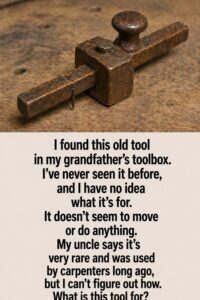
A small wooden tool.
It didn’t look like anything he recognized.
A Tool That Didn’t Make Sense
At first glance, it seemed simple.
A block of wood with a handle. A long wooden beam passing through it. And near the bottom, a small metal pin or spike sticking out.
There was also a small screw on top, like something meant to adjust or lock the position.
Driton turned it in his hands, studying it carefully.
“It doesn’t even move properly,” he said.
Or at least, not in a way that made sense.
He tried sliding the wooden beam. It shifted slightly, but it didn’t immediately reveal its purpose.
“What is this even used for?” he wondered.
The Curiosity Grows
He had never seen anything like it before.
It wasn’t a hammer.
It wasn’t a measuring tape.
It didn’t look like a cutting tool.
And yet, it clearly wasn’t random. It was well-made, worn from use, and designed with intention.
That’s what made it so interesting.
Driton showed it to his uncle later that day.
A Hint, But No Full Answer
His uncle smiled as soon as he saw it.
“That’s an old one,” he said.
Driton raised an eyebrow. “Old… but what is it?”
“It was used by carpenters,” his uncle replied. “A long time ago. Not many people use those anymore.”
That answer only made things more frustrating.
“What does it do?” Driton asked.
His uncle shrugged slightly. “I don’t remember exactly… but it was important.”
Now the mystery felt even bigger.
A Tool From Another Era
Determined to figure it out, Driton started researching.
He searched through old woodworking tools, compared shapes, and eventually found something that looked exactly like it.
The answer was surprisingly simple—and clever.
The Real Identity
The tool is called a marking gauge.
It’s a traditional woodworking tool used for one specific purpose:
 To draw straight, precise lines parallel to the edge of a piece of wood.
How It Works
Here’s where it gets interesting.
The tool has three main parts:
- A wooden beam (the long piece)
- A sliding block (the thicker part with the handle)
- A small metal pin or blade
To use it, a carpenter would:
- Adjust the distance between the pin and the block
- Lock it in place using the screw on top
- Run the tool along the edge of a piece of wood
As the block slides along the edge, the metal pin scratches a straight line into the surface.
This line acts as a guide for cutting, shaping, or joining wood pieces.
Why It Was So Important
Before modern measuring tools, precision was harder to achieve.
Carpenters relied on tools like this to create accurate, repeatable measurements.
Without a marking gauge, it would be difficult to:
- Keep lines straight
- Maintain consistent spacing
- Ensure pieces fit together properly
It was a simple tool—but essential for quality work.
Why It Feels Confusing Today
To someone unfamiliar with woodworking, the tool can seem strange.
It doesn’t look like it “does” anything.
There are no moving parts that spin or cut.
No electronics. No obvious function.
But that’s because its purpose is subtle.
It doesn’t build—it guides.
And that’s why it’s so easy to misunderstand.
A Tool That Requires Skill
Using a marking gauge wasn’t just about dragging it across wood.
It required:
- A steady hand
- Careful measurement
- Experience with materials
Carpenters relied on it to prepare their work before making cuts.
In many ways, it was the first step in the entire process.
Why It’s Rare Today
Modern tools have replaced many traditional ones.
Today, carpenters often use:
- Measuring tapes
- Laser guides
- Precision rulers
But in the past, tools like this were standard.
Now, they’re mostly found in old toolboxes, workshops, or collections.
That’s why Driton’s uncle called it “rare.”
Not because it was unique—but because it belongs to another time.
A Moment of Understanding
After learning what it was, Driton picked up the tool again.
This time, he saw it differently.
He adjusted the beam.
Tightened the screw.
Imagined running it along a piece of wood, marking a perfect line.
Suddenly, it made sense.
What once looked like a random object now felt like a precise instrument.
More Than Just a Tool
It wasn’t just about what the tool did.
It was about what it represented.
Craftsmanship.
Attention to detail.
A time when every measurement mattered.
And every line had to be exact.
The Outcome
Driton placed the marking gauge back in the toolbox—but not in the same way.
Before, it was just an unknown object.
Now, it was something meaningful.
Something worth keeping.
Not because it was rare—but because it told a story.
Final Thoughts
Sometimes, the most confusing objects turn out to be the simplest.
A small wooden tool with a metal pin might not seem important at first.
But once you understand it, everything changes.
It becomes clear.
Purposeful.
Even impressive.
Because behind that simple design is a tool that helped shape real work, real craftsmanship, and real history.
All hidden in a single question:
“What is this tool for?”