Wisdom from a Retired Teacher Goes Viral Among Parents
Education is one of those topics that almost everyone feels strongly about. Whether it’s discussions about childcare, teaching methods, school systems, or long-term academic goals, opinions tend to be passionate and deeply personal. For many, education represents far more than a structured process—it is the very foundation of a child’s future.
The early years of a child’s life are widely considered the most influential. During this time, children don’t just learn academic skills like reading and math; they also develop emotional intelligence, social awareness, discipline, and values that shape their adulthood. Because of this, it’s no surprise that conversations about education often become intense. People want the best outcomes for children, and any suggestion that the system may be failing can trigger strong reactions.
Despite the many voices weighing in on education—parents, policymakers, and commentators—few perspectives carry as much weight as those from individuals who have spent decades inside the classroom. Teachers witness firsthand the daily realities of student behavior, parental involvement, and systemic challenges. Their insights are grounded in lived experience rather than theory.
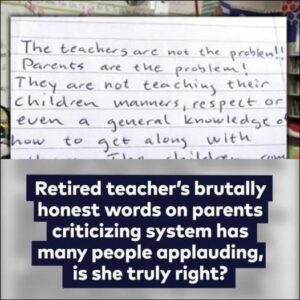
One such perspective came from Lisa Roberson, a retired teacher whose candid and straightforward message about education gained widespread attention online. Her words didn’t come from speculation or secondhand information—they were shaped by years of teaching, observing, and navigating the complexities of public schools. That authenticity is what made her message resonate so strongly.
The Viral Letter That Sparked a National Conversation
In 2017, Roberson wrote an open letter that was published in The Augusta Chronicle. What began as a local opinion piece quickly spread across social media, reaching parents, educators, and policymakers across the country. The letter ignited debates that continue even today, as people revisit her arguments when discussing school performance and accountability.
It’s important to recognize that her message came before the COVID-19 pandemic—a time that dramatically reshaped education through remote learning, hybrid classrooms, and new challenges for both teachers and families. Yet, even after those global disruptions, her central argument remains highly relevant.
At its core, Roberson’s message is clear and bold: the struggles within the education system cannot be blamed solely on teachers or schools. Instead, she argues that a significant portion of the issue stems from a lack of parental involvement.
This perspective stands in contrast to a common narrative that places the burden of educational failure entirely on educators. By shifting the focus toward families, Roberson challenges readers to rethink where responsibility truly lies.
A Teacher’s Frustration—Backed by Experience
Roberson begins her letter with a tone that is both direct and unapologetic. She expresses frustration with individuals who criticize the education system without having recent or relevant classroom experience. Her point is simple: meaningful solutions cannot come from those who don’t understand the day-to-day realities teachers face.
Her argument is not abstract—it is grounded in specific, relatable examples. She describes situations where students come to school wearing expensive clothing or carrying high-end gadgets, yet lack basic learning supplies like pencils, paper, or notebooks. In many cases, teachers step in to provide these items themselves.
This observation highlights a deeper issue. While appearances may suggest that children are well provided for, their fundamental educational needs are often overlooked. Teachers, already stretched thin, are left to fill gaps that should be addressed at home.
Roberson’s intention is not to shame parents, but to bring attention to a disconnect that directly impacts student success. Her message underscores a key reality: even the most dedicated teacher cannot fully compensate for a lack of support outside the classroom.
The Role of Parents in Education
One of the most impactful aspects of Roberson’s letter is her emphasis on the role parents play in shaping their children’s educational outcomes. She raises a series of questions that prompt reflection:
- Do parents attend school events and parent-teacher conferences?
- Do they communicate regularly with teachers?
- Do they ensure their children complete homework?
- Do they provide the basic tools needed for learning?
These may seem like simple responsibilities, but Roberson argues they are often neglected. When parental involvement is inconsistent or absent, students are more likely to struggle academically and socially.
Her message reinforces the idea that education is not something that happens only within school walls. It is a shared responsibility between teachers and families. When one side fails to meet its role, the entire system is affected.
Student Accountability Matters Too
While much of Roberson’s focus is on parental responsibility, she also highlights the importance of student accountability. Learning is not a passive process—students must actively engage in their education.
She points out behaviors that hinder progress, such as failing to take notes, neglecting homework, or disrupting the classroom environment. These actions not only affect individual performance but also impact the learning experience of others.
By including students in the conversation, Roberson presents a more balanced perspective. Education, she suggests, requires effort and commitment from all parties involved: teachers, parents, and students alike.
Beyond Academics: Social and Emotional Development
Another key point in Roberson’s message is that education extends beyond textbooks and test scores. Schools are also environments where children learn how to interact with others, manage emotions, and develop respect and responsibility.
However, these skills are often first introduced at home. When children arrive at school without a foundation in basic manners or social behavior, teachers must spend additional time addressing these gaps.
This creates a ripple effect. Classroom disruptions increase, lesson time decreases, and overall learning is impacted. Roberson’s perspective serves as a reminder that academic success is closely tied to social and emotional development—and that these begin within the family.
Communication Is the Missing Link
Roberson also stresses the importance of communication between parents and schools. When parents fail to respond to emails, phone calls, or meeting requests, it weakens the support system that students rely on.
Effective communication allows teachers and parents to work together, address challenges early, and create a consistent environment for children. Without it, problems can escalate and become harder to resolve.
Her message is clear: collaboration is essential. Schools cannot operate in isolation, and parents play a crucial role in reinforcing what happens in the classroom.
Public Reaction: Agreement and Debate
The response to Roberson’s letter was immediate and intense. Many readers praised her honesty, appreciating her willingness to address difficult truths. Some parents acknowledged gaps in their own involvement and began reflecting on how they could improve.
Others, however, pushed back. Critics argued that broader issues—such as poverty, underfunded schools, and systemic inequalities—also play a significant role in educational challenges. These factors, they suggested, cannot be ignored.
The debate highlighted the complexity of the issue. Education is influenced by a wide range of social, economic, and cultural factors. While parental involvement is critical, it is only one piece of a larger puzzle.
Even so, Roberson’s core message remained influential. Her perspective encouraged people to consider the role of families more seriously in discussions about education reform.
Lessons Reinforced by the Pandemic
Years after the letter was published, the COVID-19 pandemic brought many of Roberson’s points into sharper focus. As schools transitioned to remote learning, the role of parents became more prominent than ever.
Students depended on their families for structure, support, and guidance. Those with strong parental involvement often adapted more successfully, while others struggled to keep up.
This period highlighted a reality that Roberson had emphasized years earlier: education is most effective when it is supported at home. The pandemic didn’t create this truth—it simply made it more visible.
A Shared Responsibility
At its heart, Roberson’s message is about shared responsibility. Teachers provide instruction, structure, and guidance within the classroom. Parents reinforce those lessons at home, ensuring consistency and support. Students, in turn, must engage actively in their own learning.
When all three elements work together, the results can be powerful. When one is missing, the system becomes strained.
Her letter serves as a reminder that improving education is not about assigning blame—it’s about recognizing the roles each group plays and working collaboratively toward a common goal.
A Lasting Impact
Even years after it went viral, Roberson’s letter continues to spark conversation. It is often referenced in discussions about school performance, parental involvement, and education reform.
What makes her message enduring is its simplicity. She does not rely on complex theories or data-heavy arguments. Instead, she focuses on everyday actions—showing up, staying involved, communicating, and supporting children consistently.
These are not revolutionary ideas, but they are powerful when applied consistently.
Final Thoughts
Lisa Roberson’s viral message is more than just a critique of the education system—it is a call to action. It challenges parents to take a more active role, encourages students to take responsibility, and reminds society that education is a collective effort.
Her words highlight an important truth: schools cannot succeed alone. The foundation of a child’s success is built not just in classrooms, but in homes, communities, and everyday interactions.
By emphasizing accountability, collaboration, and engagement, Roberson offers a path forward—one that requires effort from everyone involved.
And perhaps that is why her message continues to resonate: because at its core, it reminds us that shaping the next generation is a responsibility we all share.