It was supposed to be an ordinary drive down a quiet rural road.
The kind of road where houses are far apart, trees lean over the pavement, and the silence feels almost too complete. For Nancy Walsh, a real estate agent who often travels through remote areas for property showings, it was just another evening on the job.
Until something unusual made her slow down.
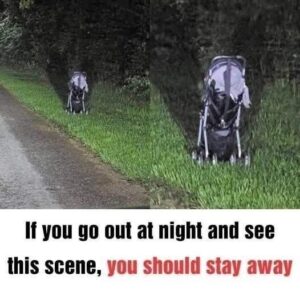
At first glance, it looked innocent.
A stroller.
Sitting alone near the edge of the road.
No house nearby. No parked car. No visible parent. Just a baby stroller placed carefully on a grassy verge beside a tree line.
But something about it didn’t feel right.
“It was just… too strange,” Walsh later said. “There was no reason for it to be there.”
She kept her distance at first, her headlights cutting through the dusk and illuminating the unsettling scene. The stroller stood motionless in the glow, as if waiting.
And that is exactly what made her uneasy.
In most situations, a stroller signals urgency—panic, a lost child, or someone in distress. But in this case, there was no sound. No movement. No explanation.
Just silence.
Instead of approaching, Walsh made a decision that she would later urge others to follow without hesitation.
She stayed in her car.
Then she took out her phone.

A Warning Shared in Real Time
Walsh posted what she saw on Facebook shortly after the encounter. Along with the photos she had taken from inside her vehicle, she included a warning:
“If you see a stroller, car seat, or any baby item alone in the middle of nowhere, please don’t get out. Call 911 instead.”
Her message spread quickly.
Within hours, thousands of people had shared the post. Within days, it had gone viral, reaching tens of thousands across different platforms.
Many commenters responded with concern, while others confirmed they had heard of similar situations before.
Some insisted it was not an isolated incident.
According to online discussions, the stroller setup is part of a dangerous scam designed to exploit human compassion.
How the Scam Is Supposed to Work
The concept is disturbingly simple.
A stroller, car seat, or baby-related item is placed in a visible but isolated location—often on rural roads, quiet suburban streets, or poorly lit areas.
A passing driver sees it and assumes something is wrong. Most people, especially parents or caregivers, feel an immediate emotional pull to stop and check.
That moment of concern is exactly what the perpetrators rely on.
Once a driver exits their vehicle, they become vulnerable.
Reports shared online describe scenarios involving robbery, vehicle theft, and physical threats. In some cases, criminals allegedly use the distraction to approach the vehicle from the opposite side, or to ambush the driver once they are out of the car.
While not every report has been independently verified, law enforcement agencies in various regions have acknowledged similar tactics being used in roadside crimes.
The underlying principle is always the same: create urgency, trigger empathy, and exploit hesitation.
The Advice From Authorities and the Public
The overwhelming response to Walsh’s post echoed one consistent message:
Do not get out of the car.
Instead, people advised:
- Lock your doors immediately
- Keep your distance
- Call emergency services
- Report the exact location
- Wait for authorities to arrive
One commenter summarized it simply:
“It’s bait. Stay inside and let the police handle it.”
Another added:
“Your instinct is to help—but in situations like this, the safest way to help is from inside your locked vehicle.”
Law enforcement professionals have long warned about similar setups, especially in isolated areas where response times may be longer and visibility is low.
The key concern is not just the object itself, but what may be waiting nearby.
Why These Scams Work So Well
Experts in criminal behavior often point out that scams like this rely on one powerful human trait: empathy.
Most people are conditioned to respond to the idea of a vulnerable child. A stroller on the roadside triggers immediate emotional concern. That reaction happens faster than logical assessment.
Criminal tactics like this are designed to exploit that instinct.
The more realistic and emotionally charged the setup, the more likely someone is to act without caution.
That is what makes these situations particularly dangerous—not just the physical risk, but the psychological manipulation behind them.
Not Every Case Has a Criminal Motive
Some commenters on Walsh’s post pointed out that not every abandoned baby item is part of a scam. In rare cases, items may be left behind accidentally or placed temporarily for donation or pickup.
However, even those agreeing with this possibility emphasized the same conclusion: it is never worth taking the risk.
A stroller on the side of a road does not come with context. There is no way to know whether it is harmless or dangerous without exposing oneself to potential harm.
Because of that uncertainty, the safest approach remains caution.
Other Similar Roadside Tricks Reported Online
The stroller scenario is not the only one of its kind.
Online users have shared warnings about other setups designed to lure people out of their vehicles, including:
- Fake car accidents or staged breakdowns
- Individuals pretending to be injured or unconscious
- Cries for help coming from wooded or hidden areas
- Objects placed to simulate urgency or emergencies
In many of these cases, the goal is the same: to create a situation where a driver feels morally compelled to stop.
Authorities often stress that while helping others is important, personal safety must always come first.
A Message That Spread Far Beyond One Road
Walsh’s post continued to circulate widely, eventually being shared more than 23,000 times. What began as one woman’s unsettling experience turned into a broader public safety reminder.
Her warning resonated especially with parents, caregivers, and people who frequently drive alone.
It also sparked conversations about how quickly everyday compassion can be turned into vulnerability in the wrong circumstances.
For Walsh, the goal was not to create fear—but awareness.
“If I had gotten out of my car without thinking,” she later reflected, “I don’t want to imagine what could have happened.”
Final Reminder
The abandoned stroller scenario serves as a powerful reminder that not every situation is what it appears to be.
While instinct may push people to help immediately, modern roadside scams have evolved to take advantage of that instinct.
The safest response is simple:
Stay in your vehicle. Lock your doors. Call for help. Let trained authorities assess the situation.
Because sometimes, the most responsible way to help… is not stepping out at all.