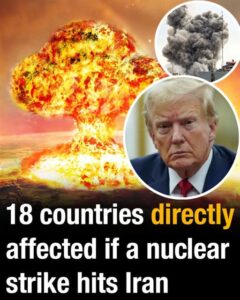
Fears of a broader global conflict intensified after Donald Trump issued a stark warning involving Iran, heightening anxiety before news emerged of a temporary ceasefire. While tensions may have briefly eased, the underlying concern remains clear: in the event of a nuclear strike, the consequences would extend far beyond any single nation.
The impact of a nuclear detonation is immediate and overwhelming. Within moments, entire areas can be erased. At close range, structures, infrastructure, and life itself are instantly vaporized. Expanding outward, the force of the blast crushes buildings, ignites fires, and leaves widespread devastation across miles. For those who survive the initial explosion, the danger continues in a different form—radiation exposure that can cause severe injury, long-term illness, and, in many cases, death.
Amid this backdrop, political rhetoric has drawn heightened scrutiny. Pakistan’s Prime Minister Shehbaz Sharif confirmed early Wednesday that the United States and Iran had agreed to a temporary two-week ceasefire, according to the BBC. The announcement followed a series of comments by Trump that quickly circulated online and prompted concern.
<blockquote>“A whole civilization will die tonight, never to be brought back again. I don’t want that to happen, but it probably will. However, now that we have Complete and Total Regime Change… maybe something revolutionarily wonderful can happen, WHO KNOWS?”</blockquote>
The remarks were met with criticism and sparked renewed debate about the potential escalation of the conflict. Discussions surrounding nuclear capabilities resurfaced, particularly after Vice President JD Vance stated that the United States possesses “tools” that have not yet been used in the current situation—language widely interpreted as a reference to advanced or strategic weaponry.
Iran, for its part, issued its own warnings, signaling that any attack could trigger retaliation against targets across the region. While the immediate concern centers on Iran, experts caution that the consequences of a nuclear strike would not remain contained within its borders.
Geographically, Iran is surrounded by multiple neighboring countries that could be directly exposed to radioactive fallout. Iraq, Turkey, Armenia, Turkmenistan, Afghanistan, and Pakistan all share land borders with Iran, placing them at immediate risk depending on environmental factors such as wind direction and atmospheric conditions.
Across the Persian Gulf, additional countries could also face serious repercussions. Kuwait, Bahrain, the United Arab Emirates, Qatar, Saudi Arabia, and Oman are closely connected through shared air currents and water systems. In particular, the region’s heavy reliance on desalinated seawater introduces a critical vulnerability—any contamination of the Gulf could rapidly evolve into a widespread public health crisis affecting millions.
Beyond these immediate zones, secondary risks could emerge in countries such as Syria, Lebanon, Israel, and Jordan. Shifting fallout patterns, combined with regional weather systems, mean that radioactive material could travel unpredictably, extending the reach of the disaster.
While it is impossible to determine exactly how such a scenario would unfold, the broader implications are widely understood. A nuclear event would not be limited to one target or one country. Instead, it would trigger a cascade of humanitarian, environmental, and geopolitical consequences, affecting multiple nations both directly and indirectly, with effects that could last for generations.